Paul Muni was best when he did least. In the irons in I Am a Fugitive from a Chain Gang a glance and a flexing hand carry the film; in the biopics that followed, under the beards and the makeup, he acted, and it shows.
Fi1m perspective
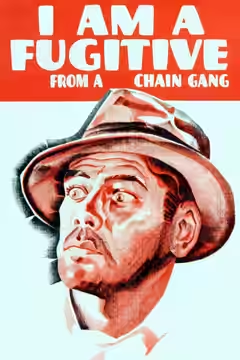
The moment in I Am a Fugitive from a Chain Gang (1932) that stays with us is not a speech. In the camp James Allen glances at the guards and his hand flexes once in the irons. That is all, and it tells you what he wants, what he cannot have and how long he has been counting. It shook us more than anything said aloud in the film, and the film says a good deal aloud, none of it landing as hard. Muni could do this. He did not always choose to.
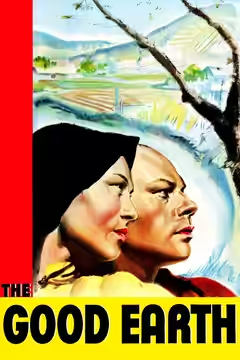
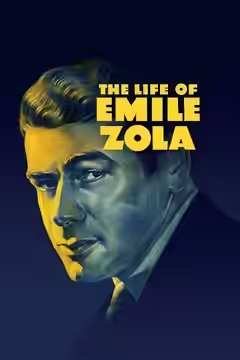
He came up in the Yiddish theatre, a child in his parents' company and then a member of the Yiddish Art Theatre, and he did not play Broadway in English until 1926. Fox signed him in 1929 for The Valiant and Seven Faces; neither made him. 1932 did, twice over: Tony Camonte in Scarface and Allen on the chain gang, which brought a Warner Bros contract and, with it, the prestige biographies. The Story of Louis Pasteur (1936) and The Life of Emile Zola (1937), both directed by William Dieterle, set the pattern: a real man, months of research into how he spoke and moved, a great deal of makeup. The same year he played Wang, a Chinese farmer, in The Good Earth. He went back to the stage between pictures, and his last film was The Last Angry Man (1959).
The charge against him has always been overacting, and it is not unfair. Dieterle, who directed three of the biopics, kept saying so, and our own review of the chain gang film found him broader in the early scenes, where the script has him explain what he wants to build, than in the camp, where he barely moves. The Yiddish stage taught him to send a whisper to the back row, and on screen that training could work against him, because the camera is already in the front row. The makeup was the other trap. He was compared to Lon Chaney, and like Chaney he seemed to believe the transformation was the performance. Often it was only the costume.
But watch him in the irons, or in the good suits Orry-Kelly gives him in the film's middle stretch, a man who has become somebody and is waiting for it to be taken away. That stillness is rarer than any beard. He said once that "'star' is what you call actors who can't act", and he meant it as a boast about being a journeyman. It is a good line, and the chain gang film is where he earns it. Start there. Go on to Scarface if you want the noise. The biopics can wait.
Biography
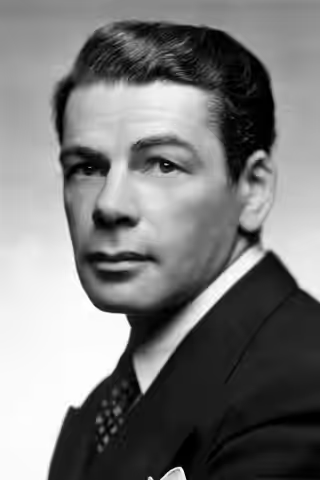
Paul Muni was an American stage and film actor. Born Frederich Meshilem Meier Weisenfreund on 22 September 1895 in Lemberg, then in the Austro-Hungarian Empire (now Lviv, Ukraine), he began his career in the Yiddish theatre and later appeared on Broadway before entering films.
He is known for his roles in Scarface (1932), I Am a Fugitive from a Chain Gang (1932), The Story of Louis Pasteur (1936), for which he won the Academy Award for Best Actor, and The Life of Emile Zola (1937). He received several further Academy Award nominations for Best Actor and also won a Tony Award for his stage work.