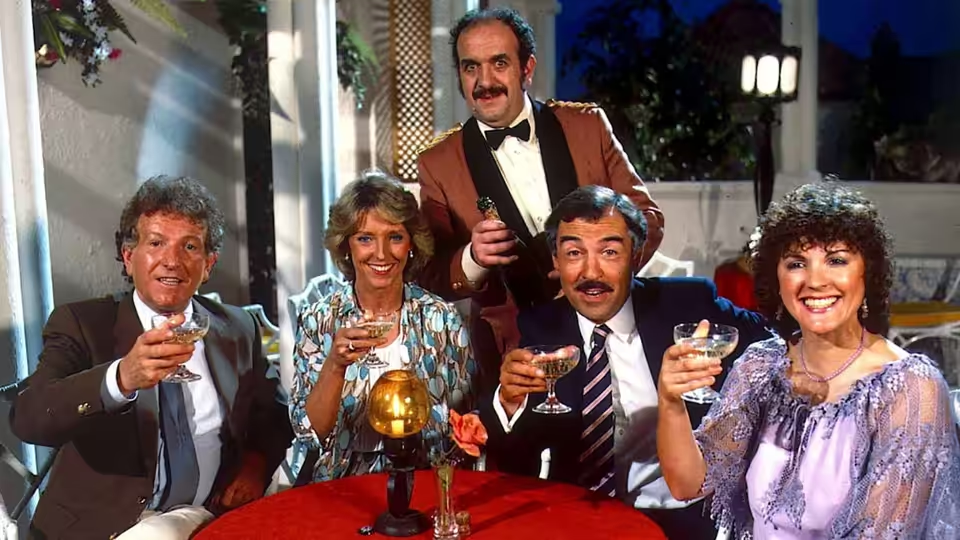
A package-holiday sitcom built on one lie told twenty-two times, with a lead we never warmed to and a hotel set that never leaves the studio. Gwen Taylor is the reason to stay, and she is not reason enough.
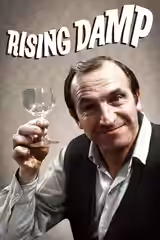
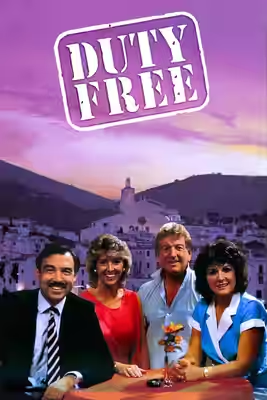
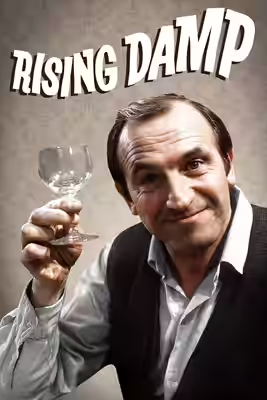
Duty Free was written by Jean Warr and Eric Chappell, and Chappell had already given British television Rising Damp, so the shape of the thing is familiar: a small, shabby man lies to get what he wants, and the people around him either catch him or do not. Here the small man is David Pearce (Keith Barron), on a hotel holiday with his wife Amy (Gwen Taylor). In the hotel bar they meet Robert and Linda Cochrane (Neil Stacy and Joanna Van Gyseghem), who are better off and let everyone know it, and before the first half-hour is out David is telling Amy his first lie about where he has been. Three series, 22 episodes, 1984 to 1986, and every one of them is that first episode again with the furniture moved. It is poor, and we suspect the people who enjoyed it at the time knew it was poor and enjoyed it anyway.
Taylor is the best thing in it by some distance. Amy is a woman who suspects, cannot prove, and decides each evening to give it one more day, and Taylor plays the deciding on her face rather than in the lines. When David’s excuse for a missing hour collapses at the dinner table and she simply picks up her fork, we felt something we had not expected to feel in a programme of this kind, which was sorry for her. Neil Stacy’s Robert is a decent turn too, a man so pleased with himself that he could be told the truth to his face and take it as a compliment. Carlos Douglas, as the waiter, gets one line a scene, delivers it with the patience of a man who has watched a thousand of these couples, and gets most of the laughs that are not Taylor’s.
The trouble is David. The series needs us to be on his side, at least a little, because the lies are his and we are asked to want him to get away with them. Barron plays him as sly rather than frightened, and sly is the wrong choice. A man lying to his wife across a hotel table might be funny if his fear showed; this David only ever looks as if he is enjoying the arithmetic. We laughed perhaps four times across the first series and three of those were Taylor. The rest of the time we sat with a low, steady dislike of the man at the centre of it, which is not a feeling a sitcom can run on for three years.
It is a studio programme, and it looks like one. Alan Pyrah lights the hotel bar, the two bedrooms and the balcony with the same flat, even wash, so that the world outside is glimpsed through a door and the sea arrives only in postcard inserts between scenes. Vernon Lawrence and Les Chatfield direct for the studio cameras rather than the audience at home, and Robin McDonell and Trevor Pugh cut on the laugh, every time, so that the track laughs before we have decided whether to. Each episode has the same geography: bar, bedroom, bedroom, corridor, bar. By the third we could have drawn the floor plan.
Chappell’s Rising Damp had a liar at its centre too, but Rigsby’s lodgers were given weapons, and they used them. Amy and Robert are given suspicion and obliviousness, one each, and have to make those last. The reviews so far find the whole thing bleak and almost without laughs, and we would score it a little higher only because Taylor and Douglas are doing real work in it, and because the premise of a married man lying his way through a hotel holiday is a better idea than the series ever lets it be.
It was first shown on 13 February 1984, and anyone who took a package holiday that decade will recognise the hotel, the drinks, and the couple at the next table who should not be sitting together. Going back is another matter. We would not.