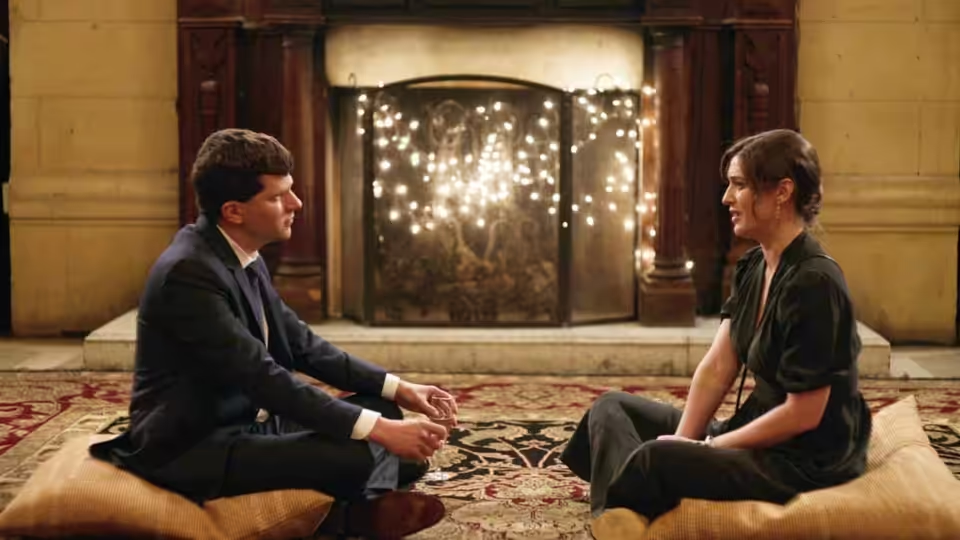
Taffy Brodesser-Akner’s adaptation of her own novel asks a good deal of patience in its first half and repays most of it. The narration explains too much and the finale goes soft, but Claire Danes and Lizzy Caplan make it worth your week.
Toby Fleishman is a few months out of his marriage when the series finds him. His phone is full of women who want to meet him and his new flat is full of not much. Then his estranged wife Rachel hands him their two children for the summer and becomes hard to reach. Taffy Brodesser-Akner, adapting her own novel over eight episodes, tells all of this in the voice of Toby’s old friend Libby Epstein (Lizzy Caplan), and that choice is what the series turns out to be about. It is good, and worth your week. It asks a good deal of patience before it says why.
For six of the eight episodes we are inside Toby’s account, and Jesse Eisenberg plays him as a man sure he is the reasonable one. He is short, and every room has been arranged to remind him. Sharon Lomofsky gives the family flat tall windows and a view, and Toby’s new place low ceilings and a sofa that looks hired. Leah Katznelson dresses Claire Danes’s Rachel in tailoring with edges and Toby in the soft shirts he wore at twenty. Corey Walter and Tim Orr shoot Toby’s summer in hard, bright daylight, which suits a man who believes he can see everything clearly.
By the fourth episode we were bored of Toby’s phone. The dating montages, which Josh Beal, Jacquelyn Le and Jeffrey M. Werner cut into short, bright, interchangeable bedrooms, make the same point three or four times over. We now think Brodesser-Akner wanted us to tire of him, and we did. Not everyone will stay for the sixth hour to find out why the first five felt as they did.
Caplan narrates almost without pause, and most of the critics who dislike the series dislike this. The voice-over tells us what Toby is thinking, then what Libby makes of that, then how it bears on her own life in the suburbs, where she has stopped writing and started counting the years. Half the time it is too much; there are scenes where Eisenberg’s face has done the work and the voice comes in anyway. But Caplan’s delivery, quick and flat and a little frightened, is the best thing in the first half, and her scenes with Adam Brody’s Seth Morris, the friend who never married and is now, alarmingly, about to, have the ease of people who have known each other since they were nineteen. Brody is given less than he deserves.
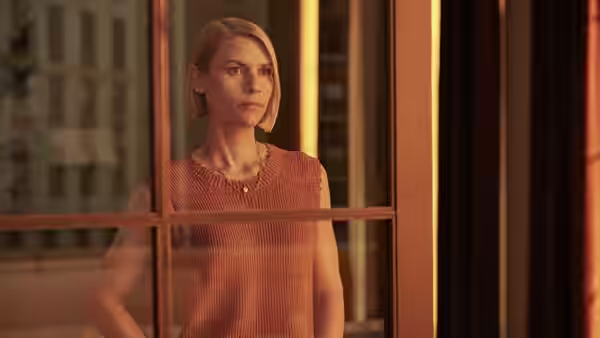
For most of the run Rachel appears as Toby remembers her: jaw set, phone in hand, late. Danes plays these fragments with a tightness that only pays out later. Late on, the series changes whose story it is telling, and we will not describe what it shows. We will say that the episode which belongs to Danes is the one that got at us, and that we watched a good deal of it with a hand over our mouth. The reason is easy to name. Danes is left alone on screen for long stretches, the directors hold on her well past where most television would cut, and Caroline Shaw’s score, spare strings for most of the series, all but disappears.
The finale then explains what we have just seen. Libby lays it out in narration, a character lays it out again in dialogue, and the last scenes reach for a warmth the previous seven hours were right to refuse. Most critics have found the ending soft, and so did we. Having spent seven hours teaching us to doubt a narrator, the series ends by asking us to take her word for it.
Divorce stories usually let both parties speak; Bergman’s Scenes from a Marriage gives husband and wife the first hour between them. Brodesser-Akner withholds one of them for six. The gamble mostly comes off, but the first half is meant to grate, and it does. Five directors share the episodes, and we could not tell where one hand ended and the next began, which is to the script’s credit.
Watch it two episodes a night rather than one a week. Taken weekly, Toby’s summer would feel like a sentence; taken in pairs it is a set-up, and the pay-off is worth the wait.