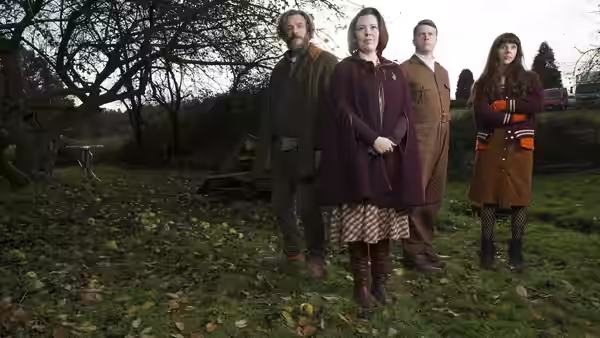
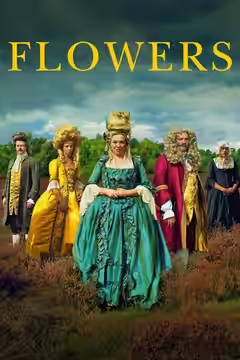
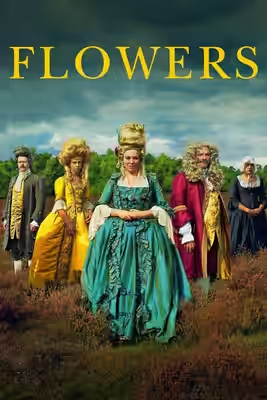
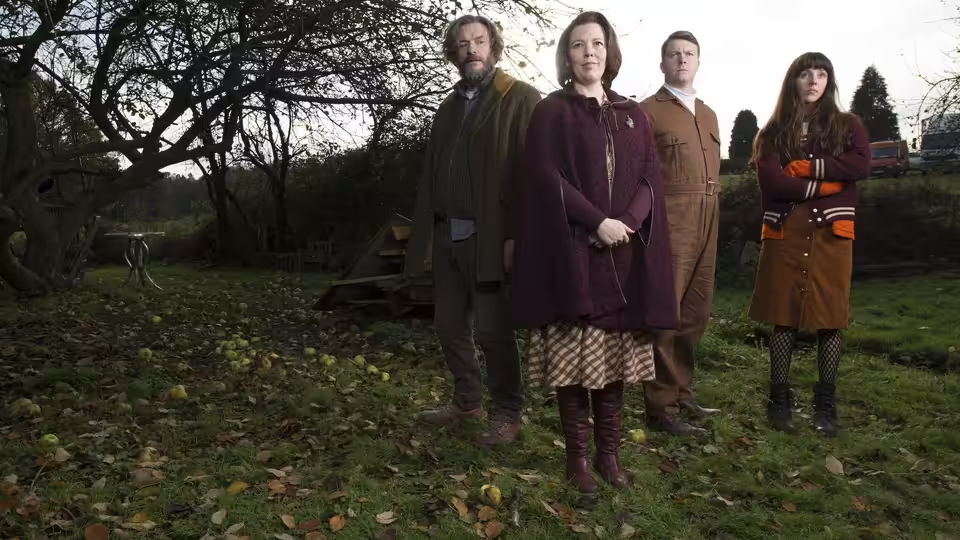
Deborah Flowers (Olivia Colman) and her family stand beneath a tree in the garden
Series review

Flowers

2016 · Created by Will Sharpe · Series · 25m

In a sentenceA family comedy that makes sitting quietly in separate rooms sound like a perfectly reasonable group activity

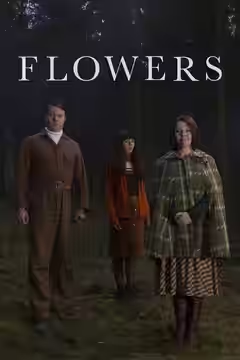
Deborah Flowers (Olivia Colman), Maurice Flowers (Julian Barratt), Amy Flowers (Sophia Di Martino) and Donald Flowers (Daniel Rigby) are the family at the centre of this comedy-drama. Shun (Will Sharpe) joins an ensemble that also includes Abigail (Georgina Campbell) and George (Angus Wright). Mental distress enters the programme’s account of family life, with surreal humour sitting alongside its darker concerns. Across 25-minute episodes, the series follows its characters through comedy that keeps returning to the difficulty of living with other people.

Plays from YouTube when you press play; nothing loads from them until then.

Fi1m review

Will Sharpe’s family comedy-drama is funny and worth the discomfort, with Olivia Colman and Julian Barratt making the awkward exchanges count. Its surreal flourishes can grow tiresome, and his performance as Shun risks a stereotype.

Flowers is worth the discomfort, provided a family comedy does not have to offer much reassurance. Creator, writer and director Will Sharpe brings mental distress close to the jokes, and usually judges that closeness well. The programme can be funny without making its characters’ difficulties seem negligible, a harder task than simply alternating laughter with solemnity. Its chief weakness is an occasional insistence on being strange when the actors have already given us enough to watch.

Olivia Colman, as Deborah Flowers, and Julian Barratt, as Maurice Flowers, give the series its most persuasive moments. Their shared scenes have precise comic timing, but neither performer makes the discomfort feel safely finished when the joke arrives. We laughed, then felt uneasy about laughing, because the hurt in their exchanges remained audible. Colman in particular makes us stay interested in the person speaking, even when the writing seems keen to direct our attention towards its own oddness.

Jamie Cairney’s cinematography gives the gloom an emphatic presence, while Luana Hanson’s production design supports the series’ surreal manner. That concentration of effort helps make the programme feel distinctive, but can also become oppressive. We sometimes wanted less encouragement to notice how peculiar everything was. The performances are strong enough to hold our attention without so much insistence around them, and the quieter exchanges benefit from having less to compete with.

Selina Macarthur’s editing is most effective when it gives the performers room to establish an awkward rhythm. The more indulgent stretches make the pauses and changes of tone feel laboured instead. Arthur Sharpe’s music contributes to that heightened atmosphere; it suits the programme, though the cumulative emphasis can grow tiring. With episodes running for 25 minutes, even a short stretch can feel crowded by all these competing demands.

Will Sharpe’s portrayal of Shun is a more troubling reservation. The broadness risks stereotype, and the performance can ask for a laugh before the character has persuaded us. That matters in a series whose writing elsewhere takes such care over distress. His willingness to be conspicuously odd is often productive as a director, but here we wanted him to be more exacting with himself as a performer.

Against the reassuring habits of family comedy, the programme’s willingness to stay uncomfortable is welcome. Its mental-health concerns do not feel like a worthy subject added to excuse the jokes; they affect how the humour works. The writing is especially good at letting amusement persist in bleak material without requiring a cheerful explanation afterwards. It falters when the surreal flourishes seem to be there chiefly because another ordinary exchange would apparently not do.

We recommend Flowers to viewers who can tolerate some overstatement in a comedy that takes unhappiness seriously. Colman and Barratt make that bargain worthwhile. There is warmth here, although its creator does not always make it easy to reach. If tonight calls for television that will settle everyone’s nerves, choose something else.
Critical consensus AI synthesised

76
Positive
4
Mixed
1
Negative
0
The Guardian
26 April 2016 · Sam Wollaston
90*

Wollaston calls Flowers gloriously dark, bold and genuinely original, with a worrying hint of truth. He especially praises the performances of Olivia Colman, Julian Barratt and Will Sharpe.

Read the full review →
Radio Times
25 April 2016 · Kasia Delgado
70*

Delgado gives the series a positive verdict, describing it as bleakly funny. She singles out its unusual ability to find humor in life’s grimness.

Read the full review →
The Hollywood Reporter
3 May 2016 · Daniel Fienberg
70*

Fienberg finds Flowers a distinctive, gloomy comedy-drama that will not appeal to everyone, but welcomes its singular sensibility. He praises Olivia Colman’s performance, while noting that Will Sharpe’s portrayal of Shun risks ugly stereotypes.

Read the full review →
Evening Standard
11 June 2018 · Susannah Butter
65*

Butter finds the series funny and engaging, though its surreal, heady style can become self-indulgent. She singles out Olivia Colman and Julian Barratt’s scenes for their comic timing and sharp performances.

Read the full review →
Den of Geek
11 June 2018 · Rosie Fletcher
90*

Fletcher finds the first two episodes of series two compelling, funny, and moving, with darkness that never overwhelms their humor. She especially praises Will Sharpe’s astute writing for balancing mental-health themes with surreal comedy.

Read the full review →

Straight answers AI written, from our review

Is Flowers worth watching?
Flowers is worth watching if we can tempt you with an uncomfortable family comedy that takes unhappiness seriously; we score it 78 out of 100. Olivia Colman and Julian Barratt make the awkward exchanges funny and painful, though the surreal flourishes grow tiring and Will Sharpe’s broad performance as Shun risks stereotype.
How long is Flowers, and what is it rated?
Flowers has episodes of about 25m. It is a comedy and drama series.
Where can I watch Flowers in the Netherlands?
Flowers is not on any streaming or rental service in the Netherlands at the moment. It is available in 3 other countries; change your country at the top of the page to see where. Availability is checked daily.
How violent or frightening is Flowers, and is it suitable for children?
Flowers has a UK 15 certificate and is not suitable for children under 15; its treatment of mental distress and uneasy family exchanges also makes it a poor choice for reassuring viewing. We find the humour unsettling because the hurt persists after the jokes, rather than because of any specific violence or frightening imagery we can identify here.
How does Flowers compare to Life Is Sweet?
Flowers is the more insistently surreal family comedy, while Life Is Sweet is the stronger choice for patient viewers who prefer ordinary disappointments and affection that feels earned. We recommend both for jokes that leave unhappiness intact, but find the heightened gloom of Flowers more tiring; both can push their broader performances towards caricature.
What should I watch after Flowers?
After Flowers, try Life Is Sweet (1990, Fi1m 84): Another difficult family, with jokes that never make its unhappiness seem trivial. Then Toni Erdmann (2016, Fi1m 86): Family embarrassment stretched until the laughter becomes difficult to separate from sadness; and A Woman Under the Influence (1974, Fi1m 86): For the family distress rather than the laughs; considerably harder going.

Cast

If you liked this, try…

  1. Life Is Sweet (1990, Fi1m 84)Another difficult family, with jokes that never make its unhappiness seem trivial.

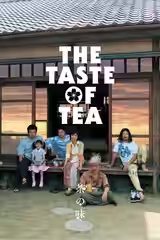
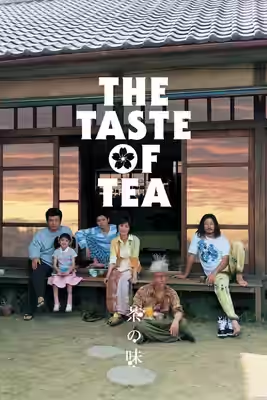
  2. The Taste of Tea (2004) · not reviewed yetSurreal family life with more breathing room and a gentler comic temperament.

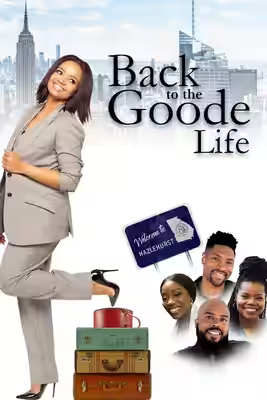
  3. Back to Life (2019) · not reviewed yetA dark comedy that gives awkward encounters time to become properly painful.

  4. Toni Erdmann (2016, Fi1m 86)Family embarrassment stretched until the laughter becomes difficult to separate from sadness.

  5. A Woman Under the Influence (1974, Fi1m 86)For the family distress rather than the laughs; considerably harder going.

Free account

Know what to watch tonight

Two lists that know where things are streaming, collections you can share, your own score beside ours, and Discover that remembers what you have seen.

  • Want to see, sorted by what is streaming now
  • Seen, with your score out of ten
  • No adverts, ever