Marlon James’s five-part Kingston crime story has a lead performance from Tamara Lawrance that holds it together when the case does not. Vivid and sharp-tongued, better at people than plot, and in a hurry by the final episode.
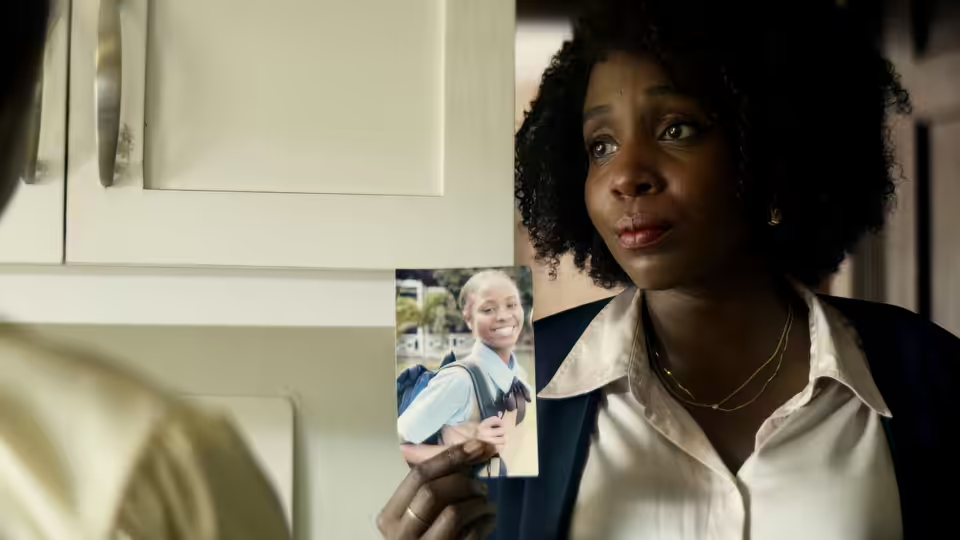
Marlon James has brought Kingston to television and has refused to tidy it up for visitors. Get Millie Black is five episodes about a detective, Millie-Jean Black (Tamara Lawrance), who has come back from the London police to work missing persons in Kingston, and about a schoolgirl nobody with power is looking for. It is good. We would recommend it to anyone who likes a crime story with some weather in it, with the warning that the case it is built on is the weakest thing in it, and it gets weaker as it goes.
Lawrance is the reason to stay. She plays Millie clenched: shoulders up, voice flat, a woman who has learned to say less than she knows. James gives her a running narration, and the pleasure of it is the gap between the flat voice she uses on colleagues and the one in her head, which is furious and funny and does not stop. Gershwyn Eustache Jnr, as her partner Curtis, is the one person she speaks to normally, and their scenes in the car have the easy rhythm of a long working marriage. James and Theresa Ikoko’s scripts give everyone a particular way of talking, and the series trusts you to keep up.
The scenes that got at us were not in the police station. Millie’s sister Hibiscus (Chyna McQueen) lives in the gullies that run under the city, among people the force would rather not see, and McQueen plays her as the louder, quicker and braver of the two. When Millie tries to help, Hibiscus will not be helped, and Lawrance’s face in those scenes, wanting to hold on and knowing it is not hers to decide, moved us more than anything in the investigation. We did not expect a whodunit to send us away thinking about a sister rather than a suspect, and this one did.
Antonia Lowe’s production design does more than any speech to explain the Kingston the series sees. The uptown houses are white and cool and have too many empty rooms; the gully is corrugated zinc and painted concrete with a river of rubbish through the middle; the police station sits between the two in beige and strip light, and nobody in it looks as if they are paid enough. The three directors, Tanya Hamilton, Annetta Laufer and Jean Luc Herbulot, keep the camera close to faces and let the heat show on them. Carly Paradis’s music is mostly low drums and bass, under the dialogue rather than on top of it, and it has the sense to stop when a scene needs to be quiet.
The case is the trouble. It begins as a missing girl and grows, as these things do, into something larger involving the island’s rich and a reach across the Atlantic, and by the fourth episode we were keeping a list of who knew what, and the list was not helping. Joe Dempsie’s Luke Holborn, the Scotland Yard man who arrives from London and treats the Jamaican police as local colour, is written as a point about Britain and Jamaica and plays as one. Dempsie does what he can, but the character is there to be wrong about things so that Millie can be right. Anjli Mohindra and Christopher Daley have roles that promise more than five hours leave room for. Five episodes is a sensible length for this story, and the last one is still rushing to finish.
The comparison the series invites and resists is Death in Paradise, the one with a British detective solving murders in the Caribbean sun. Get Millie Black has the same island and the same visitor, and uses them to say something sharper: the visitor is not the hero and the sun is not a holiday. Most critics have taken it as a welcome break from the usual procedural, and we agree with them more or less exactly, including the ones who found the mystery the least of it.
Watch it close together, two episodes a night, so the names stay in your head. And keep an eye on McQueen, who takes every scene she is given.