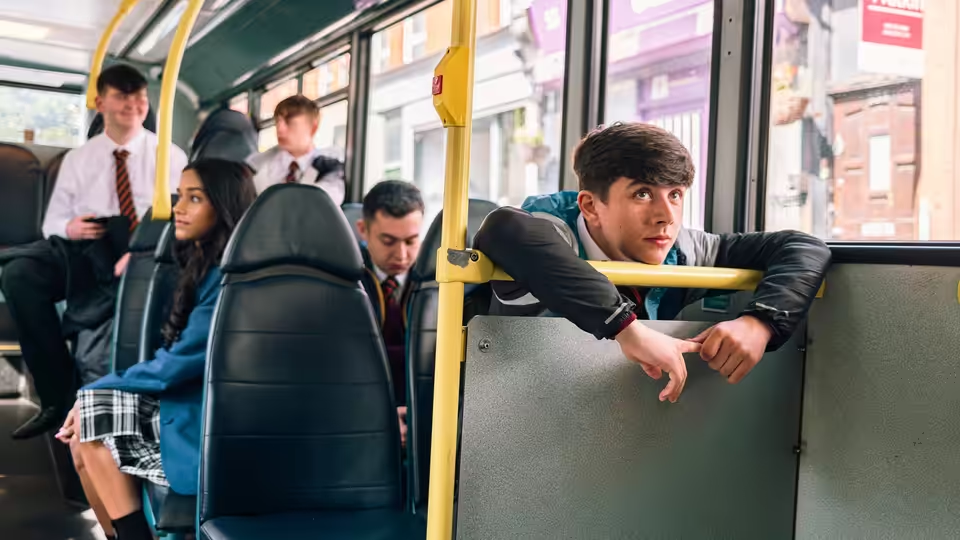
Danny Kenny’s Liverpool school sitcom is quick, warm and often properly funny, with a young cast who talk over each other like real friends. It is also played at a volume that tires the ear, and it is best when it slows down, which is not often.
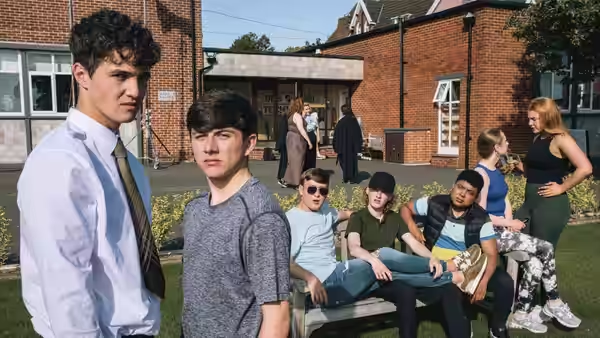
Danny Kenny has written a sitcom about a Liverpool comprehensive and filled it with teenagers who never stop talking. That is the joke and the method. G’wed follows Reece (Dylan Thomas Smith), the class livewire, as he adopts Christopher (Jake Kenny-Byrne), the new boy whose accent arrived from somewhere with more trees, and the two of them, with Ziad (Malek Alkoni), spend each episode getting into trouble that is mostly their own fault. It is a likeable, fast, frequently funny thing, and it is decent rather than more than that. It is also exhausting in a way that we will try to explain.
The cast is the reason to watch. Smith plays Reece as a boy who has worked out that if he is the loudest person in any room nobody will ask him anything, and he lets you see the working. Kenny-Byrne has the harder job, since Christopher is the straight man and the outsider, and he manages to be both without turning into a pair of glasses with a surname. Alkoni’s Ziad gets the best running gag in the first series, which is simply that he has picked up the slang quicker than anyone wants him to. The three of them talk over each other the way actual friends do, half a sentence each, and when the scripts let that happen without a punchline attached it is the most convincing thing on screen.
Leanne Best is the anchor, and the series knows it. Jodie, Reece’s mum, is written as the tired adult in a show full of children, and Best plays her with the patience of a woman who has heard every excuse and is quietly fond of the boy making them. There is a kitchen scene, early on, where Reece is lying to her and she lets him finish, and we found ourselves more touched than a show this noisy had any business making us. It was the waiting that did it. Everyone else in G’wed is trying to be heard; Best gets her effects by not bothering.
Chloe English and Akaash Meeda direct, and they have chosen pace over everything else. Thomas Perrett cuts the classroom scenes so that no line is allowed to breathe before the next one lands on top of it, and for a while that is exhilarating. By the third episode it is simply tiring. Jokes that would have earned a laugh if they had been given a second are trampled by the one behind them, and the few moments of feeling have to shout to be noticed. The series is at its best when it stops moving: Jodie’s kitchen, a bus stop, two boys walking home. Those scenes are rarer than they should be.
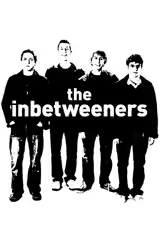
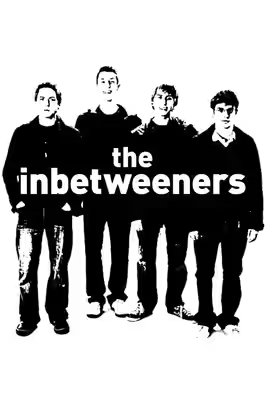
It will be compared to The Inbetweeners, and the comparison is fair as far as it goes. Both are about boys who are less worldly than they pretend; both run on humiliation. What Kenny adds is a city. Liverpool on television is usually a football ground or a crime scene, and here it is a school, a chippy and a front room, with people who are funny because they are from there and not in spite of it. The Syrian boy, the posh boy and the Scouse boy are all outsiders in slightly different directions, and the show gets real comedy out of none of them quite admitting it. It does not do much with the girls in the first series; Gemma Barraclough’s Mia-Louise and Amber Harrison’s Aimee are given attitude and little else, and we noticed.
The first run is six episodes, and it has since grown to a second of five and a third of seven, which suggests somebody believed in it, and they were right to. We can see what it wants to be: a school comedy with a heart that does not apologise for the heart. It gets there in bursts. If you were ever sixteen in a town that television does not usually bother with, you will recognise most of it. Watch two episodes at a time and no more; it is a show that is better in small doses, and it would not thank us for saying so.