Ian Hislop and Paul Merton stand beside oversized lettering, smiling at the camera
Series review

Have I Got News for You

1990 · Series · 30m

In a sentenceIan Hislop wants an explanation; Paul Merton would prefer to make the question unusable

In the original set-up of Have I Got News for You, which begins in 1990, host Angus Deayton puts the news to rival team captains Ian Hislop and Paul Merton. They tackle questions drawn from the headlines, with answers providing opportunities to argue, interrupt and turn the discussion towards another joke. The competition supplies the structure for half an hour of comedy about public events and the people involved. Across the series, the participants include Sandi Toksvig, Rose Matafeo, Tim Farron and Jacob Rees-Mogg, putting different personalities alongside the captains as the news supplies fresh subjects.

Fi1m review

Ian Hislop’s impatience and Paul Merton’s deadpan nonsense make this news quiz worth returning to. We recommend it for the timing and the friction, with a caveat about how comfortable the mockery can become.

Have I Got News for You is a reliably funny way to spend half an hour, provided we are not expecting the jokes to settle anything. Its strongest asset is the difference between Ian Hislop and Paul Merton when faced with something foolish. We recommend it for their timing, with reservations about how easily familiar mockery can become comfortable. A programme that makes fun of public figures needs to stay alert to the pleasure those figures may take in being included.

Angus Deayton’s hosting establishes the usefulness of sounding faintly unimpressed. The formal delivery gives a silly line somewhere to go, and keeps a prepared joke from arriving with an instruction to laugh. There is pleasure in that restraint, though it can also encourage the impression that everyone involved knows better than everyone being discussed. The manner is particularly effective when the captains make it difficult to maintain.

Ian Hislop supplies the impatience: we believe that he wants an answer even when a laugh is easier to obtain. Paul Merton is happier to let sense slip, and his unhurried delivery gives the silliness time to register. We laughed at Paul Merton’s straight face as much as his jokes: he gives nonsense the consideration a sensible answer might deserve. The difference between the captains keeps the programme from becoming an uninterrupted exchange of knowing remarks.

The writing credits include Suchandrika Chakrabarti, Matt Hulme, Paul Dunphy and Lary Budd, and the prepared material has a difficult job. It must explain enough of a story to make the joke clear without sounding like a news bulletin with an extra sentence attached. The sharper jokes find something peculiar in a person’s words or behaviour. The weaker ones assume that recognising the target is enough, and familiarity does too much of the work.

The direction, with credits including Paul Wheeler and Abigail Dankwa, is most useful when it gives us time to look at the person receiving a joke. A reaction can tell us more about how a remark has landed than another contribution to the conversation. This is modest television craft, and it suits a programme whose main visual interest is people listening, or preparing not to. We do not need the presentation to compete with them.

The guest list introduces another difficulty. Tim Farron and Jacob Rees-Mogg are among the participants, and taking a joke well can make someone appear more agreeable without requiring much else of them. That need not ruin the comedy, but it does limit how much credit we give the programme for being tough. There are stretches when the shared amusement feels too cosy, and the familiar captains cannot make every encounter equally interesting.

Political comedy can be harsher and stranger than this, and we would not ask the programme to meet all our needs. Its half-hour format suits the lighter ambition of finding something funny in what people have been saying. The repetition will wear on anyone who needs a fresh comic approach each time, though the captains remain good company. Watch an episode for Paul Merton’s timing, without feeling obliged to warm to everyone who turns up.


Critical consensus AI synthesised

1 of 6
Positive
1
Mixed
0
Negative
0
Den of Geek
6 May 2008 · Simon Brew
95*

Brew calls the Brian Blessed episode exceptionally funny and among the best television he has watched in a long time. He especially praises Blessed’s wild hosting, including his roaring headlines and comic antics.

Read the full review →

Straight answers AI written, from our review

Is Have I Got News for You worth watching?
Have I Got News for You is worth watching for Ian Hislop’s impatience and Paul Merton’s deadpan nonsense; we score it 80. We recommend its half-hour news quiz format for the timing and friction between the captains, though the mockery sometimes becomes too comfortable, particularly when public figures gain goodwill simply by taking a joke.
How long is Have I Got News for You, and what is it rated?
Have I Got News for You has episodes of about 30m. It is a comedy and news series.
Where can I watch Have I Got News for You in Vietnam?
Have I Got News for You is not on any streaming or rental service in Vietnam at the moment. It is available in 1 other country; change your country at the top of the page to see where. Availability is checked daily.
How does Have I Got News for You compare to The Thick of It?
Have I Got News for You offers more restrained political comedy than The Thick of It, with a news quiz rather than ministerial chaos supplying the jokes. We favour The Thick of It for sharper, more unpleasant comedy, though its relentless abuse can become repetitive. Have I Got News for You suits a lighter half-hour, with the captains’ timing compensating for occasionally cosy mockery.
What should I watch after Have I Got News for You?
After Have I Got News for You, try The Thick of It (2005, Fi1m 94): The same impatience with official language, with substantially less restraint over the swearing. Then Yes Minister (1980, Fi1m 89): Civil servants make evasion sound so reasonable that we nearly approve; and Network (1976, Fi1m 86): Television’s appetite for outrage gets a harsher, more troubling comic treatment.

Cast

If you liked this, try…

  1. The Thick of It (2005, Fi1m 94)The same impatience with official language, with substantially less restraint over the swearing.

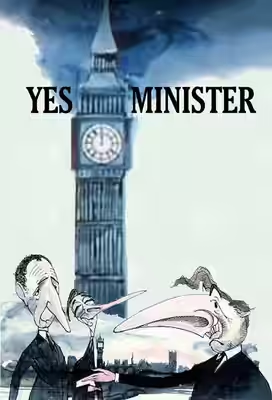
  2. Yes Minister (1980, Fi1m 89)Civil servants make evasion sound so reasonable that we nearly approve.

  3. The Newsroom (1996) · not reviewed yetA newsroom comedy for those who suspect vanity also writes the headlines.

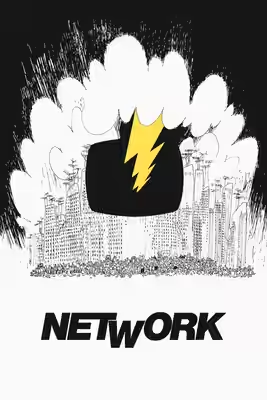
  4. Network (1976, Fi1m 86)Television’s appetite for outrage gets a harsher, more troubling comic treatment.

  5. The Death of Stalin (2017, Fi1m 83)Political self-preservation turns grotesque, with laughter that offers little comfort.

Free account

Know what to watch tonight

Two lists that know where things are streaming, collections you can share, your own score beside ours, and Discover that remembers what you have seen.

  • Want to see, sorted by what is streaming now
  • Seen, with your score out of ten
  • No adverts, ever