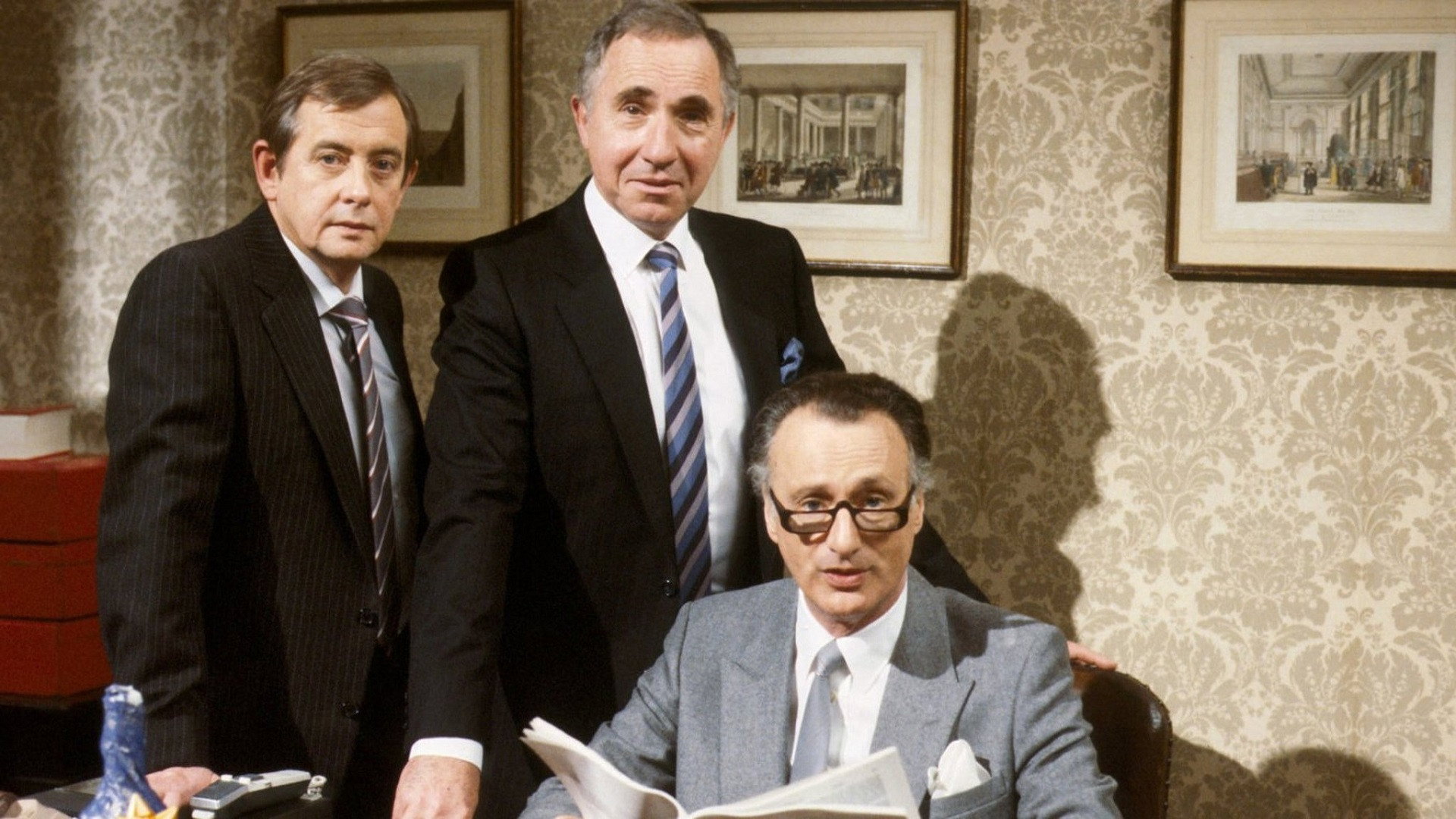
Antony Jay and Jonathan Lynn’s political comedy earns its reputation through exact dialogue and three finely judged performances. Its habits become familiar, but Paul Eddington, Nigel Hawthorne and Derek Fowlds keep the exchanges worth hearing.
Yes Minister is an unusually satisfying political comedy, and we recommend it for the writing and the three performances that make every exchange worth following. Created and written by Antony Jay and Jonathan Lynn, it treats getting a straight answer as a task requiring patience and close attention. Somebody is always trying to control the conversation. The characters’ habits can become predictable, but the actors keep finding small variations in how they conceal irritation or announce that they have understood.
Paul Eddington’s Jim Hacker gives the comedy someone whose discomfort matters. Eddington allows him to look pleased with himself without making him unbearable, then lets uncertainty interfere with the satisfaction. We recognise the wish to appear in command even when the conversation has become difficult to follow. That is a delicate performance, because making Hacker merely foolish would leave the other actors with an easy target and us with little reason to care about the exchange.
Nigel Hawthorne’s Sir Humphrey Appleby is the chief pleasure, though his elaborate speech needs Eddington’s responses to stay funny. Hawthorne makes qualification upon qualification sound entirely reasonable, holding his composure long enough for the excess to become the joke. We laughed aloud at how little embarrassment he shows while making an answer less useful with every additional phrase. Jay and Lynn give him the language, but Hawthorne’s calm delivery makes us believe that Sir Humphrey considers this a perfectly adequate way to communicate.
Derek Fowlds has the quieter task as Bernard Woolley, and the three-way exchanges would be much duller without him. His attention to the precise meaning of words can interrupt a discussion just when the other two would prefer to move past the wording. Fowlds gives that precision a tentative quality, so an intervention can be funny before he has quite finished making it. The difference between his hesitations and Hawthorne’s assurance gives the dialogue changes of pace that prevent all the cleverness from sounding alike.
Directors Peter Whitmore, Sydney Lotterby and Stuart Allen keep the emphasis on those differences between the performers. The presentation is conventional, with little visual invention, but it gives us time to watch an explanation being received as well as delivered. That matters when a reaction can expose more than a speech. The pace comes chiefly from the actors, who know how long to let a statement stand before somebody finds a problem with it.
There are limits to the pleasure, particularly across three series. Jay and Lynn return to familiar kinds of vanity and evasion, and the destination of an exchange can become clear before the dialogue has finished getting there. Their repeated suspicion of anyone claiming to act for the right reasons can also feel too comfortable; after a while, we want that assumption tested more often. We would not suggest watching too many episodes together, because the recurring habits become harder to overlook.
Within the political sitcom, its distinction is how much it trusts us to enjoy listening closely. A qualification matters, and so does the moment when somebody realises what has been slipped into an apparently harmless sentence. The half-hour length suits that concentration, giving the performers room to develop an exchange without asking the same comic contest to sustain a whole evening. Start with one episode, and leave room for a second.