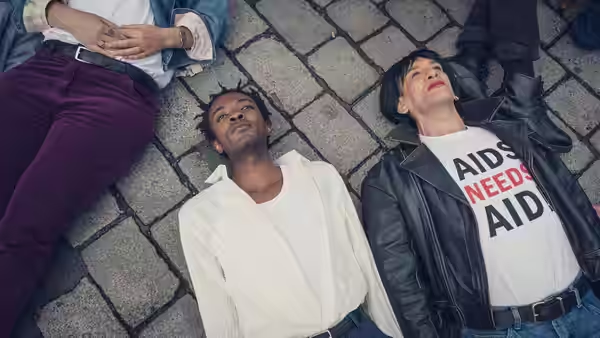
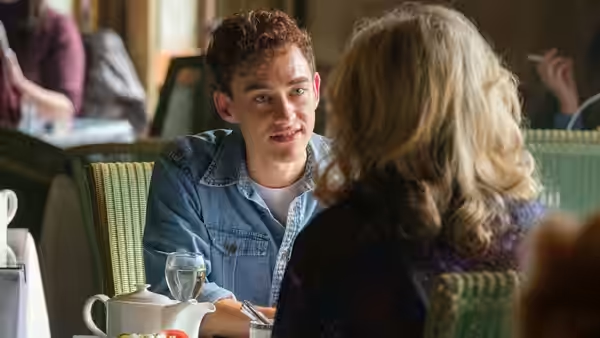
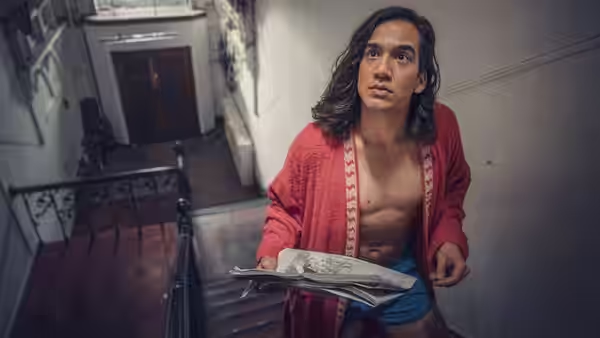
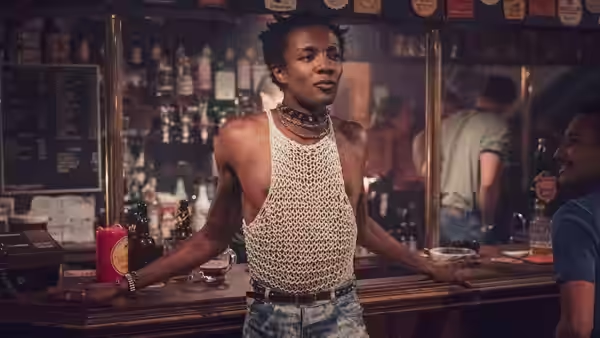
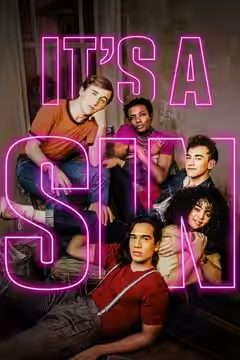
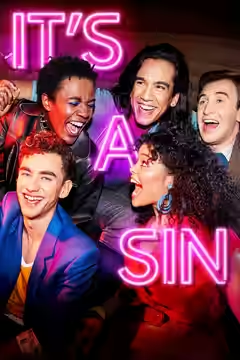
A scene from It's a Sin
Series review

It's a Sin

2021 · Created by Russell T Davies · Series · 48m · MPA TV-MA

In a sentenceA decade of the best party in London, and someone always has to leave early

London, 1981. Ritchie Tozer (Olly Alexander) leaves the Isle of Wight for a law degree he means to swap for acting the moment his parents stop looking. Roscoe Babatunde (Omari Douglas) walks out of his family’s house in Peckham in a skirt and heels before his father can put him on a plane to Nigeria. Colin Morris-Jones (Callum Scott Howells), shy and Welsh, starts as an apprentice at a Savile Row tailor, where an older colleague, Henry Coltrane (Neil Patrick Harris), takes him under his wing. With Jill Baxter (Lydia West) and Ash Mukherjee (Nathaniel Curtis) they share a flat they call the Pink Palace. Ritchie wants boys, the stage and a life his mother will never see. From New York come rumours of an illness nobody in the flat believes in.

Plays from YouTube when you press play; nothing loads from them until then.

Fi1m review

Russell T Davies’s five-part drama about a flat of young gay men in eighties London is the warmest and, for three episodes, the most controlled writing he has done. The last two reach for speeches the story had already made; the cast carry them anyway.

It’s a Sin covers ten years in five episodes: a flat in London, five friends, and an illness that begins as a rumour at the edge of the frame and walks to the middle of it. Russell T Davies wrote all five hours and Peter Hoar directed all five, and the plan is plain enough. Make the first hour such fun that we cannot bear what follows. It works.

Our verdict is that the first three episodes are as good as any British television drama we have seen in years, and the last two are louder and less sure of themselves. That is a caveat, not a warning. We would still put this in front of almost anyone who can sit through a 15 certificate, and we think it is the best thing Davies has written.

Olly Alexander plays Ritchie as a boy who has decided to be delightful and mostly manages it; the vanity is written in and Alexander does not hide it. Omari Douglas gets the funniest lines as Roscoe and delivers every one as a defence. Lydia West’s Jill is the one who reads the leaflets and rings the clinics, and West plays her worry as something she has to do quietly so the boys will not notice. The surprise is Callum Scott Howells. Colin barely speaks in the first episode. He watches the others, and by the third hour his watching has become the centre of the thing.

David Katznelson shoots the Pink Palace and the clubs in oranges and pinks, with light that seems to come from lamps somebody has thrown a scarf over, and he shoots the hospital wards in a flat green with no source you can find. Luana Hanson fills the flat with so much clutter that we notice every object that later goes missing. Ian Fulcher’s costumes move the decade along faster than the year cards do: Ritchie’s jackets get bigger, Roscoe’s get sharper, Colin’s stay the same. Murray Gold writes less music than he might have and lets the period records do the work, which is the right decision. Sarah Brewerton cuts the years as a run of nights, bodies, doors and songs, so the good times go past quickly, and that speed is the point.

The flat has a greeting, a shouted “La”, and the first few times it comes round it is a joke about how young they are. By the fourth episode it is not a joke any more, and that is when the series got us. Andria Doherty, as Colin’s mother Eileen, did the rest: a Welsh woman on a ward being told the rules by nurses in masks, who never once raises her voice. We cried, and we were not expecting to, because nothing on screen was asking us to.

The faults are Davies’s usual ones. He cannot resist a speech, and in the final episode characters start explaining to each other what the previous four hours have already shown. One late confrontation is written as an essay with a woman standing in front of it. Nathaniel Curtis’s Ash is the fifth friend and is treated like it; Roscoe’s sister Solly (Shaniqua Okwok) opens a strand about his family that the series picks up and drops. Neil Patrick Harris is good, but a face that famous in a Savile Row fitting room pulls the eye out of 1981 for a minute each time. None of this sinks it. It just means the ending is asking for more than it needs to.

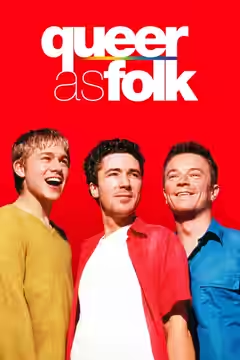
Against Davies’s own work, the comparison is with Queer as Folk from 1999, which was the party without the bill. This is the bill, and he has written it with more patience and less showing off than anything since. The reviews so far sit close to where we do, and we see no reason to quarrel with them.

Five episodes at 48 minutes is four hours, and we would not watch them in one sitting; the cutting needs a night between episodes to land. Watch it with someone. The 15 certificate is for the sex, which is frank and cheerful, and for the language, and for a fourth episode you will want company for.


Critical consensus AI synthesised

88
Positive
16
Mixed
0
Negative
0

Every one of the sixteen reviews is positive, and several call this Russell T Davies’s strongest work. The praise gathers around his writing and the way the series holds warmth, humour and sex alongside the arrival of the AIDS crisis in 1980s London without either side cancelling the other. The cast is admired almost as often, with IndieWire singling out Olly Alexander and Lydia West, and NME praising the period soundtrack.

The spread is narrow, from good to outright acclaim, and the reservations are few. Vulture is the most pointed dissenter, finding a blind spot in how the series handles its characters of colour, though it still recommends it. The Times admires it while noting the drama stays light and sentimental for a subject this heavy. Radio Times scores the opener alone, though the critic has seen the whole run. Nobody argues against watching it.

The Telegraph
17 February 2021 · ★★★★★ · Anita Singh
100

Russell T Davies’s best series so far, a drama that radiates joy and makes viewers care deeply about its characters even as it confronts the tragedy and prejudice of the AIDS crisis.

Read the full review →
Empire
18 January 2021 · Sarah Hughes
90*

The review calls it arguably Russell T Davies’ masterpiece, an involving, devastating and often very funny piece of TV that mixes humour and sorrow while remembering the human stories at the heart of the AIDS crisis.

Read the full review →
Evening Standard
22 January 2021
90*

The series is gorgeous, bright, colourful and full of warmth, joy, celebration and humour even as it depicts the poignant and shocking impact of the AIDS crisis on a group of young friends.

Read the full review →
IndieWire
18 February 2021 · Ryan Lattanzio
90*

The critic calls it a remarkable and essential AIDS drama, placing it alongside Angels in America as a vital queer opus. Strong performances, especially from Olly Alexander and Lydia West, are singled out for praise.

Read the full review →
The Guardian
22 January 2021
90*

The series is a sublime companion piece and potential masterpiece to Queer as Folk, full of humour and humanity as it follows young gay men navigating freedom and the emerging AIDS crisis in 1980s London.

Read the full review →
The i Paper
22 January 2021 · Kasia Delgado
90*

The critic praises the series as deeply affecting, highlighting its blend of warmth, joy, humour and the creeping darkness of the AIDS crisis in 1980s London. The emotional impact and strong performances are singled out.

Read the full review →

Straight answers AI written, from our review

Is It's a Sin worth watching?
It's a Sin is worth watching for almost anyone who can sit through a 15 certificate, and we scored it 84. The first three episodes are as good as any British television drama we have seen in years; the last two lean on speeches the story has already made. Watch it with someone, and leave a night between episodes.
How long is It's a Sin, and what is it rated?
It's a Sin has episodes of about 48m and is rated TV-MA by the MPA in the US. It is a comedy and drama series.
Where can I watch It's a Sin in the US?
It's a Sin is streaming on HBO Max, Hulu, The Roku Channel and Amazon Prime Video in the US. Availability is checked daily; the links above go straight to each service.
How violent or frightening is It's a Sin, and is it suitable for children?
It's a Sin is rated 15 in the UK and TV-MA in the US, and it is not for children. The certificate is for frank, cheerful sex and for strong language rather than violence, and nothing in it is frightening in the horror sense. It is, though, a drama about young men dying in the eighties, and the hospital episodes are hard to watch; the fourth is the one to have company for.
How does It's a Sin compare to Queer as Folk?
It's a Sin is the fuller and better series, though Queer as Folk is the quicker and filthier one. Both are Russell T Davies writing about young gay men in a British city, but the earlier show is all party and no bill, careless with the damage its leads do; the later one follows the party through the illness that ended it, with more patience and less showing off. Start with Queer as Folk if you want the comedy alone.

Cast

If you liked this, try…

Queer as Folk poster79

Queer as Folk

1999 · Davies’s first go at the same streets, all party and no bill

120 BPM (Beats per Minute) poster

120 BPM (Beats per Minute)

2017 · Paris, the same decade, and the anger this series holds back until the end

Angels in America poster83

Angels in America

2003 · The American version, six hours long and unafraid of angels or speeches

Longtime Companion poster

Longtime Companion

1989 · Made while it was happening; quieter, sadder and shot on a beach

Pose poster

Pose

2018 · New York ballrooms, the same illness, and a bigger wardrobe than the Pink Palace