Gervais and Merchant’s third mockumentary has one superb comic performance at its centre and its furniture borrowed from Extras. Warwick Davis is worth the seven half-hours; whether the jokes about his height are ever more than jokes about his height is harder to say.
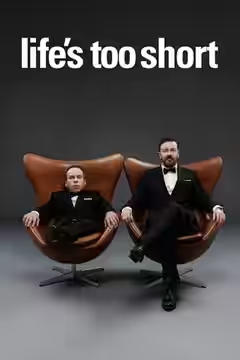
Having made The Office and Extras, Ricky Gervais and Stephen Merchant go back to the mockumentary a third time, and this time they have brought Warwick Davis to play a version of himself who is vain, tight with money and sure he is still a star. Seven episodes of half an hour each, first shown on 10 November 2011, follow him through a divorce, a tax bill and a daily walk to the office of Gervais and Merchant, where he asks for work and does not get it. It is often funny and Davis is tremendous in it. It is also a show that keeps telling us the joke is his character while it films his height, and we never quite believed it.
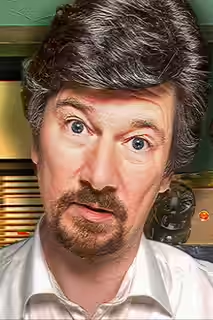
Davis is the reason to watch. He plays Warwick as David Brent reduced to scale: the same confiding glances at the camera, the same habit of announcing a principle and breaking it in the next shot, the same certainty that the room is laughing with him. He lies to his wife Sue (Jo Enright) about his earnings while the divorce is being settled, and Enright plays Sue with a tired patience that is funnier than any line she is given. Steve Brody’s accountant knows less about tax than Warwick does, and Davis carries their scene almost entirely by listening, his face going from confidence to arithmetic to dread.
The famous faces are the best thing in it after him. Liam Neeson turns up in the first episode wanting to try improvised comedy and steers every suggestion towards terminal illness, with the gravity of a man reading a eulogy. We laughed at that scene until it hurt, and the reason is Neeson’s face: he never lets on that he knows it is a comedy, and Davis, Gervais and Merchant have the sense to sit still and let him. Johnny Depp arrives with a grudge against Gervais and takes his time over it. Helena Bonham Carter, shooting a period drama, has Warwick placed in a bin so he will not spoil her eyeline. Steve Carell gets a short scene that mostly consists of being polite.
Then there is the other kind of joke. Warwick falls out of his car because his feet do not reach the ground. He is picked up and moved, more than once, like luggage. He goes in the bin. The writing insists we are laughing at a small-minded man rather than a small one, and on the page that is mostly true. The camera does not keep to the bargain. It finds the height every time, and around the third fall we stopped laughing and felt slightly ashamed of having started. Not because the gags are cruel; Davis co-created the show and plainly enjoys them. Because they are easy, and Gervais and Merchant used to be better than easy.
They play themselves as the only sane men in the building, which was funnier when Merchant was a useless agent in Extras and had something to lose. Here they sit behind a large desk and raise their eyebrows, and the smugness is not always the character’s. The shape is Extras with the agent moved to the centre: one famous guest per episode, a hopeless office, a woman at the next desk who is no help. That woman is Cheryl, and Rosamund Hanson plays her with a blank, slow kindness that is the show’s one piece of warmth; she cannot take a message and she would do anything for him. Shaun Williamson, as himself, hangs about hoping someone will give him a job. Anna Higginson’s design puts the agency in a brown, cramped room with a desk built for somebody else, and it says more about Warwick’s standing than any scene written to make the point.
The Office worked because David Brent built his own humiliations and we watched him do it. Warwick does some of that here, with the money and the lies to Sue, and those are the stretches where the show is honest about something. The rest of the time the humiliations are built for him by the writers and he only has to fall into them. The reviews split sharply on whether that balance holds. Watch the first two episodes for Neeson and for Davis talking to camera about his place in cinema. If you are still laughing when he goes into the bin, the other five will suit you; if not, you have seen the best of it.