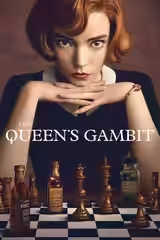
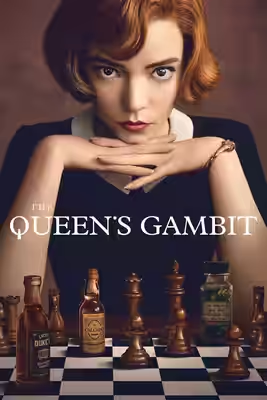
Anya Taylor-Joy gives this seven-part con-artist chase a lead worth following, and the first episode moves with real snap. After that the series repeats itself, explains itself, and never finds out what it is about beyond the running.
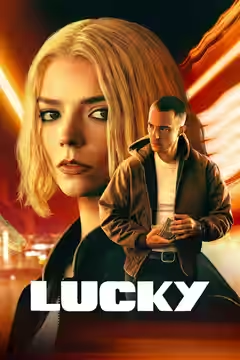
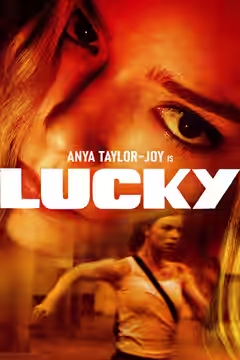
Marissa Stapley’s novel becomes a seven-episode series in which Anya Taylor-Joy plays Luciana Armstrong, called Lucky, a con artist who walks out of a heist betrayed and with everybody after her. On one side are the Mastersons, a criminal family run by Annette Bening’s Priscilla. On the other is the FBI, in the shape of Aunjanue Ellis-Taylor’s Agent Billie Rand and Mo McRae’s Agent Eli Gates. It is a chase, and for one episode it is a good one. Then it settles into a pattern it never breaks: new town, new name, somebody catching up, and by the middle of the run we could have set a watch by it.
Taylor-Joy is the reason to stay. She plays each of Lucky’s identities as a different set of habits rather than a different voice: how she stands in a doorway, how long she lets a stranger look at her before she looks back. The pleasure is watching her choose, and she never lets us see the choosing until it is done. It is a controlled, unshowy piece of work in a show that is neither of those things, and it is better than the scripts it is serving.
Bening has fun. Her Priscilla is polite, expensively dressed by Christine Wada, and unhurried in a way that reads as a threat, and whenever the series remembers she exists it improves. Ellis-Taylor plays Rand as tired, patient and unimpressed, the one person on screen who behaves like an adult with a job. Clifton Collins Jr. does more with Harris Dutch than the writing gives him. Drew Starkey’s Cary Masterson is the one the camera likes and the script does not bother with. Timothy Olyphant’s John Armstrong belongs largely to the flashbacks, alongside Quinn Aune as the young Lucky, and the flashbacks are where the writing is weakest, each one landing exactly the lesson you expect.
Three directors, Jet Wilkinson, Jonathan van Tulleken and Greg Yaitanes, share the seven episodes, and five editors share the cutting. The seams show. The opening episode has a tempo the later ones keep reaching for and not finding. Yaron Orbach and Doug Emmett shoot the road and the rooms cleanly, and Keith P. Cunningham’s production design gives us motels, bars and back offices that would serve any crime series of the last twenty years, which is the trouble: nothing in the frame belongs to this story alone. Isabella Summers’s score drives hard under the chases and drops out when the show reaches for feeling, and that restraint is the right call even when what is under it is thin.
Here is what we felt. The first episode’s set piece had us leaning forward, glad to be watching, sure we were in good hands. By the fourth episode we were bored, and then we were irritated at being bored, because everything needed was there: a lead who can hold a screen alone, two proper antagonists, a premise that has fed good films for fifty years. What was missing was anybody deciding what Lucky wants beyond the next exit.
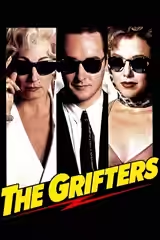
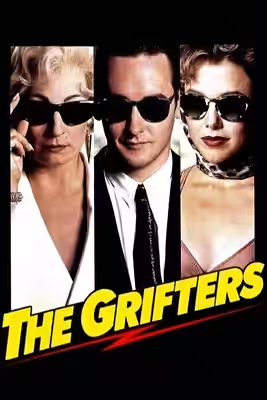
The writing keeps stopping to explain. Who the Mastersons are, what was taken, who is owed what by whom: every second scene is a briefing, and the details of the syndicate get more tangled the more time is spent on them. Meanwhile the thing the genre lives on, the con itself, the small performance for a small audience, gets less room each hour. Paper Moon (1973) and The Grifters (1990) understood that the lies are the character. Here the plot does the talking and the character waits in the car.
The reviews so far are split, some finding it gripping, others finding it assembled from better crime stories, and we sit unhappily in the middle. There is a tight, nasty four-episode series in here, and we would have liked to see it.
Watch the first episode, which earns its length. If Taylor-Joy is enough to carry you through the rest, she is good enough to do it. If not, you will know by the end of episode two, and the show will not change your mind.