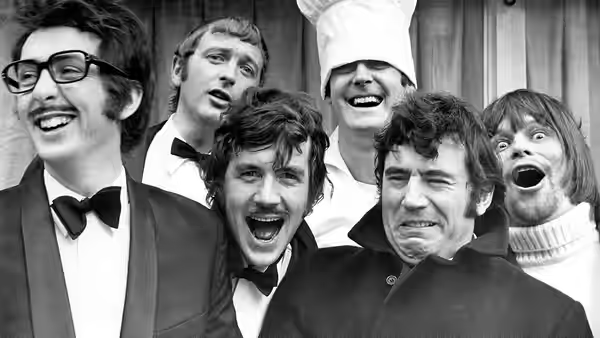
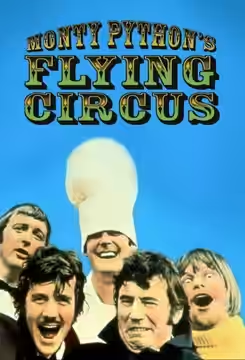
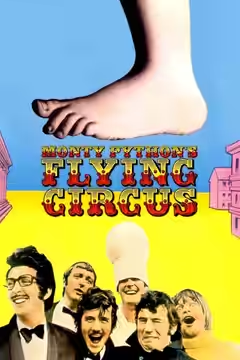
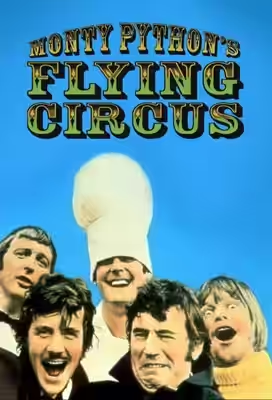
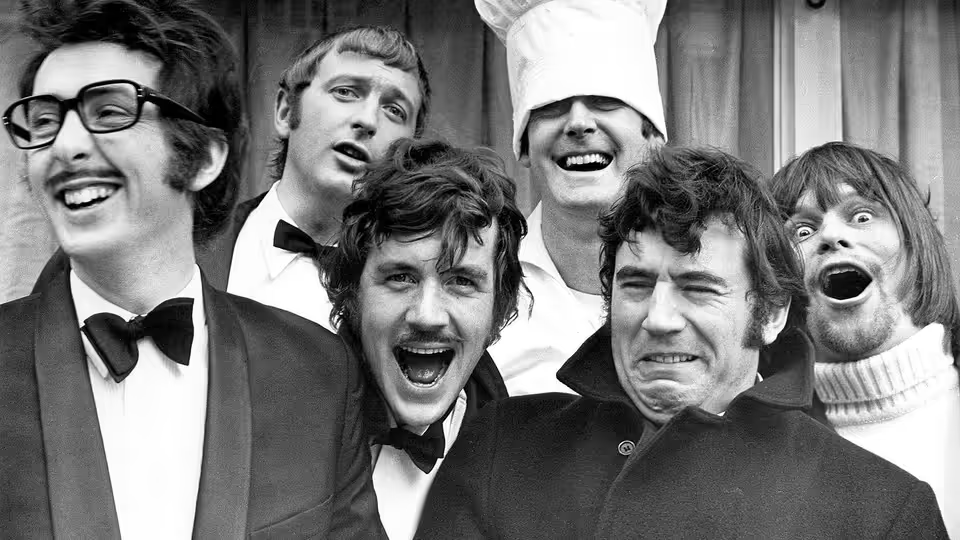
Six men in suits and chef hat pose with mouths wide open
Series review

Monty Python's Flying Circus

1969 · Created by Ian MacNaughton, John Howard Davies · Series

In a sentenceSix men explain themselves impeccably and make matters considerably worse

John Cleese, Graham Chapman, Michael Palin, Terry Jones, Eric Idle and Terry Gilliam play a succession of characters in a comedy series whose cast also includes Carol Cleveland and Connie Booth. Cleese’s parts include an announcer; Palin’s include the “It’s” man. The principal performers also write for the programme, alongside contributors including Douglas Adams, with Ian MacNaughton and John Howard Davies directing. Beginning in 1969, the programme spans four series, with thirteen episodes in each of the first three and six in the fourth.

Fi1m review

This is unruly comedy performed with exacting care, and we recommend it with one caution: the weaker stretches can be stubbornly long. The cast’s command of pompous speech remains a reliable reason to keep watching.

Monty Python’s Flying Circus is funny enough to justify putting up with its failures, though there are evenings when that arrangement requires patience. The comedy depends on people treating foolishness with the seriousness usually reserved for a formal complaint. It takes care over the words, the pauses and the certainty with which a person can be wrong. We recommend it warmly, without pretending that every prolonged exchange deserves the time it gets.

John Cleese makes that certainty particularly enjoyable. His clipped delivery seems to demand agreement before anybody has had a chance to consider what he is saying, and irritation makes his speech more exact. We laughed hardest at the way he keeps that officious tone intact as the talk becomes ridiculous. Graham Chapman is an essential counterweight: his composure gives the silliness time to register, and he rarely seems anxious to help us find the joke.

Michael Palin supplies a different pleasure, making unreasonable people sound approachable enough that we almost accept what they say. Terry Jones is more forceful, and the contrast gives these encounters a useful change of pace. Eric Idle makes smooth speech suspect; there is something funny in how easily he seems able to keep talking. All five are also credited as writers, alongside Terry Gilliam.

Directors Ian MacNaughton and John Howard Davies give the performances room without making every hesitation feel precious. The staging is most effective when it lets us watch somebody persist in being unreasonable, instead of hurrying us towards the next laugh. Robert Berk’s production design works best when it stays unobtrusive, leaving the actors’ faces and bearing to establish how seriously these people take themselves. There is craft in making such behaviour easy to follow, even when the conversation is going nowhere sensible.

The writing is less dependable about stopping. Some exchanges keep repeating an attitude after the performer has exhausted what is funny about it, and confidence begins to look like indulgence. There are stretches when the next variation produces no fresh surprise, only another opportunity to recognise the voice. The actors remain skilful through these passages, but that does not make them shorter.

Across four series, the programme offers enough changes of character to make those dull patches forgivable. Against the ordinary demands of ensemble comedy, its distinction is how little the performers ask to be liked: charm is useful here, but so are stiffness, self-importance and an unwillingness to listen. The humour rewards attention to delivery as much as attention to the words. Knowing roughly where a joke is heading does not always spoil it, because the performance can still make the familiar absurdity funny.

We would start with an episode rather than settle in for a long run. Taken in smaller helpings, the insistence is less wearing, and the differences between the performers have more chance to register. Give it your attention, but there is no obligation to treat a joke that has stopped amusing you as an examination you have failed.

Critical consensus AI synthesised

74
Positive
3
Mixed
0
Negative
1
The Guardian
5 October 2009
90*

The series rewrote the rules of television comedy with its lunatic characters and sketches that remain as funny decades later. Terry Gilliam's surreal animations gave the show its unique appearance and helped make Monty Python a national treasure.

Read the full review →
Empire
19 March 2007 · William Thomas
80*

The first series of Monty Python’s Flying Circus, arriving in 1969, delivers a strong start with many of the troupe’s finest sketches including the Dead Parrot and Nudge Nudge. It lacks the consistency of later seasons but still showcases the group’s anarchic comedy effectively.

Read the full review →
The Telegraph
12 March 2022 · Ed Power
40*

The critic argues that Monty Python's Flying Circus often fails to deliver laughs upon re-watching, with many sketches feeling dated or unfunny. He singles out the uneven quality and lack of consistent humour as the main complaint while noting the enduring cultural status of select sketches.

Read the full review →
Paste
28 September 2005 · Tim Sheridan
90*

The critic calls Monty Python’s Flying Circus the true standard-bearer of sketch comedy and an essential work in the television comedy canon. The review praises how well the material stands the test of time and its lasting influence on later shows.

Read the full review →

Straight answers AI written, from our review

Is Monty Python's Flying Circus worth watching?
Monty Python's Flying Circus is worth watching for anyone who enjoys pompous people being taken entirely seriously, and we scored it 83. The cast's command of officious speech, John Cleese's above all, is the reliable pleasure; the weaker stretches run long and repeat a joke past its use. We would start with a single episode rather than settle in for a run.
Where can I watch Monty Python's Flying Circus in the Philippines?
Monty Python's Flying Circus is not on any streaming or rental service in the Philippines at the moment. It is available in 6 other countries; change your country at the top of the page to see where. Availability is checked daily.
How violent or frightening is Monty Python's Flying Circus, and is it suitable for children?
Monty Python's Flying Circus carries a UK 15 certificate and a US TV-14 rating, so it is not made for young children. The comedy is verbal and absurd rather than frightening, built on foolishness treated with great solemnity, and there is nothing in it we found alarming. Older teenagers who can follow a long, ridiculous argument will be fine.
How does Monty Python's Flying Circus compare to Duck Soup?
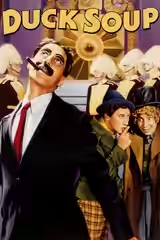
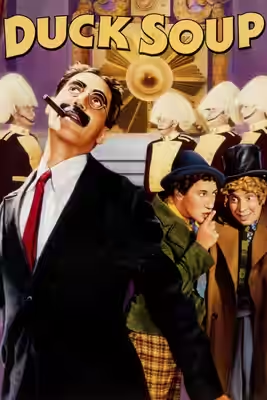
Monty Python's Flying Circus and Duck Soup both find solemn nonsense in official authority, but the film is the brisker of the two and the more consistently funny across its length. The series has more room and more variety of character, and pays for it with stretches that outstay their welcome. Choose Duck Soup for a tight evening, the Pythons for repeated smaller helpings.
What should I watch after Monty Python's Flying Circus?
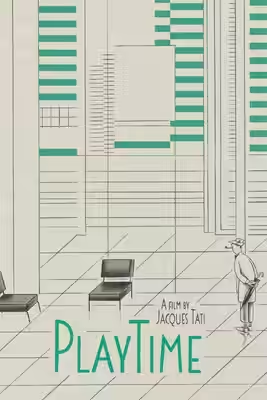
After Monty Python's Flying Circus, try Duck Soup (1933, Fi1m 88): Equally solemn nonsense, with official authority getting exactly the treatment it deserves. Then Daisies (1966, Fi1m 85): Two women behave appallingly, while the film refuses to behave any better; and Playtime (1967, Fi1m 88): Jacques Tati finds comparable absurdity in modern buildings and the people negotiating them.

Cast

If you liked this, try…

  1. Duck Soup (1933, Fi1m 88)Equally solemn nonsense, with official authority getting exactly the treatment it deserves.

  2. Daisies (1966, Fi1m 85)Two women behave appallingly, while the film refuses to behave any better.

  3. Playtime (1967, Fi1m 88)Jacques Tati finds comparable absurdity in modern buildings and the people negotiating them.

  4. The Kids in the Hall (1988) · not on Fi1m yetA different troupe, equally committed to making peculiar people feel disconcertingly familiar.

  5. A Bit of Fry & Laurie (1989, Fi1m 77)Verbal precision and elaborate misunderstandings, for those who prefer their nonsense carefully enunciated.

Free account

Know what to watch tonight

Two lists that know where things are streaming, collections you can share, your own score beside ours, and Discover that remembers what you have seen.

  • Want to see, sorted by what is streaming now
  • Seen, with your score out of ten
  • No adverts, ever