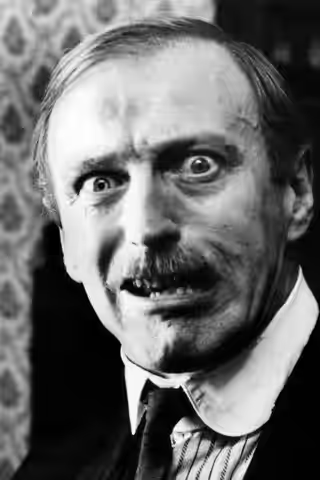
Graham Chapman could make absurdity sound like a matter requiring sober attention. We value the patience of his acting: Python's nonsense lands harder because he rarely seems concerned that we might miss the joke.
Fi1m perspective
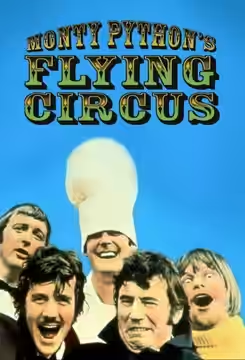
With Graham Chapman's Colonel, a sketch can be interrupted for the offence of being too silly. He gives the objection the weight of an official ruling. In Monty Python's Flying Circus (1969), that composure makes him essential: somebody has to keep a straight face while the others insist on nonsense. We laughed at his composure because he lets ridiculous talk continue without signalling that we ought to find it funny.
John Cleese is the useful comparison, and the important collaborator. Their writing partnership began before Python, in television sketch comedy. In Flying Circus, Cleese's clipped speech demands agreement; irritation only makes him more precise. Chapman is less insistent, allowing the silliness time to register without appearing impatient for a response. That difference gives the series two distinct ways of making authority look foolish.
His restraint as a performer should not obscure his appetite for taking a joke further as a writer. The suggestion that the parrot should be dead came from Chapman, a useful reminder of how much he could contribute without being the loudest presence. The series does not always deserve his patience: some of its weaker stretches go on stubbornly long. His composure remains enjoyable, even when the sketch itself has become a wait for the next one.
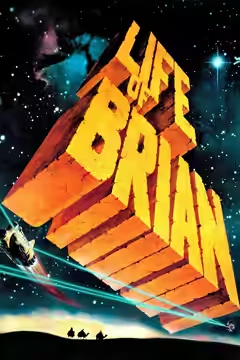
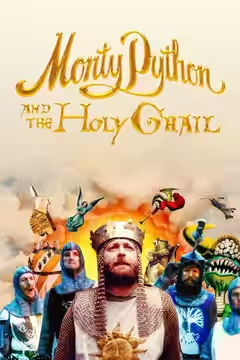
The move into leading roles made good use of that steadiness. As King Arthur in Monty Python and the Holy Grail (1975), he supplies the straight acting around which the medieval absurdity can accumulate. Playing Brian Cohen in Monty Python's Life of Brian (1979) extended his place at the centre of the group's narrative films. Those roles make sense for an actor who can take a ridiculous predicament seriously without explaining to us that it is ridiculous.
Yellowbeard (1983), which he starred in and co-wrote, offers a less persuasive reason to seek him out. Its weaker comedy is a caution against assuming that a leading part will necessarily make the best use of him. We would start with Flying Circus, and resist the temptation to watch only whoever is speaking loudest.
Biography
Graham Chapman (8 January 1941 – 4 October 1989) was an English comedian, writer and actor. He was one of the six members of the Monty Python comedy group and wrote for and appeared in their television series Monty Python's Flying Circus (1969–1974).
Chapman studied medicine at Emmanuel College, Cambridge and St Bartholomew's Hospital Medical College. He formed a writing partnership with John Cleese while at Cambridge and worked on shows including The Frost Report and At Last the 1948 Show before joining the Monty Python team in 1969. He played King Arthur in Monty Python and the Holy Grail (1975) and the title role in Monty Python's Life of Brian (1979), and co-wrote and starred in Yellowbeard (1983).