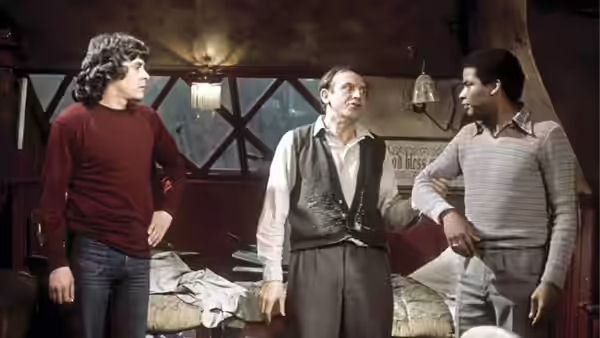
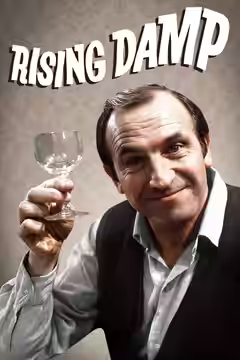
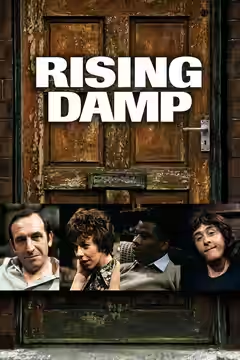
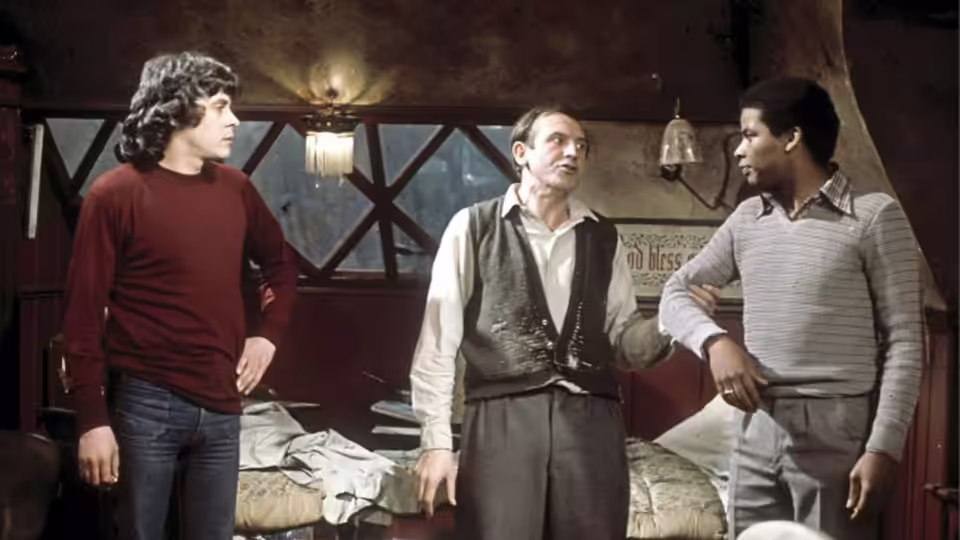
Rigsby (Leonard Rossiter) stands between Alan and Philip in a bedroom
Series review

Rising Damp

1974 · Created by Eric Chappell · Series · 30m

In a sentenceLeonard Rossiter talks as though pausing might allow someone else to be right

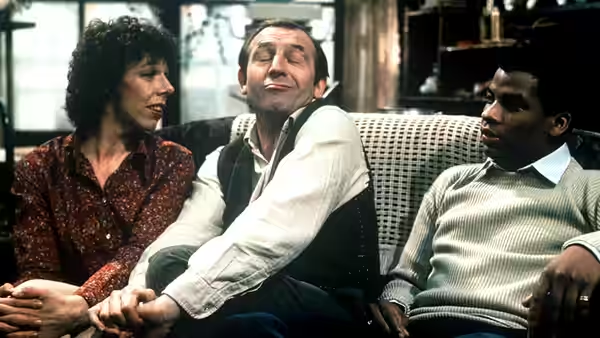
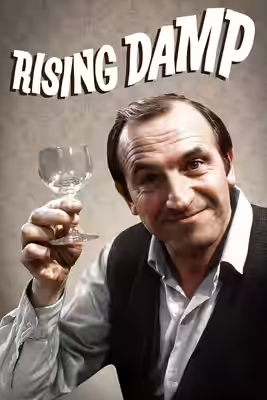
Rigsby (Leonard Rossiter) trades words with Ruth (Frances de la Tour), Alan (Richard Beckinsale) and Philip (Don Warrington). His quick speech and physical reactions set the pace of encounters shaped by longing, disappointment and the possibility of reconciliation. The comedy follows the tensions between these people, with the others answering a man who rarely seems short of something to say. Their exchanges leave room for feelings that persist beyond the immediate disagreement. Created by Eric Chappell, Rising Damp unfolds in half-hour episodes across four series.

Fi1m review

Rising Damp is sharply funny, with Leonard Rossiter setting a pace the ensemble can match. A few lines need the actors’ help, but the characters’ unhappiness gives us a reason to care after the laughter stops.

Rising Damp is sharply funny, and its disappointments hurt enough to keep the comedy from becoming merely busy. Created by Eric Chappell, it gives Leonard Rossiter the chance to dominate an exchange without reducing everyone else to an audience. The acting is the reason to recommend it, with a small reservation about lines that need more help than they should. We would happily spend another half-hour with this cast.

As Rigsby, Leonard Rossiter speaks at a speed that seems to leave no time for reconsideration. The words arrive quickly, and the physical comedy keeps the agitation visible even when the dialogue might be enough on its own. We laughed at that restless combination of voice and movement. The performance keeps Rigsby’s unhappiness in view, too, so that the laughter comes with an uncomfortable awareness of how much effort he is expending.

That performance needs people who can share a scene without competing for the same effect. Frances de la Tour as Ruth, Richard Beckinsale as Alan and Don Warrington as Philip give the exchanges the variety they need. Their contribution is easy to undervalue if we remember only the busiest performance; the comedy depends on what happens between the actors and how they answer one another. The ensemble feels properly matched, and the programme benefits whenever it allows us to appreciate someone besides Rigsby.

The weakness is easier to hear when a line attracts attention chiefly because of the way it has been delivered. Some of the dialogue feels thinner than the actors make it sound, and the brisk pace can hurry us past that rather than repair it. Eric Chappell’s comedy has enough feeling to survive the unevenness, but that dependence on performance is noticeable. A quieter delivery would leave a few jokes exposed, particularly when the pleasure comes almost entirely from the timing.

Produced by Ronnie Baxter, the half-hour programme gives the actors enough room to establish a rhythm without making every exchange feel laborious. The speed is useful, but so is the sense that these performers are listening to one another. Against the ordinary demands of a character sitcom, that is a substantial achievement, and it explains why the comedy sustains our attention. Rigsby is strongly drawn, the other performers remain distinct, and the writing gives them feelings to play as well as jokes.

The uneven lines are worth acknowledging, though they are a modest reservation about a series with this much comic skill. Across four series, the attraction is the ensemble and the complicated feelings it can bring into a short exchange, including the possibility that these people might find some accommodation with one another. Give it an episode rather than treating it as familiar background noise. Come for Leonard Rossiter, but keep an ear on the people answering him.
Critical consensus AI synthesised

3 of 6
Positive
3
Mixed
0
Negative
0
The Guardian
20 November 2009
90*

The critic argues that Rising Damp has aged even better than Fawlty Towers due to its faded, snappy style and Leonard Rossiter's rapid delivery. It singles out the physical comedy and the depth of hopelessness, yearning, and reconciliation beneath the surface.

Read the full review →
The Telegraph
1 September 2024
90*

The piece marks the 50th anniversary by calling Rising Damp sitcom gold that could never be made today, praising its enduring appeal and Leonard Rossiter's uniquely complex Rigsby character. It highlights the rich interplay and how the show transcended its era through writing and performance.

Read the full review →
The Independent
28 August 1999
70*

The retrospective marks the 25th anniversary by calling it a landmark of TV comedy that was quickly commissioned after a strong pilot. It quotes contemporary praise for the cast and writing while noting its lasting legacy despite varying initial views on the scripts.

Read the full review →

Straight answers AI written, from our review

Is Rising Damp worth watching?
Rising Damp is worth watching for anyone who likes a character sitcom built on a strong ensemble, and we scored it 84. Leonard Rossiter sets a relentless pace as Rigsby, and Frances de la Tour, Richard Beckinsale and Don Warrington answer him well enough that the unhappiness behind the jokes registers. Our reservation is that some lines are thinner than the actors make them sound.
How long is Rising Damp, and what is it rated?
Rising Damp has episodes of about 30m. It is a comedy series.
Where can I watch Rising Damp in the US?
Rising Damp is streaming on Amazon Prime Video, BritBox, The Roku Channel and Tubi in the US. Availability is checked daily; the links above go straight to each service.
How does Rising Damp compare to Steptoe and Son?
Rising Damp and Steptoe and Son are both comedies about prickly people who need each other and are disappointed by each other, but the earlier programme rests on two performers where the later one spreads its weight across four. Steptoe and Son is the more painful and can become wearing in its quarrelling; Rising Damp is the lighter evening, with more variety in who gets the laugh. Pick the earlier for hurt, the later for pace.
What should I watch after Rising Damp?
After Rising Damp, try Steptoe and Son (1962, Fi1m 83): Another prickly comic relationship made painful by disappointment and the need for company. Then Tampopo (1985, Fi1m 84): For precise ensemble comedy that lets appetite, embarrassment and ordinary longing coexist.

Cast

Awards

BAFTA Television Awards, 1979

Nominated
Best Entertainment Performance

BAFTA Television Awards, 1978

Won
Best Situation Comedy

If you liked this, try…

  1. Steptoe and Son (1962, Fi1m 83)Another prickly comic relationship made painful by disappointment and the need for company.

  2. The Odd Couple (1968) · not reviewed yetPetty domestic grievances give two exact comic actors plenty to work with.

  3. Tampopo (1985, Fi1m 84)For precise ensemble comedy that lets appetite, embarrassment and ordinary longing coexist.

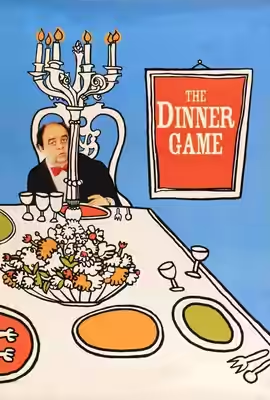
  4. The Dinner Game (1998) · not reviewed yetSmugness meets patient comic punishment in a farce with little wasted motion.

  5. Fisk (2021) · not reviewed yetDry delivery and awkward encounters, with room for the supporting cast to matter.

Free account

Know what to watch tonight

Two lists that know where things are streaming, collections you can share, your own score beside ours, and Discover that remembers what you have seen.

  • Want to see, sorted by what is streaming now
  • Seen, with your score out of ten
  • No adverts, ever