Julie Burchill and Katie Baxendale’s Brighton teen drama is quick, rude and funny, and Olivia Hallinan’s Kim is a narrator worth following anywhere. The first series knows exactly what it is; the second forgets, and tidies up a story that was better messy.
Julie Burchill and Katie Baxendale took Burchill’s novel about a fifteen-year-old girl in love with her best friend and turned it into twenty episodes of 24 minutes, first shown on 7 June 2005. The idea is simple and the show never pretends otherwise: Kim wants Sugar, Sugar wants everyone else, and Kim tells us about it in a voiceover that is braver than she is. It wants to be as rude about teenagers as teenagers are about each other, and for most of the first series it manages it. Sugar Rush is good, and it is good in a way that British television did not often attempt at the time, which is to put a gay girl at the centre and let her be ordinary, selfish and sixteen minutes from disaster at all times.
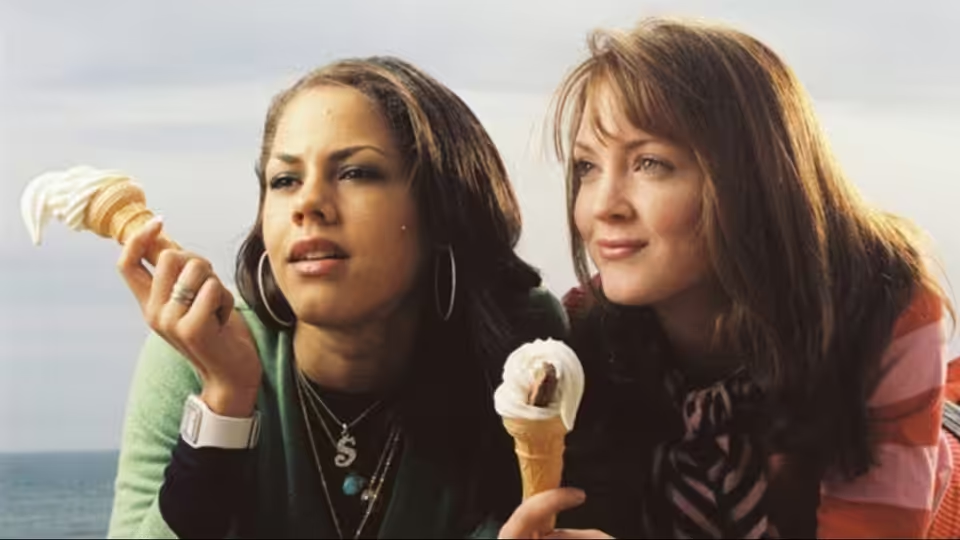
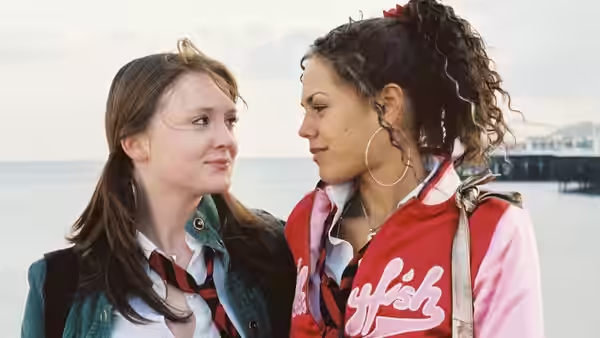
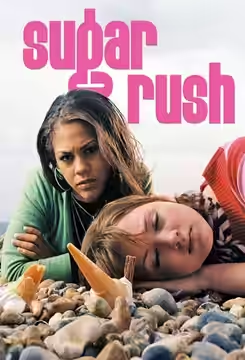
Olivia Hallinan plays Kim as a watcher. She stands at the edge of rooms, says little, and lets the narration say the things her face is already saying, which is where the comedy lives: we hear the lust and the panic while she passes a drink. Lenora Crichlow’s Sugar is the opposite, loud, bored, careless with other people and impossible not to look at, and Crichlow is clever enough to let us see that Sugar enjoys being looked at by Kim in particular and would never say so. The two of them on the pebbles, sharing a bottle, one talking and one listening, is the show, and whenever Baxendale’s scripts trust that, they are the best thing on screen.
Jim O’Donnell shoots Brighton as a place that is always slightly too bright, the pier lit like a fairground, the sea flat and white, the pubs orange. The camera is handheld and close, so the town feels like something Kim is being pushed through rather than somewhere she lives. Paul Cripps gives the family a house permanently half-finished, dust sheets on the furniture and Dale’s ladder in the hall, which is a neat way of keeping the affair in every frame without a line about it. Rhona Russell and Eleanor Baker put Sugar in whatever is tightest and pinkest and Kim in what Sugar would wear if she had less nerve, and the difference tells you who leads. Directors Philip John and Sean Grundy keep each episode moving at the speed of a pop song, which suits the first series and starts to feel like a habit in the second.
The adults are better than they need to be. Sara Stewart’s Stella is not a monster, just a woman who has decided she deserves one nice thing and has picked Neil Jackson’s Dale, who is handsome, dim and oddly kind. Richard Lumsden’s Nathan is the funniest person in the house precisely because he is the least aware of what is happening in it. The show is quietly pointed about this: Kim watches her mother want something she should not, and recognises it, and the voiceover never has to spell that out.
We laughed a great deal at Sugar, and then, somewhere around the third episode, felt slightly ashamed of ourselves, because the show had been telling us all along that Kim was in pain. There is a scene on the beach where Sugar goes off with a boy and Kim stays on the stones with the voiceover still cracking jokes, and Hallinan simply stops acting the jokes. It is a small thing and it got us. The series knows the difference between a girl being funny and a girl being brave, and it waits for you to notice.
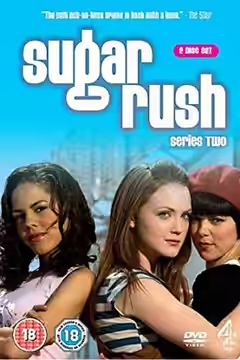
The second series, first shown on 15 June 2006, brings in Sarah-Jane Potts as Saint and softens almost everything. The jokes get slacker and more frequent; the voiceover begins explaining what the face has already told us; Sugar is pushed to the edge of her own show. Burchill’s wish to shock was never the point, and the moments where the writing strains for it, a line delivered for the gasp rather than the laugh, are the ones that have dated. Most critics have been kinder to the second run than we are, and we think they were grading it on what the first had earned.
It remains rare. Nearly two decades on, a British series with a teenage lesbian narrator, written from inside her head and not as a special episode, is still something you have to look for. See the first ten episodes with someone who remembers being fifteen, and treat the rest as an epilogue the show did not strictly need.