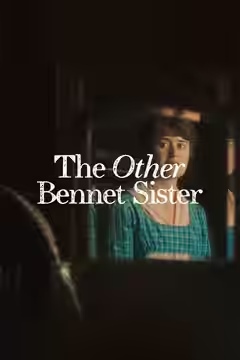
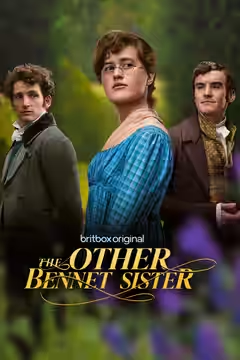
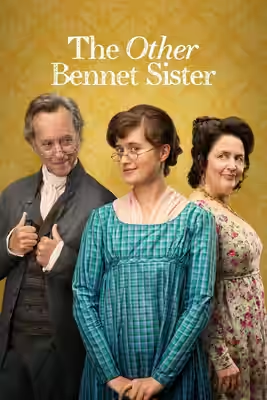
Ella Bruccoleri makes Mary Bennet worth following in this warm, uneven period drama. The sympathy is earned by her performance, though the writing sometimes makes her family crudely unpleasant to help us along.
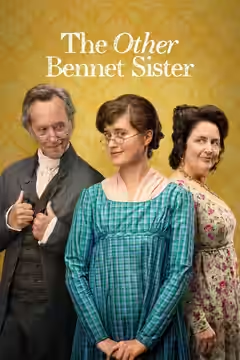
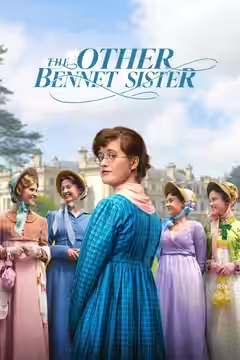
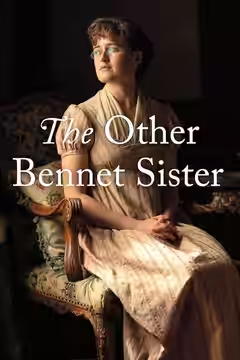
Ella Bruccoleri is reason enough to spend more time with Mary Bennet in The Other Bennet Sister. This expansion of Pride and Prejudice, adapted from Janice Hadlow’s novel, follows Mary towards greater independence and the possibility of romance. The shy sister gets room to develop a personality beyond her usefulness as a family joke. We recommend the programme to anyone who likes character-led period drama, with reservations about how insistently it asks us to take Mary’s side.
Bruccoleri makes shyness feel awkward and limiting without turning it into a request for pity. There is enough seriousness in her performance to stop Mary’s discomfort becoming another endearing eccentricity. We were moved by the hurt she finds beneath the jokes about Mary’s marriage prospects, because she makes being overlooked feel like something endured for years. Her performance gives Mary’s growing self-respect enough weight to make us care about more than the prospect of a suitable man.
Writers Sarah Quintrell and Maddie Dai are less sure-footed when arranging the people around her. Too often, the family is made unpleasant enough to leave us little to decide about whom to support. Ruth Jones as Mary’s mother and Tanya Reynolds as Caroline Bingley are among a cast capable of making broad comedy watchable, but the same jokes return too often. The repeated attention to Mary’s marriageability starts to feel like a shortage of other things to say about her, particularly when Bruccoleri has already made the embarrassment clear.
The stronger idea is that Mary can become more assured without being remade into a different kind of heroine. There is no obligatory transformation to reassure us that she was beautiful all along, and that restraint matters. In a romance, it is easy to make a woman’s value depend on somebody finally choosing her; here, her increasing knowledge of herself gives the courtship something else to rest on. The attention paid to what Mary wants keeps the romantic material from taking over completely.
Directors Jennifer Sheridan and Asim Abbasi give the comedy and the more vulnerable material space to coexist, although that patience can become slackness. The half-hour episodes sound brisk, yet individual scenes sometimes continue after their point is clear. Luke Bryant’s cinematography and Anne Chmelewsky’s music help keep the series welcoming when the family comedy turns harsh, but the production’s polish cannot make every exchange worth its length. We wanted firmer decisions about when to leave a scene, particularly once we already understood why Mary felt out of place.
Dónal Finn’s Mr Hayward gives the romantic side enough appeal to justify its place alongside Mary’s self-discovery. The series is sensible to leave room for both pleasures, rather than treating affection as an embarrassment to a story about independence. Bruccoleri remains the main attraction, holding our interest even when the writing is less patient with the people around her. Give it an evening if a gentle period romance appeals, and allow for a family whose failings have been underlined rather heavily