David Mitchell, Lee Mack and Rob Brydon make a simple guessing game warmly funny, with enough disagreement to keep it lively. Thin stories sometimes stretch the patience, but their company makes the weaker rounds worth forgiving.
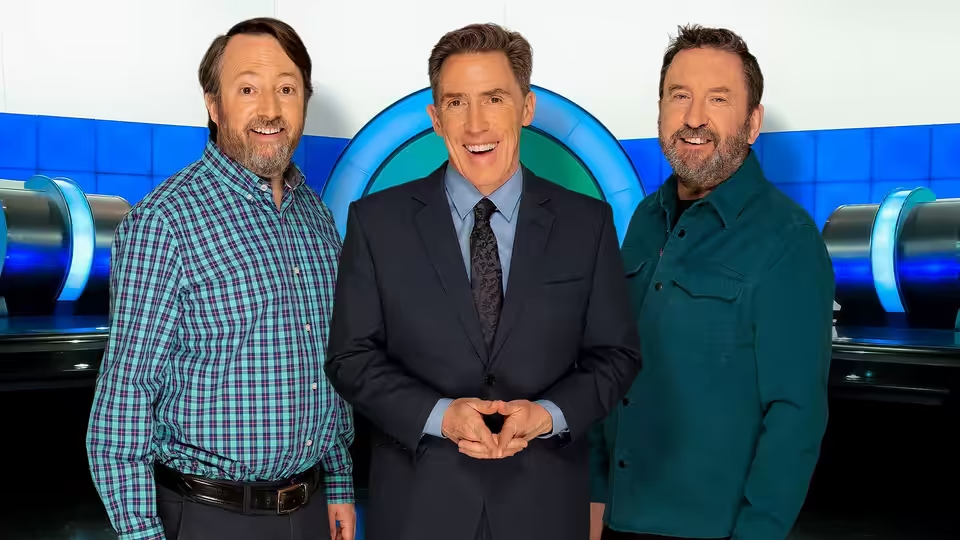
Would I Lie to You? is a good comedy programme built around a simple game, and we would happily spend half an hour in its company. The participants present personal stories, and the opposing team has to decide which ones to believe. Peter Holmes’s format gives everyone a reason to ask questions, interrupt and object without needing much explanation. With David Mitchell and Lee Mack as captains and Rob Brydon hosting, the pleasure comes from the questions as much as the answers.
The story has to withstand being examined, which is a useful discipline for a comedy programme. An unlikely detail invites another question, and an answer can make the account still harder to accept. We can follow the attempt to work it out even when the jokes are doing most of the work. That keeps the conversation accessible: there is something to listen for beyond who can get the next laugh.
David Mitchell brings the seriousness that makes the silliness worthwhile. His questioning has a precision that Lee Mack is particularly good at disrupting, and their opposition gives the programme much of its pace. We laughed at David Mitchell’s exasperation when Lee Mack made a straightforward question harder to settle; the insistence on getting a sensible answer was the funny part. Neither captain needs to stop being funny while trying to win, though their methods could scarcely be more different.
Rob Brydon is important to how friendly this remains. He can join the competition without making every exchange about the host, and he lets the captains disagree without turning the guests into targets. There is sharpness here, but little appetite for humiliating somebody who cannot answer as quickly. For a programme dependent on people challenging one another, that makes a considerable difference to how an evening with it feels.
Barbara Wiltshire’s direction serves the conversation without demanding attention for itself. We need to know who is pressing the question and who is struggling with the answer, and the presentation makes that easy. The 30-minute running time helps: there is room to enjoy the exchanges without asking for much of the evening. We would not ask for a longer version.
The weakness is how much depends on the story under examination. When there is too little in it to sustain the questioning, even a capable comic can seem to be buying time, and an extra joke does not always help. The captains’ familiar differences can also make an exchange feel settled before the team has made its decision. We like the company enough to forgive those stretches, though watching several episodes together makes the repetitions harder to miss.
Among panel shows, this offers a welcome reason for everyone to listen. The guests supply information that the captains need to make their decisions, so there is a purpose to the conversation even when somebody has temporarily run out of jokes. It is worth choosing for the company even if guessing correctly holds no appeal. We would start with a single episode and save the next for another evening.