Roland Emmerich gives the mammoths and pyramids more attention than the people. A few imposing sequences cannot rescue an adventure whose thin characters and slow storytelling make 109 minutes feel needlessly long.
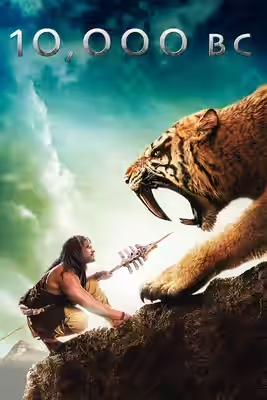
Roland Emmerich’s 10,000 BC is a poor adventure with a few welcome bursts of spectacle. It wants the simplicity of an old-fashioned hero’s tale, with enormous creatures, danger and a sense that everything matters terribly. There is nothing wrong with that ambition, or with treating prehistory as a place for fantasy. The trouble is that the screenplay by Roland Emmerich and Harald Kloser gives us little reason to care about the people occupying all that space.
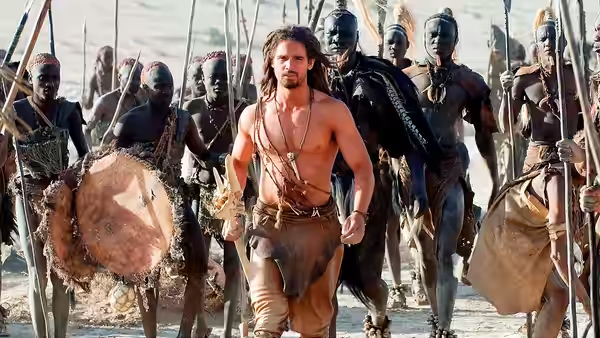
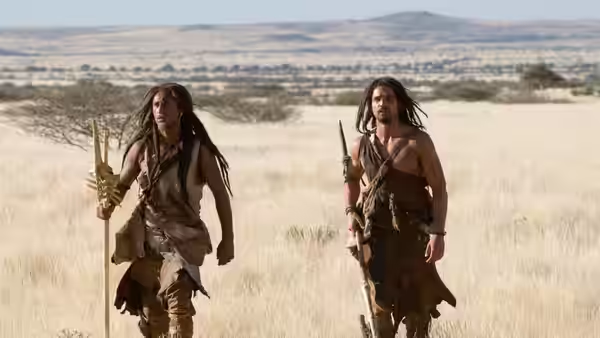
Steven Strait’s D’Leh and Camilla Belle’s Evolet are asked to sustain attention that the writing has not earned. Their characters have so little personality that it is difficult to become interested in them before the next set piece arrives. Cliff Curtis faces the same problem as Tic-Tic: the script provides a name and a function, but too few distinctive qualities. The cast are left to deliver weak dialogue with a seriousness that makes its shortcomings harder to ignore.
Omar Sharif supplies the narration, and the weight of the delivery becomes another obstacle. A voice with this much authority ought to help a legend along; here it makes the telling feel slower. We were bored by the solemn narration and the thinly drawn people, rather than amused by the film’s extravagance. An adventure this fanciful needs a lighter touch, especially when it pauses to tell us how much everything matters.
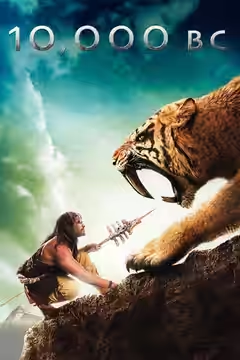
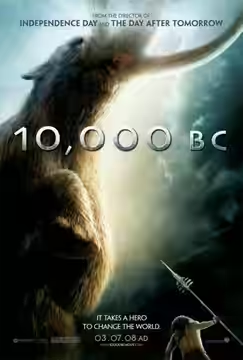
The mammoth stampedes do briefly provide some momentum. Ueli Steiger’s cinematography gives these passages a scale the human scenes struggle to match, and for a while there is enough movement to hold our attention. The computer-generated creatures do not always look solid enough to threaten anyone, which holds the excitement back even here. Still, these passages are a welcome break from the ponderous storytelling.
Jean-Vincent Puzos’s production design is more successful at supplying things worth looking at. The pyramid sequences have an imposing size, with buildings that give the adventure some of the grandeur it keeps announcing. The costumes by Renée April and Odile Dicks-Mireaux also show an inventiveness missing from much of the dialogue. There is care in the appearance of this world, and that deserves acknowledgement even when the film offers so little reason to stay in it.
Alexander Berner’s editing does not solve the uneven allocation of time: the story drags, then the action seems to finish before it has earned the wait. At 109 minutes, this should not feel like such a long journey between brief entertainments. Harald Kloser and Thomas Wander supply the music, but the score cannot generate much excitement around these characters. Too much of the work has been left to departments that cannot rewrite the script.
A simple adventure can survive all manner of absurdity if it gives us somebody worth following. This one’s lack of curiosity about its people matters more than any question of historical accuracy, and its solemnity makes it harder to enjoy the silliness. Unless mammoth stampedes are enough on their own, we would choose another adventure.