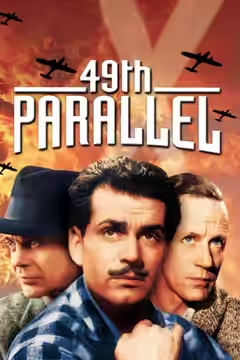
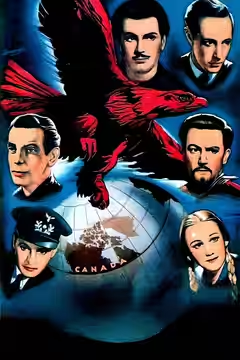
Powell and Pressburger’s wartime manhunt sends six stranded U-boat men across Canada and lets each stop make the case against them. Episodic by design and broad in places, it is still tense, well played and, in Anton Walbrook’s speech at the dinner table, unexpectedly moving.
Britain in 1941 needed America in the war and America had not decided. Michael Powell and Emeric Pressburger built a thriller around that fact. Six German submariners are stranded in Canada with their boat gone, and the only safe ground is the border with the neutral United States, the 49th parallel of the title. Pressburger’s script sends them south through a country that keeps producing people who disagree with them. It is a chase film in which the hunted stop, every twenty minutes, to be told why they are wrong.
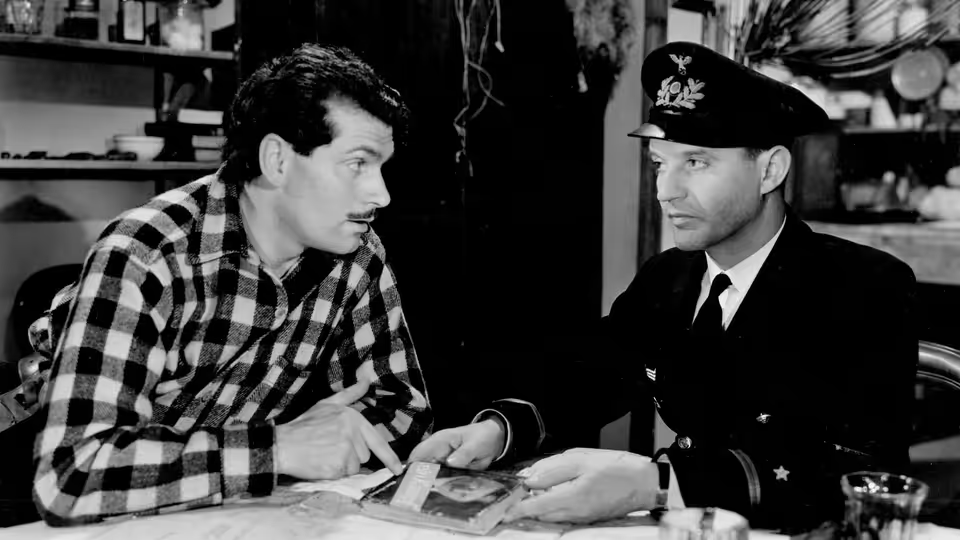
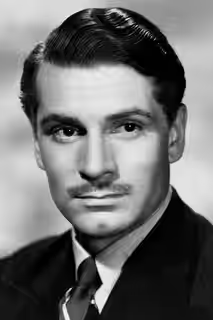
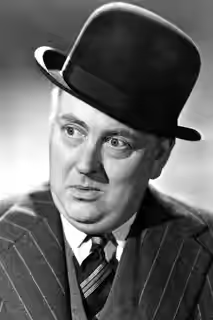
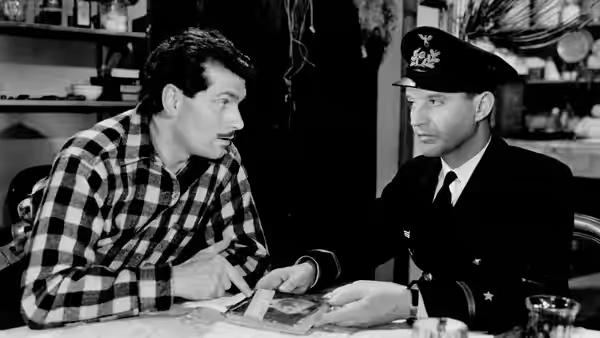
The opening stretch is the most straightforwardly exciting. Freddie Young shoots the submarine in hard grey light and the shore of Hudson Bay as a flat nothing with a few huts on it; the film was plainly made in Canada, not a studio tank. When Lieutenant Hirth (Eric Portman) and his men walk into the trading post, where the Factor (Finlay Currie) and Johnnie the trapper (Laurence Olivier) have been alone for months, we were frightened for the two of them. Nothing much happens for a minute. The Germans stand by the stove, and the hut stops being safe. Olivier’s French-Canadian accent is thick enough to spread on toast; the man he plays is decent and outnumbered, and that is all the scene needs.
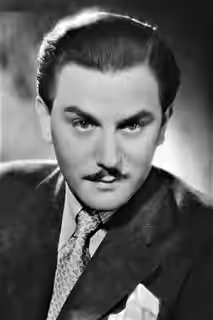
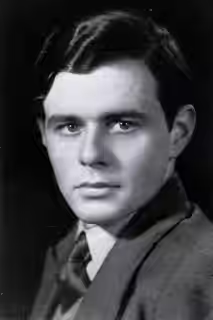
Portman is the reason it works. Hirth is a believer, thin-lipped, quoting the Führer at men who would rather eat, and Portman never plays him as a fool. He is frightening because he is competent and certain. Around him, Raymond Lovell’s Kuhnecke is the practical one, a man who can fly a plane and would like to keep living, and Niall MacGinnis’s Vogel is a baker in a uniform, softer than the others and getting softer. The film has not, in 1941, forgiven them anything, but it lets them be six different men, which is rare in wartime pictures.
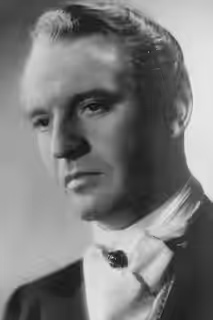
The stretch we did not expect to get us is the farming settlement, a community of German-speaking pacifists who left Germany long before Hitler. Anton Walbrook, as their leader Peter, is given a speech about what freedom means to people who have lived without it, delivered at dinner to men who have come to recruit his neighbours. Walbrook plays it quietly, almost apologetically, and we found our eyes stinging over what is, on paper, propaganda. Glynis Johns, as Anna, has only a few scenes and a face that carries most of them. Hirth’s response to the speech is the film at its coldest and most intelligent.
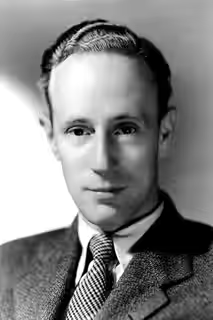
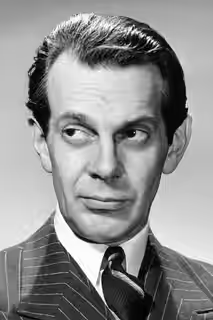
Leslie Howard turns up as Philip Armstrong Scott, a writer camping in the Rockies with a modern painting, a shelf of banned books and no interest in the war, and his scenes are the sharpest written, because for once the argument runs both ways: the Germans despise him as soft and the film half agrees, until it does not. Raymond Massey arrives late as Andy Brock, a Canadian soldier, in a segment played broad and landing with a thump. David Lean’s cutting holds the journey together better than the structure deserves, moving six men from lake to prairie to mountain without a wasted shot. Ralph Vaughan Williams’s score, open brass and hymn-like strings, says this is a country worth fighting over before anyone on screen does.
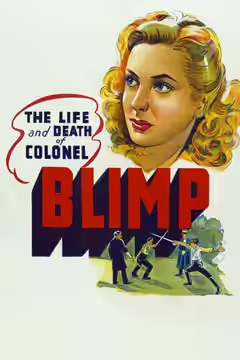
It is episodic by design, and the design shows. Each stop is a lesson with a Canadian attached, and by the third we could hear the next one being set up. The people the Germans meet exist to represent something, Frenchman, farmer, writer, soldier, and only Howard and Walbrook are also people. Set against what Powell and Pressburger made afterwards, The Life and Death of Colonel Blimp (1943) or A Matter of Life and Death (1946), it is plain and purposeful and has none of their strangeness.
Most critics like it and so do we, with the caveat that viewers should know what they are getting. It runs 123 minutes and was in British cinemas from 24 November 1941, when the outcome it argues for was not yet certain, and it is best watched with that in mind. The arguments have dated less than the speeches.