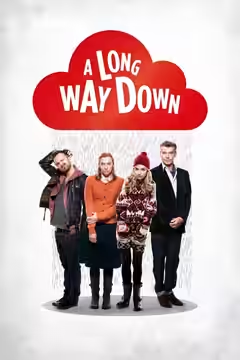
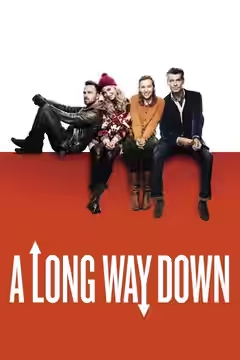
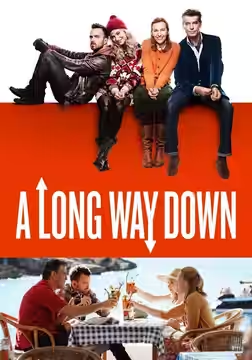
Toni Collette brings warmth to a poor comedy-drama that makes despair look far too easy to resolve. The cast find occasional humour, but Pascal Chaumeil’s film offers reassurance before it has earned much belief.
Pascal Chaumeil’s A Long Way Down is a poor comedy-drama with a humane idea and too little patience for the people it asks us to care about. Jack Thorne adapts Nick Hornby’s novel into a story of four troubled people finding company, with suicide supplying the reason they need it. There is nothing inherently wrong with finding humour in despair, and a joke can offer relief without making somebody’s pain seem small. Here, though, the easy jokes and ready reassurance repeatedly do just that.
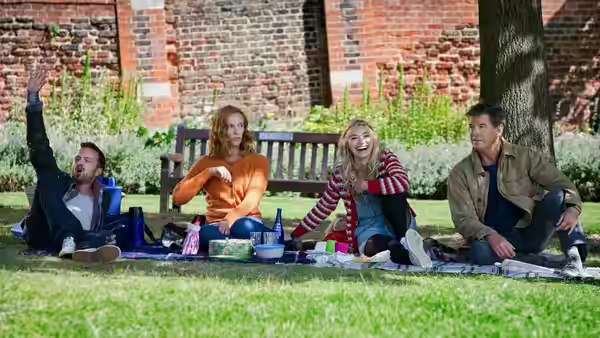
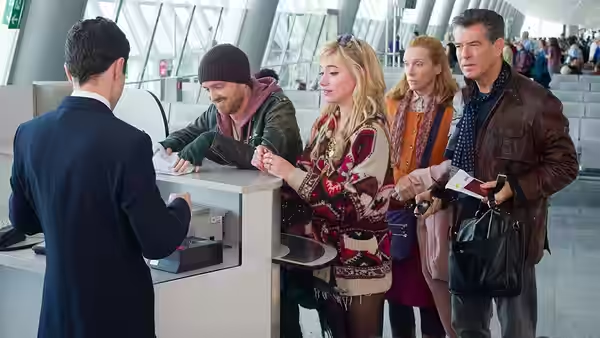
The chief difficulty is how quickly the writing expects us to accept the group as a source of comfort. Jack Thorne gives the characters recognisable attitudes, but too little of the particular experience that might explain those attitudes. Irritability, withdrawal and warmth provide a workable set of contrasts; they cannot, by themselves, make friendship convincing. When the film asks us to feel encouraged by these people finding one another, we are still waiting to understand why they would want to remain in one another’s company.
Toni Collette comes closest to answering that question as Maureen Thompson. There is warmth in her performance, but also an awkwardness that keeps the character from becoming merely the group’s reassuring presence. We were moved by that awkwardness: she makes being with other people look like something that takes effort. For those moments, the film allows a person to seem uncertain without immediately treating the uncertainty as a problem to be cleared up.
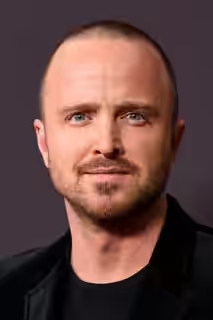
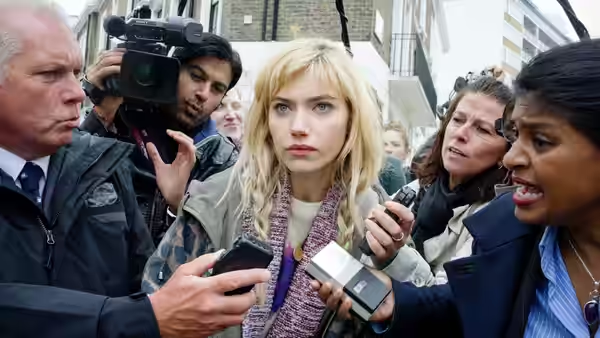
Pierce Brosnan’s Martin Sharp supplies some welcome grumpiness, and his comic timing gives the sharper lines a chance. Imogen Poots brings useful friction to Jess Crichton, although the abrasiveness becomes tiring when the writing keeps returning to it. Aaron Paul has less to work with as J.J. Maguire, whose brooding offers too little variation to sustain our interest. The actors establish differences quickly; Pascal Chaumeil struggles to turn those differences into exchanges that feel spontaneous.
Ben Davis’s cinematography and Chris Oddy’s production design leave little impression of individual lives beyond the performances. We wanted the surroundings to tell us something the dialogue did not, especially when the dialogue was working so hard to make everyone explicable. Dario Marianelli’s music cannot make the film’s reassurances feel earned. Too much of the emotional work is left to a sympathetic cast, and Toni Collette cannot do it for everyone.
The 96-minute running time is modest, but the editing by Barney Pilling and Chris Gill cannot settle the changes of tone. A moment needs time to register before the next change of mood, particularly when the subject is this serious. The pace gives the actors too few opportunities to make those transitions believable. Against the demands of an ensemble comedy, the film is oddly impatient with the small hesitations through which strangers become friends.
The wish to offer hope is welcome, and there are flashes of humour here that do not come at anyone’s expense. But the film keeps making recovery sound simpler than its characters’ difficulties suggest, which makes its kindness feel careless. We cannot recommend it on the strength of one affecting performance and a few dry lines. Those drawn by Toni Collette should be prepared to spend much of the evening waiting for her.