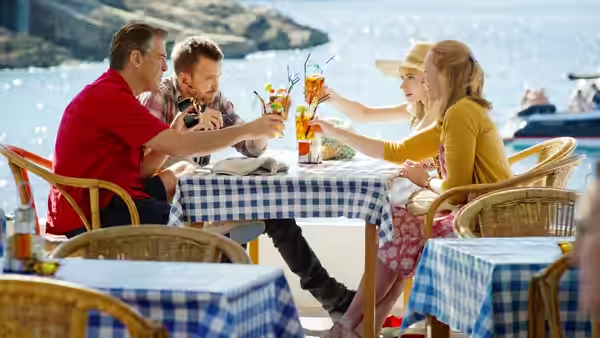
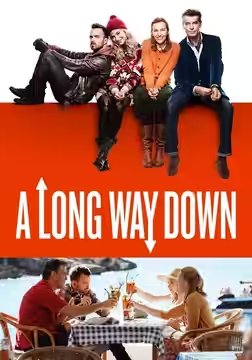
Four people sit around a checkered café table, sharing drinks beside the water
Film review

A Long Way Down

2014 · Directed by Pascal Chaumeil · 1h 36m

In a sentenceToni Collette does the listening while the script hands out the platitudes

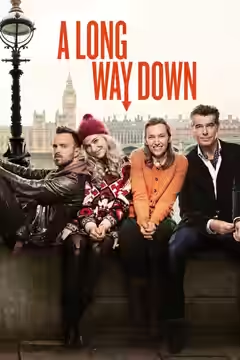
Martin Sharp (Pierce Brosnan), J.J. Maguire (Aaron Paul), Jess Crichton (Imogen Poots) and Maureen Thompson (Toni Collette) are four people struggling with the wish to end their lives. Their friendship brings them into contact with one another’s troubles as they look for reasons to carry on. Jess’s abrasive manner, Martin’s grumpiness and J.J.’s brooding make the company difficult. Maureen brings a quieter presence to the group. Adapted by Jack Thorne from Nick Hornby’s novel, the comedy-drama follows their attempts to find affection and support while dealing with despair.

Plays from YouTube when you press play; nothing loads from them until then.

Fi1m review

Toni Collette brings warmth to a poor comedy-drama that makes despair look far too easy to resolve. The cast find occasional humour, but Pascal Chaumeil’s film offers reassurance before it has earned much belief.

Pascal Chaumeil’s A Long Way Down is a poor comedy-drama with a humane idea and too little patience for the people it asks us to care about. Jack Thorne adapts Nick Hornby’s novel into a story of four troubled people finding company, with suicide supplying the reason they need it. There is nothing inherently wrong with finding humour in despair, and a joke can offer relief without making somebody’s pain seem small. Here, though, the easy jokes and ready reassurance repeatedly do just that.

The chief difficulty is how quickly the writing expects us to accept the group as a source of comfort. Jack Thorne gives the characters recognisable attitudes, but too little of the particular experience that might explain those attitudes. Irritability, withdrawal and warmth provide a workable set of contrasts; they cannot, by themselves, make friendship convincing. When the film asks us to feel encouraged by these people finding one another, we are still waiting to understand why they would want to remain in one another’s company.

Toni Collette comes closest to answering that question as Maureen Thompson. There is warmth in her performance, but also an awkwardness that keeps the character from becoming merely the group’s reassuring presence. We were moved by that awkwardness: she makes being with other people look like something that takes effort. For those moments, the film allows a person to seem uncertain without immediately treating the uncertainty as a problem to be cleared up.

Pierce Brosnan’s Martin Sharp supplies some welcome grumpiness, and his comic timing gives the sharper lines a chance. Imogen Poots brings useful friction to Jess Crichton, although the abrasiveness becomes tiring when the writing keeps returning to it. Aaron Paul has less to work with as J.J. Maguire, whose brooding offers too little variation to sustain our interest. The actors establish differences quickly; Pascal Chaumeil struggles to turn those differences into exchanges that feel spontaneous.

Ben Davis’s cinematography and Chris Oddy’s production design leave little impression of individual lives beyond the performances. We wanted the surroundings to tell us something the dialogue did not, especially when the dialogue was working so hard to make everyone explicable. Dario Marianelli’s music cannot make the film’s reassurances feel earned. Too much of the emotional work is left to a sympathetic cast, and Toni Collette cannot do it for everyone.

The 96-minute running time is modest, but the editing by Barney Pilling and Chris Gill cannot settle the changes of tone. A moment needs time to register before the next change of mood, particularly when the subject is this serious. The pace gives the actors too few opportunities to make those transitions believable. Against the demands of an ensemble comedy, the film is oddly impatient with the small hesitations through which strangers become friends.

The wish to offer hope is welcome, and there are flashes of humour here that do not come at anyone’s expense. But the film keeps making recovery sound simpler than its characters’ difficulties suggest, which makes its kindness feel careless. We cannot recommend it on the strength of one affecting performance and a few dry lines. Those drawn by Toni Collette should be prepared to spend much of the evening waiting for her.


Critical consensus AI synthesised

40
Positive
1
Mixed
6
Negative
9

Most critics find A Long Way Down an unconvincing adaptation, with its attempts at reassurance and broad comedy poorly suited to a story about suicidal despair. The praise clusters around individual performances rather than the writing: Toni Collette receives repeated credit for bringing warmth and emotional weight to thin material, while Pierce Brosnan’s casting and grumpy humour earn some approval. Those strengths rarely persuade the reviews that the film handles its subject with enough care.

The main divide concerns whether the friendship offers sufficient humanity to offset the sentimentality. IndieWire is the clearest supporter, finding an unconventional, humane alternative to formulaic romance despite problems with pacing. The Guardian also finds a genial film that retains some of the novel’s bittersweet tone. More hostile reviews regard the humour as forced and the treatment of suicide as trivialising; even several mixed assessments question the characters’ credibility and the uneasy balance of comedy and tragedy.

IndieWire
14 February 2014 · festival review · Tara Karajica
70*

The critic finds the film a worthwhile, unconventional alternative to formulaic Valentine’s Day romances, despite pacing issues and a forced happy ending. She singles out its humane portrayal of friendship and affection among four troubled people for praise.

Read the full review →
Screen Daily
10 February 2014 · Mark Adams
64*

The accessible page does not reveal the critic’s verdict. It provides no praise or complaint beyond identifying the film.

Read the full review →
The New York Times
64*

The page could not be accessed, so the critic’s verdict is unavailable. No praise or complaint can be reliably identified from the supplied text.

Read the full review →
The Guardian
10 February 2014 · festival review · Andrew Pulver
60*

Pulver finds the adaptation genial and lightweight, retaining much of the novel’s bittersweet tone. He praises Pierce Brosnan’s casting but notes that the rush to a neat ending sacrifices some of the book’s intricacies.

Read the full review →
The AV Club
10 July 2014 · C · Mike D'Angelo
57

The critic finds the adaptation tonally inconsistent and unconvincing about why its characters should keep living. He singles out Imogen Poots’s abrasive performance as a welcome counterpoint to Aaron Paul’s dull brooding.

Read the full review →
Time Out
18 March 2014 · ★★ · Cath Clarke
40

Clarke finds the film disappointing, calling it hokey and fake. She singles out the novel’s playful premise as a problem for the adaptation.

Read the full review →

Straight answers AI written, from our review

Is A Long Way Down worth watching?
A Long Way Down is difficult to recommend, and we score it 40 out of 100 for making despair look too easy to resolve. Toni Collette brings affecting warmth and the cast find occasional humour, but even viewers drawn by her performance should expect thin characterisation and reassurance the film has not earned.
How long is A Long Way Down, and what is it rated?
A Long Way Down runs 1h 36m. It is a comedy and drama film.
Where can I watch A Long Way Down in Finland?
A Long Way Down is available to rent from Apple TV from €3.99. Availability is checked daily; the links above go straight to each service.
How violent or frightening is A Long Way Down, and is it suitable for children?
A Long Way Down has a UK 15 certificate and centres on four people struggling with the wish to end their lives, making it unsuitable for children. We would urge caution for anyone sensitive to suicide themes: the comic treatment does not remove the seriousness of the subject, though our review does not establish how graphic any violence is.
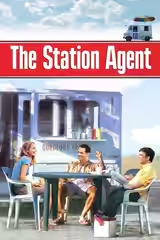
How does A Long Way Down compare to The Station Agent?
A Long Way Down is the less persuasive friendship comedy; we recommend The Station Agent for its quieter account of lonely people learning to share their days. The latter gives its actors room to make companionship convincing, while A Long Way Down rushes towards reassurance, despite Toni Collette’s warmth and some welcome dry humour.
Is A Long Way Down based on a true story or a book?
A Long Way Down is adapted by Jack Thorne from Nick Hornby’s novel, rather than presented as a true story. We find the film’s characterisation thin and its reassurance too easy, but that judgement does not establish how faithfully it follows the book; familiarity with the source is not needed to follow its account of four troubled people finding company.
What should I watch after A Long Way Down?
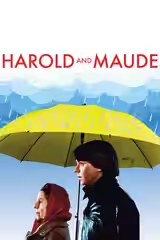
After A Long Way Down, try The Station Agent (2003, Fi1m 82): A quieter, more persuasive account of lonely people learning to share their days. Then Harold and Maude (1971, Fi1m 81): Black humour and unlikely affection, with the nerve this film keeps losing; and Mary and Max (2009, Fi1m 80): An awkward friendship given the time and emotional care it needs.

Cast

If you liked this, try…

  1. The Station Agent (2003, Fi1m 82)A quieter, more persuasive account of lonely people learning to share their days.

  2. Harold and Maude (1971, Fi1m 81)Black humour and unlikely affection, with the nerve this film keeps losing.

  3. A Man Called Ove (2015) · not on Fi1m yetAnother difficult man finds company, with greater patience for his unhappiness.

  4. Mary and Max (2009, Fi1m 80)An awkward friendship given the time and emotional care it needs.

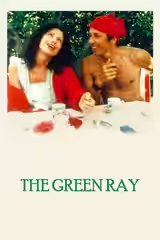
  5. The Green Ray (1986) · not on Fi1m yetLoneliness observed closely, without hurrying towards a reassuring lesson about company.