A Real Pain poster

A Real Pain

2024 · Directed by Jesse Eisenberg
1h 30mComedyDrama15
76
Fi1m score
77
Critics · 13
Audience · not yet

Where to watch in the UK

Checked 10 September at 22:29. Prices and availability change; the service’s page is the last word.

Plays from YouTube when you press play; nothing loads from them until then.

Synopsis

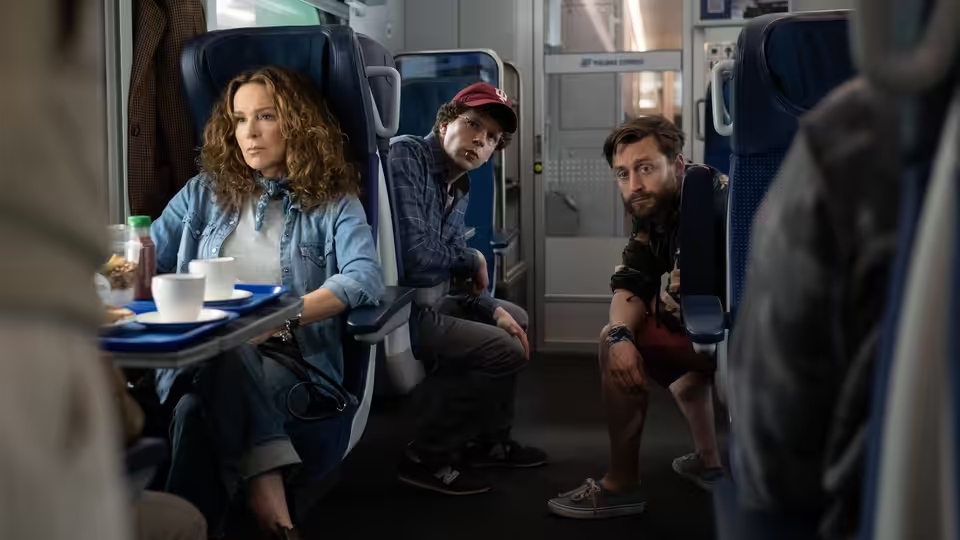
David and Benji Kaplan are cousins who grew up almost as brothers and have drifted apart. David (Jesse Eisenberg) has a job, a wife, a small son and a bottle of pills; Benji (Kieran Culkin) has none of those things and says whatever comes into his head. Their grandmother, who survived the war in Poland and got out, has died and left them money to see where she came from. They join a small heritage tour led by James (Will Sharpe), a British guide, alongside Marcia (Jennifer Grey), Eloge (Kurt Egyiawan) and a married couple, Mark and Diane (Daniel Oreskes and Liza Sadovy). The plan is to finish at her old house. Benji has other plans, or none.

Fi1m review

In a sentenceKieran Culkin hugs strangers, cries at statues and steals the film from the man who wrote it

Jesse Eisenberg’s second film sends two cousins on a Holocaust tour of Poland and lets Kieran Culkin loose on it. It is funny, short and sadder than it lets on; it is also thinner around the edges than the performance at its centre.

Jesse Eisenberg has written and directed a comedy about two Jewish American cousins who fly to Poland to see the camps, and he has cast himself as the one you are not meant to warm to. David Kaplan (Eisenberg) has a job, a wife, a small son and a bottle of pills. Benji (Kieran Culkin) has a bedroom in his mother’s basement and a habit of saying what everyone else is too polite to say. Their grandmother has died and left them money to see the country she survived and left, so they join a small heritage tour and plan to finish at her old house. It runs 90 minutes, funny for most of them and sad for the rest, and it is at its best whenever Culkin is talking. When he stops, you notice how little has been built around him.

Culkin is the reason to see it. Benji hugs strangers at the airport, hands round a joint on a hotel roof, tells the guide his tour has too many dates and not enough people, and cries at things nobody else has noticed. Culkin does not play any of this for charm. He plays a man who is right about half the time and unbearable for all of it, and he keeps the panic visible under the noise. It is the best work he has done.

Eisenberg gives himself the thinner part and plays it honestly. He has spent twenty years as the fast-talking anxious one, and David is that man grown up and wanting credit for it: he has coped, he has medicated, and he cannot understand why nobody is impressed. The script sides with Benji more often than it should, and in the middle David’s case is made for him in a speech rather than found in a scene. Even so, the two of them are good company, and the film knows when to leave them alone in a hotel room.

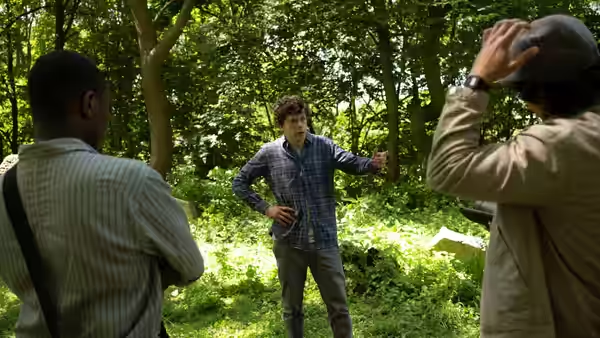
The moment we keep coming back to is early, in Warsaw. Benji decides the group should climb on to a war memorial and pose among the bronze soldiers, while David hangs back with the camera and the face of a man whose flight has been cancelled. We laughed, properly, and then we did not much want to have. That is how the film works: the joke and the discomfort arrive together and Eisenberg does not tell you which one to keep.

Michał Dymek shoots Poland in flat grey daylight with no attempt to make it pretty, and stays close on faces in trains, coaches and hotel corridors. Between scenes Robert Nassau cuts to still shots of blocks of flats, tram stops, a courtyard, a synagogue, and the only music under them is Chopin, on a solo piano and left alone. Mela Melak’s hotels look like every package-tour hotel you have stayed in, which is right. Małgorzata Fudala puts Benji in cargo shorts and a hoodie, dressed for a different holiday, and David in the zipped jacket of a man who has read the itinerary. The tour’s most serious stop is shot without music and almost without words, and that is the correct decision.

The trouble is everyone who is not a Kaplan. Will Sharpe’s James is a British guide who studied all this at university and lost nobody to it, and Sharpe plays him carefully, as a man who knows the dates and is starting to suspect they are not enough. He gets one scene where Benji takes him apart and one where he answers, and both are good. The others get less. Jennifer Grey’s Marcia is recently divorced, Kurt Egyiawan’s Eloge survived Rwanda and converted, and Daniel Oreskes and Liza Sadovy are a married couple who mostly nod. Each is handed one speech and a reaction shot. Egyiawan makes the most of his, and the film seems aware there is a larger story in Eloge that it has decided not to tell.

Set against Eisenberg’s first film as a director, When You Finish Saving the World, this is a clear step up: warmer, funnier and less pleased with its own bad mood. Set against the odd-couple road film in general it sits in the upper half, held there by one performance. The last stretch declines to tie anything off. Some critics have found that a little cold; we found it honest.

Watch it with a relative you love and would not choose to travel with, and do not expect the film to tell either of you who was right.

Critical consensus AI synthesised

77
Positive
12
Mixed
0
Negative
1

The reviews for A Real Pain agree almost to a fault. Nearly every critic singles out Kieran Culkin as Benji, the volatile cousin, and most treat his performance as the reason the film works; several call it a step up from anything he has done before. Jesse Eisenberg’s writing and direction draw steady credit for keeping comedy and Holocaust remembrance in the same frame without one crowding out the other, and for a script that finds its laughs in awkward silences. The reservations are quiet: a few find the filmmaking modest next to the acting, Sight and Sound thinks it does not quite hold together as either a road trip or a character study, and one or two note that it ends without easy relief. The one clear dissent comes from The New Yorker, which finds the film stronger as an idea than as drama, the buddy-comedy shtick getting in the way of what it wants to say about inherited trauma. The spread is narrow.

Variety
21 January 2024 · Critics Pick · Owen Gleiberman
85*

Eisenberg reveals major chops as writer-director in this funny, heady road movie about cousins on a Holocaust tour in Poland. Culkin gives a sensational performance establishing him as a movie star, with the film deftly interweaving comedy and gravitas.

Read the full review →
Time Out
29 January 2024 · ★★★★ · Phil de Semlyen
80

The review praises the spiky, funny and personal road-trip movie and the inspired pairing of Culkin and Eisenberg, highlighting Culkin's performance which adds melancholy and despair amid awkward laughs.

Read the full review →
Vulture
16 January 2025 · Bilge Ebiri
80*

The critic calls it a touching character study anchored by Culkin's lively performance, a light movie with a heavy heart that moves gently while hinting at darkness underneath, capturing the dissonance of living amid infinite evil through the cousins' bickering and bonding on the tour.

Read the full review →
The AV Club
30 September 2024 · B-
70

The critic finds the film a charming, sensitive two-hander that balances its Holocaust tour narrative and odd-couple comedy, marking an improvement over Eisenberg's debut with wry humor and gut-wrenching heartache, though it ends on a slightly cynical note without simple catharsis.

Read the full review →
The New Yorker
5 November 2024 · Richard Brody
40*

The film is seen as far better as a concept than as a drama, with a shticky bromance that obscures its attempt to probe the Holocaust legacy. Eisenberg’s effort to find an original cinematic form for the moral burden falls short despite strong conceptual elements.

Read the full review →
Empire
6 January 2025 · Ian Freer

The film is a sublime mismatched-buddy comedy and road trip that balances funny, solemn, and emotional tones through strong central performances. It succeeds as a tender, funny treatise on family jealousies and our relationship to the past, soaring on the pairing of Eisenberg and Culkin despite modest filmmaking.

Read the full review →

Cast

Stills

If you liked this, try…

Everything Is Illuminated poster

Everything Is Illuminated

2005 · Another American goes east to find a grandparent’s village and finds mostly awkwardness.

The Trip poster

The Trip

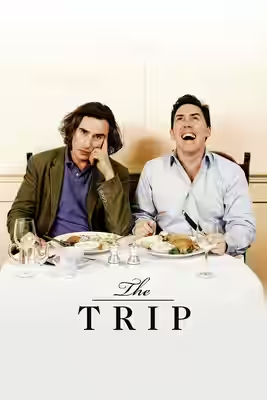
2010 · Two men who cannot stop competing, in cars and restaurants, over six lunches.

Toni Erdmann poster

Toni Erdmann

2016 · A father embarrasses his daughter across Bucharest; the laughs hurt in the same places.

Ida poster

Ida

2013 · Poland in black and white, and a young woman learning what happened to her family.

The Meyerowitz Stories poster

The Meyerowitz Stories

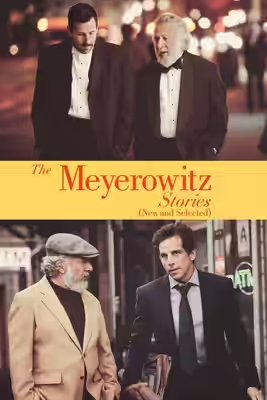
2017 · Adult siblings, an impossible father, and nobody willing to say the obvious thing first.