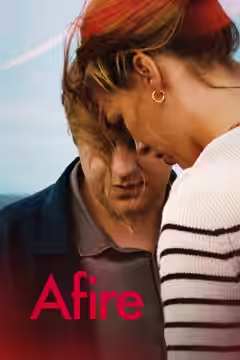
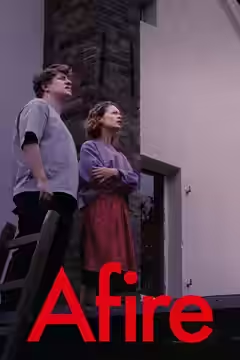
Christian Petzold’s summer-house comedy about a novelist who cannot stop wrecking his own holiday is the funniest film he has made and one of the sharpest. Thomas Schubert makes Leon unbearable and then pitiable; only the graver last act wavers.
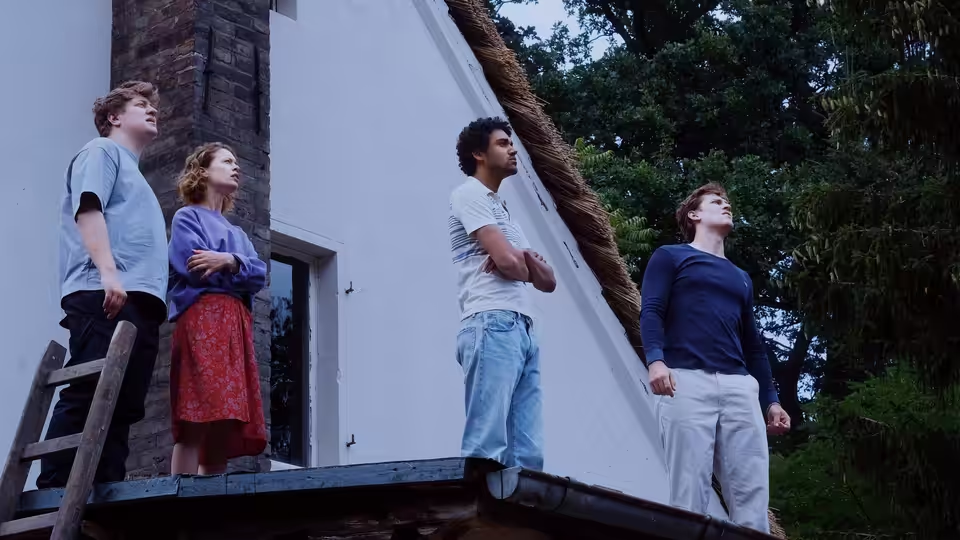
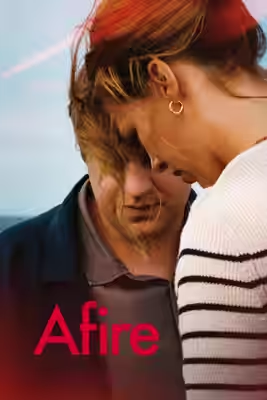
Christian Petzold, whose last two films Transit (2018) and Undine (2020) were cool, exact and haunted, has made a comedy. Leon (Thomas Schubert), a novelist with a second book due, and his friend Felix (Langston Uibel), a photography student, drive out to Felix’s family’s summer house near the Baltic. The car dies in the forest. They walk the rest of the way, and when they arrive somebody is already living there. Afire is the funniest thing Petzold has made and one of his sharpest, and only in its last movement, when the summer turns grave, does it lose a little of its footing.
The joke, and the film, is Leon. Schubert plays him heavy and sulking, shirt buttoned in the heat, at the kitchen table with a manuscript called Club Sandwich that he will not let anyone read. Asked to come swimming he says the work will not allow it, and then does no work. He hears Nadja (Paula Beer) through the wall at night before he has seen her, learns she sells ice cream in the town, and decides what she is on the strength of that. We laughed at him a great deal in the first half hour, and then caught ourselves, because we have sat at that table and refused that swim, and Petzold knows it.
Beer plays Nadja with amusement rather than patience. She watches Leon make his mistakes and lets him finish making them, which is crueller than correcting him and much funnier. Uibel gives Felix an easy warmth; his portfolio is portraits of people at the shore, first from behind looking at the water and then turned to face the camera, and it is a better idea than anything in Leon’s book. Enno Trebs is Devid, the lifeguard from the beach, whom Leon files as a fool and who turns out to be nothing of the kind.
Hans Fromm shoots the summer plainly: hard bright daylight on the pines, the sea a flat blue, the house in warm wood. Klaus-Dieter Gruber’s interiors are small and shared, with walls thin enough that everyone hears everything, which is the engine of half the plot. Katharina Ost puts Leon in dark trousers and a black shirt while the others are in swimwear, so he looks like a mourner at a picnic. The fire is a plume on the horizon, then a helicopter, then a fine grey ash settling on the garden table, then a sky that goes red at night. There is no score to speak of. One melancholy pop song plays, and plays again, and by the third time it has changed its meaning.
Then Helmut arrives. Matthias Brandt plays Leon’s publisher as a kind, tired man who has read a great many manuscripts and knows within a page what he is holding. The scene in which he reads while Leon watches his face for a verdict is the film’s best, and we found it hard to look at. Bettina Böhler holds on Leon’s face a beat longer than is comfortable. Brandt says almost nothing about the book, and Leon hears all of it.
The last stretch is where the reviews part company, and where we part a little with the film. The fire comes closer and the film turns serious, and Petzold handles the turn with a device we will not describe, one that comes close to explaining what we have just watched. It is done with taste and it is moving in places, but the comedy had been telling us the same things more lightly and better. Leon is also a great deal to spend 103 minutes with, and some viewers will have had enough of him by the hour. That is a fair response, and the film has courted it.
Set against Barbara (2012) or Phoenix (2014), this is looser and warmer and has more people laughing in it, and Petzold turns out to be good at that too. See it with someone who has ever tried to write anything, and watch them shift in their seat when Leon says the work will not allow it. It runs 103 minutes and carries a 12A.