Jon Shenk and Bonni Cohen’s follow-up to the 2006 slideshow is better looking and more human, and its Paris section has real tension. But this is a film about Al Gore before it is one about the climate, and it admires him too much.
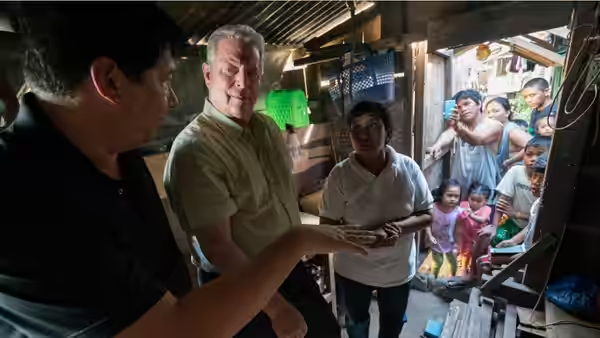
Eleven years after An Inconvenient Truth, Al Gore is still giving the slideshow. Jon Shenk and Bonni Cohen follow him for the best part of two years as he gives it, updates it and trains other people to give it, and the long middle of the film is the climate conference in Paris in December 2015. Davis Guggenheim’s 2006 film was a lecture with a man standing in front of it. This one is a portrait of the man, with the lecture moved to the background.
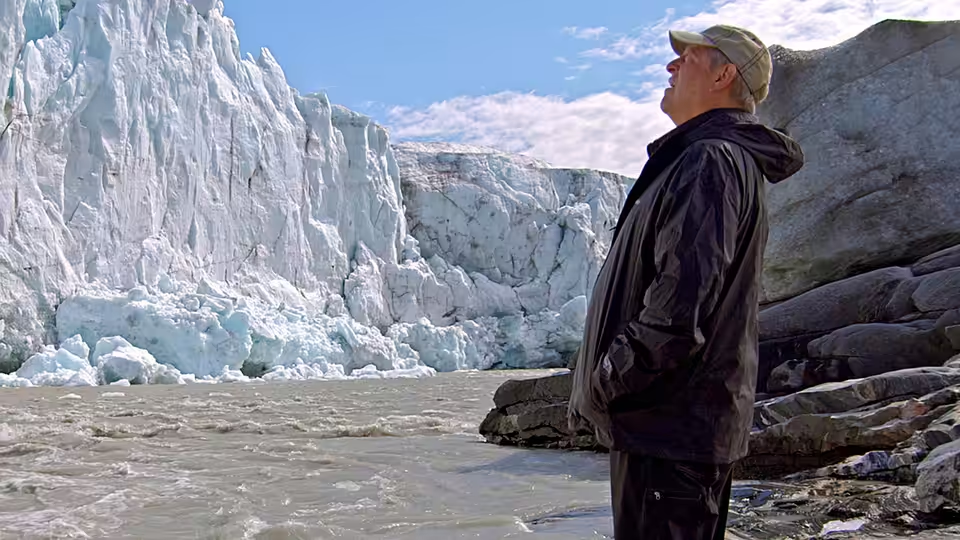
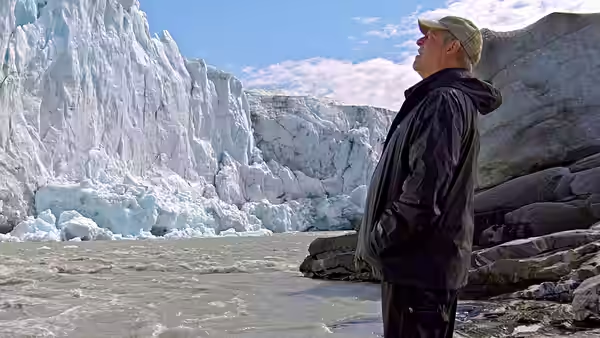
Shenk, who also shoots it, has a good eye for the size of things. In Greenland he puts Gore beside a channel of meltwater the width of a road, running fast and grey towards a hole in the ice, and holds the shot long enough for the roar to do the talking. In Miami Beach he follows Gore in waders along a residential street under a foot of seawater on a cloudless afternoon. The Greenland sequence frightened us in a way the graphs of 2006 never did, because there was nothing to interpret. That was the ice, and it was going.
Paris is the best-made stretch. Gore arrives in a city still raw from the attacks of 13 November, and the film settles into the side rooms where the deal is being argued. India’s energy minister tells him, reasonably, that his country will burn the coal the West burned unless someone offers it something cheaper. Gore gets on the phone to an American solar company and tries to arrange exactly that. Don Bernier and Colin Nusbaum cut these days as a thriller, calls and corridors and a man checking his watch, and for twenty minutes Gore is doing something rather than explaining it, which suits him. We doubt the agreement turned on one man’s phone calls as neatly as the film implies, and the film leaves no room for the doubt.
The trouble is the admiration. The film cannot pass a ballroom without cutting to the audience on its feet. It replays the 2006 prediction that the sea would one day reach the World Trade Center site, then shows the water doing it during Hurricane Sandy, and lets Gore stand there being right. He was right. We did not need telling three times. Jeff Beal’s score puts strings under every speech and a swell under every sunrise, so that when the pictures have already done the job the music does it again, louder. By the hour mark the structure has settled into a loop, disaster then ballroom then disaster then ballroom, and our attention drifted to the hotel carpets.
The scene that should have been the heart of it is nearly thrown away. Georgetown, Texas, a Republican town with a Republican mayor, has moved to wind and solar power because it worked out cheaper, and the mayor says so plainly. It is the one moment in 100 minutes where the case is made by someone who did not need Al Gore to make it. Shenk and Cohen treat him as a lovable curiosity, the conservative who came round, and the film is faintly amused by the audience it most needs to reach.
Then the election happens. The film was shot and cut before the 2016 presidential election, and the material added afterwards turns a victory lap into a plea. Donald Trump appears in archive footage, Gore is seen on his way into Trump Tower for a meeting, and the optimism of the first ninety minutes has nowhere to go. It is a hurried ending, and it leaves the Paris section looking older than it is.
Guggenheim’s film was a lecture you could take notes from. This one is a man you watch getting tired. Gore is a good subject, drier and funnier off the stage than on it, and the moments where the camera catches him slumped in an airport lounge say more about the cost of this work than any speech does. There are not enough of them. If you want to watch somebody keep making the case after a decade of being ignored, this is the one, and at 100 minutes and a PG it is a shorter evening than it feels.