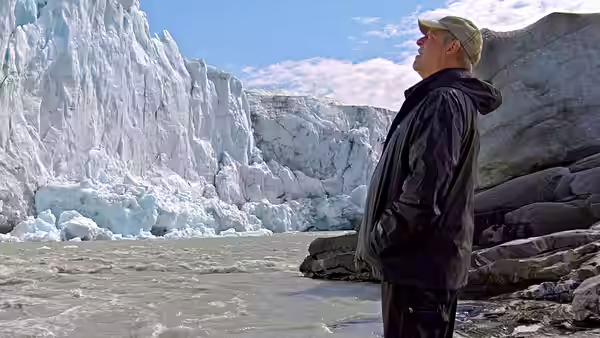
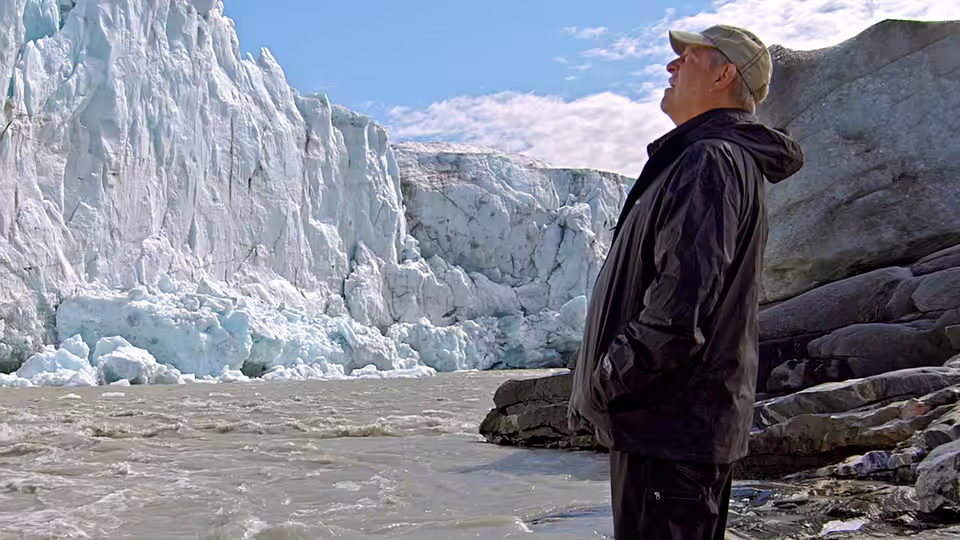
Al Gore stands beside a rocky shore, looking up at a towering glacier
Film review

An Inconvenient Sequel: Truth to Power

2017 · Directed by Jon Shenk, Bonni Cohen · 1h 40m

In a sentenceAl Gore wades through Miami Beach in rubber boots, and the film never quite stops admiring him for it

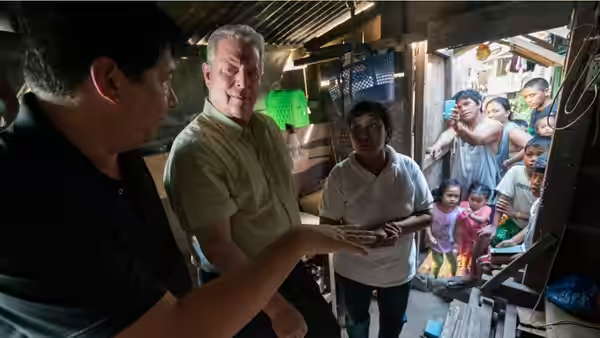
A decade after An Inconvenient Truth, former Vice-President Al Gore (himself) is still on the road with his climate slideshow. Jon Shenk and Bonni Cohen follow him to Greenland, where scientists show him meltwater pouring off the ice sheet, and to Miami Beach, where he wades along a street flooded by the sea on a clear afternoon. In hotel ballrooms he trains volunteers to give the presentation themselves. Barack Obama (archive footage) and Donald Trump (archive footage) mark the political ground shifting under him, and in the run-up to the climate conference in Paris in December 2015 he sets off to persuade the world’s delegations, India’s among them, to sign a deal.

Plays from YouTube when you press play; nothing loads from them until then.

Fi1m review

Jon Shenk and Bonni Cohen’s follow-up to the 2006 slideshow is better looking and more human, and its Paris section has real tension. But this is a film about Al Gore before it is one about the climate, and it admires him too much.

Eleven years after An Inconvenient Truth, Al Gore is still giving the slideshow. Jon Shenk and Bonni Cohen follow him for the best part of two years as he gives it, updates it and trains other people to give it, and the long middle of the film is the climate conference in Paris in December 2015. Davis Guggenheim’s 2006 film was a lecture with a man standing in front of it. This one is a portrait of the man, with the lecture moved to the background.

Shenk, who also shoots it, has a good eye for the size of things. In Greenland he puts Gore beside a channel of meltwater the width of a road, running fast and grey towards a hole in the ice, and holds the shot long enough for the roar to do the talking. In Miami Beach he follows Gore in waders along a residential street under a foot of seawater on a cloudless afternoon. The Greenland sequence frightened us in a way the graphs of 2006 never did, because there was nothing to interpret. That was the ice, and it was going.

Paris is the best-made stretch. Gore arrives in a city still raw from the attacks of 13 November, and the film settles into the side rooms where the deal is being argued. India’s energy minister tells him, reasonably, that his country will burn the coal the West burned unless someone offers it something cheaper. Gore gets on the phone to an American solar company and tries to arrange exactly that. Don Bernier and Colin Nusbaum cut these days as a thriller, calls and corridors and a man checking his watch, and for twenty minutes Gore is doing something rather than explaining it, which suits him. We doubt the agreement turned on one man’s phone calls as neatly as the film implies, and the film leaves no room for the doubt.

The trouble is the admiration. The film cannot pass a ballroom without cutting to the audience on its feet. It replays the 2006 prediction that the sea would one day reach the World Trade Center site, then shows the water doing it during Hurricane Sandy, and lets Gore stand there being right. He was right. We did not need telling three times. Jeff Beal’s score puts strings under every speech and a swell under every sunrise, so that when the pictures have already done the job the music does it again, louder. By the hour mark the structure has settled into a loop, disaster then ballroom then disaster then ballroom, and our attention drifted to the hotel carpets.

The scene that should have been the heart of it is nearly thrown away. Georgetown, Texas, a Republican town with a Republican mayor, has moved to wind and solar power because it worked out cheaper, and the mayor says so plainly. It is the one moment in 100 minutes where the case is made by someone who did not need Al Gore to make it. Shenk and Cohen treat him as a lovable curiosity, the conservative who came round, and the film is faintly amused by the audience it most needs to reach.

Then the election happens. The film was shot and cut before the 2016 presidential election, and the material added afterwards turns a victory lap into a plea. Donald Trump appears in archive footage, Gore is seen on his way into Trump Tower for a meeting, and the optimism of the first ninety minutes has nowhere to go. It is a hurried ending, and it leaves the Paris section looking older than it is.

Guggenheim’s film was a lecture you could take notes from. This one is a man you watch getting tired. Gore is a good subject, drier and funnier off the stage than on it, and the moments where the camera catches him slumped in an airport lounge say more about the cost of this work than any speech does. There are not enough of them. If you want to watch somebody keep making the case after a decade of being ignored, this is the one, and at 100 minutes and a PG it is a shorter evening than it feels.
Critical consensus AI synthesised

63
Positive
8
Mixed
13
Negative
3

Most critics find the sequel useful and well-timed, but few think it matches the first film. The reviews lean mildly positive, with the majority settled in the middle. Praise clusters on the Paris climate conference section, particularly Gore’s lobbying for India’s support, which several reviewers call the most dramatic stretch. The footage of floods and storms, and the visits to communities already living with the damage, are repeatedly cited as the film’s most forceful material, along with Gore’s weary, visible commitment.

The complaints cluster on Gore himself. Slant, The Ringer and The New Yorker argue the film spends so long admiring its subject that climate diplomacy and grassroots activists are crowded out, and The AV Club calls the tone close to hagiography. Others find it functional rather than cinematic, or feel its hopeful ending sits awkwardly after the American withdrawal from the Paris agreement. The spread is wide: the warmest notices come from the festival screenings, and the harshest find a film with too few new ideas.

Variety
19 January 2017 · festival review · Owen Gleiberman
90*

Gleiberman finds the sequel vital, impassioned, and newly urgent in the political climate. He praises its emotionally compelling portrait of Gore’s climate activism and the hopeful turn toward affordable renewable energy.

Read the full review →
Los Angeles Times
27 July 2017 · Kenneth Turan
76*

Turan finds the sequel involving and unexpectedly passionate, arguing that its message is more urgent than ever. He especially praises the scenes showing Gore’s efforts to secure India’s support for the Paris climate agreement.

Read the full review →
The Hollywood Reporter
19 January 2017 · festival review · THR Staff
72*

The critic finds the sequel fine and often hopeful, while noting it cannot match the original’s impact. They praise its vivid evidence of climate change and examples of renewable-energy progress, but fault its silence about Gore’s approach to Trump.

Read the full review →
Empire
9 August 2017 · Ian Freer
70*

Freer finds the sequel important and persuasive, though less urgent and gripping than its predecessor. He praises the Paris climate-conference section for its drama and Gore’s palpable commitment to change.

Read the full review →
Vulture
4 August 2017 · Emily Yoshida
65*

Yoshida finds the film fascinating as a character study, though its upbeat, pat conclusion feels inadequate to the political moment. She especially praises the unglamorous scenes of Gore negotiating and organizing climate action.

Read the full review →
Screen Daily
20 January 2017 · festival review · Anthony Kaufman
64*

The accessible page identifies this as a Sundance review, but the critic’s verdict is unavailable. The paywall shell reveals no specific element singled out for praise or criticism.

Read the full review →

Straight answers AI written, from our review

Is An Inconvenient Sequel: Truth to Power worth watching?
An Inconvenient Sequel: Truth to Power is a mixed recommendation at best, and we scored it 58. The Greenland meltwater and the Paris negotiations are well made and the former frightened us, but the film admires Al Gore too much and settles into a loop of disaster then standing ovation. Worth an evening if you want to watch him keep making the case; otherwise not.
How long is An Inconvenient Sequel: Truth to Power, and what is it rated?
An Inconvenient Sequel: Truth to Power runs 1h 40m. It is a documentary film.
Where can I watch An Inconvenient Sequel: Truth to Power in South Korea?
An Inconvenient Sequel: Truth to Power is available to rent from Apple TV from ₩2,000. Availability is checked daily; the links above go straight to each service.
How does An Inconvenient Sequel: Truth to Power compare to An Inconvenient Truth?
An Inconvenient Sequel: Truth to Power is a portrait of Al Gore, where An Inconvenient Truth is his climate lecture with the man standing beside it. The sequel is better shot and more human, and its Paris section has real tension, but the original is the clearer and more useful film. Start with the 2006 one if you want the argument; watch the sequel if you want the man.
What should I watch after An Inconvenient Sequel: Truth to Power?
After An Inconvenient Sequel: Truth to Power, try An Inconvenient Truth (2006, Fi1m 78): The original lecture, plainer and clearer, with the man standing beside his graphs. Then Honeyland (2019, Fi1m 82): One beekeeper in North Macedonia, and a quieter lesson about taking too much.

Cast

If you liked this, try…

  1. An Inconvenient Truth (2006, Fi1m 78)The original lecture, plainer and clearer, with the man standing beside his graphs.

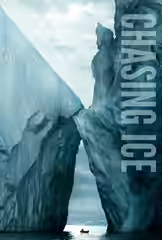
  2. Chasing Ice (2012) · not reviewed yetTime-lapse cameras watch glaciers go; the pictures make the argument without a presenter.

  3. The War Room (1993) · not reviewed yetAnother campaign seen from the corridors, with better jokes and far less at stake.

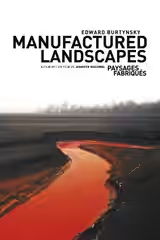
  4. Manufactured Landscapes (2006) · not reviewed yetEdward Burtynsky’s photographs of China’s factories and scrapyards, held long enough to hurt.

  5. Honeyland (2019, Fi1m 82)One beekeeper in North Macedonia, and a quieter lesson about taking too much.