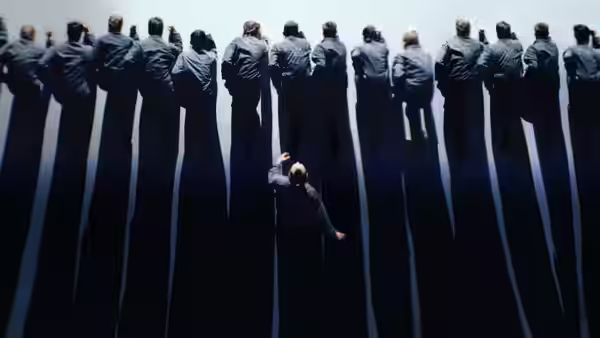
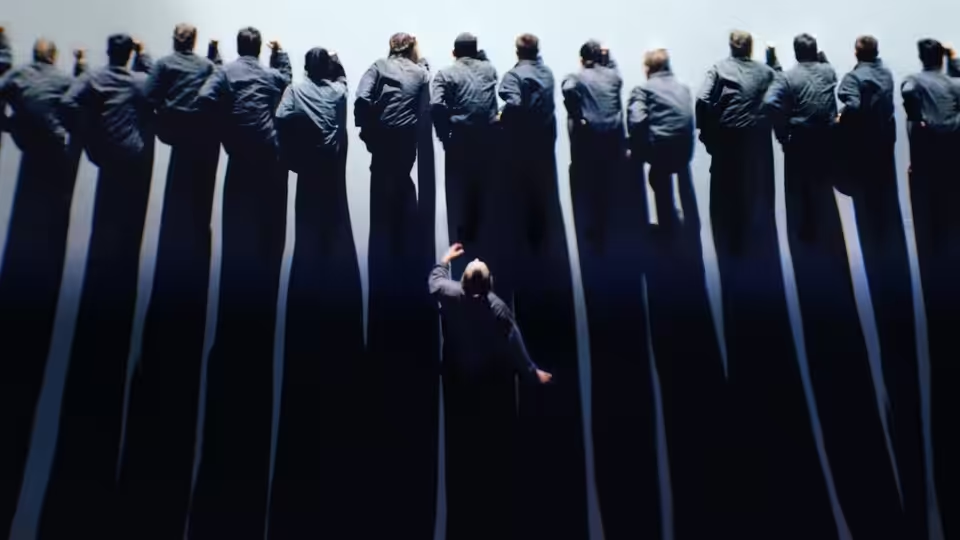
A man reaches toward a line of dancers standing above him against a dark backdrop
Film review

Anima

2019 · Directed by Paul Thomas Anderson · 15m

In a sentenceFifteen minutes of Thom Yorke being pushed around by concrete, commuters and gravity, all of it in time

An underground carriage carries a dozen commuters in dark coats, and all of them are falling asleep. Among them sits Thom Yorke, playing himself, in a cap, nodding with the rest. The sleep becomes movement: heads drop and jerk back in unison, shoulders twitch down the row (the dancers include Frida Dam Seidel, Joseba Yerro Izaguirre and Dorotea Saykaly). Across the aisle a woman (Dajana Roncione) catches his eye, gets off at the next stop and leaves a small case behind on the seat. Yorke picks it up and goes after her. He wants to return it; the station has other ideas, with turnstiles that will not let him through and a crowd that carries him the wrong way. There is no dialogue. Three songs from Yorke’s album of the same name run through the fifteen minutes.

Plays from YouTube when you press play; nothing loads from them until then.

Fi1m review

Paul Thomas Anderson sets three Thom Yorke songs to fifteen minutes of dance, and the opening carriage of twitching commuters is worth the quarter of an hour on its own. The middle leans too long on one idea; the ending earns its calm.

Paul Thomas Anderson calls Anima a one-reeler, and he means it: fifteen minutes, three songs from Thom Yorke’s album of the same name, no dialogue, and Yorke himself in a cap being shoved about by a city that has not noticed him. Anderson has made music videos before, for Radiohead among others, and this is longer than any of those and shorter than anything else he has put his name to. It wants to be a silent film with a modern score, and for most of its running time it is one. We would give it the quarter of an hour, and we would give it a proper screen.

The first song is the best thing in it. Darius Khondji lights the carriage so the fluorescent tubes drain every face to the same grey, and a dozen commuters in dark coats sit nodding off. Then the nodding becomes a dance: a head drops and jerks back, a shoulder twitches, and the twitch travels down the row of seats like a current through a wire. Andy Jurgensen cuts on the beat for the first few bars, then stops cutting and lets the carriage sway. We laughed at the first head-drop. We had stopped laughing by the fourth, because we recognised the posture from every early train we have ever taken, and it is not a comfortable thing to see from the outside.

Yorke is not a trained dancer and the film is built so that he does not need to be. He is the one body in the carriage that moves slightly out of time, and the choreography uses that: the ensemble, Frida Dam Seidel, Joseba Yerro Izaguirre, Dorotea Saykaly and the rest, are precise, and he is a man trying to keep up with his own sleep. When a woman across the aisle (Dajana Roncione) leaves her small case on the seat, he picks it up and follows her off the train, and the station turns on him. Turnstiles refuse him and a crowd presses him backwards against the barrier. He plays all this with the patience of a silent comedian, letting each thing happen to him and registering it half a second late.

The middle song is where the film dawdles. Petr Kunc’s production design gives Anderson a wide tilted plane of concrete, a plaza that leans like a ship’s deck, and the dancers slide down it on their backs while Yorke tries to walk up. It is the clearest idea in the film and also the one that lasts longest. By the third slide we were aware of how much of the song was left, which is not something you want to feel in a fifteen-minute film. The reviews so far have been mostly warm, with one dissent calling the film directionless. We think it has a direction, but this is the stretch where it loses its footing, and the dissent has a point here.

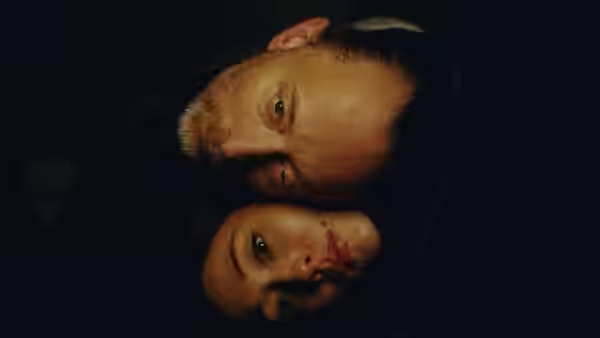
The last song puts it right. Night, a street of cobbles and shuttered shops, lamps throwing long shadows, and Roncione back in the frame. Khondji’s light softens for the first time, and the track opens up with it, the bass giving way to a slow wash of synthesiser; Nigel Godrich shares the music credit with Yorke, and this is the stretch where the record sounds most like a film score. What follows is a duet rather than a chase, and Anderson shoots it close enough that you can see Yorke concentrating on his feet. We will not say where the night ends. We will say that the final shot, which involves a tram and a change in the light, moved us more than fifteen minutes had any right to, and that it did so with Yorke’s face doing almost nothing.

Set against Anderson’s features, this is a small thing on purpose. The lonely man in a drab coat being buffeted by the world is a figure he has drawn before, most clearly in Punch-Drunk Love, and Anima is that film’s distant cousin: the same anxiety, the same late tenderness, a tenth of the length. The question with any film attached to an album is whether it stands without the record. This one does, mostly. You will follow what is happening without having heard a note beforehand, though you will probably want to hear the rest afterwards.

Watch it late, on the largest screen you own, with the sound up. It is fifteen minutes long. We have sat through trailers for longer, and enjoyed them less.
Critical consensus AI synthesised

75
Positive
5
Mixed
0
Negative
1
IndieWire
26 June 2019 · David Ehrlich
90*

Ehrlich praises ANIMA as a breathtaking, emotionally stirring dream ballet and a vivid expression of Thom Yorke’s music. He singles out its choreography and cinematography, especially the tender reunion sequence, for praise.

Read the full review →
RogerEbert.com
80*

The headline presents the film as mesmerizing, indicating a positive verdict. It singles out the collaboration between Paul Thomas Anderson and Thom Yorke for praise.

Read the full review →
The i Paper
26 June 2019 · ★★★★ · Joseph Walsh
80

Walsh finds the collaboration bizarre, beautiful and exhilarating, with an impact that outlasts its brief running time. He especially praises the mesmerizing dance sequences and Darius Khondji’s cinematography, which expands on Yorke’s lyrics.

Read the full review →
The Guardian
26 June 2019 · Peter Bradshaw
35*

Bradshaw finds the film visually bold but ultimately directionless, with an underwhelming dramatic payoff. He singles out Yorke’s fierce, propulsive music as its strongest element.

Read the full review →
Collider
26 March 2023 · Emma Shapera
90*

Shapera presents Anima as a deeply moving, heartfelt film despite its brief runtime. She especially praises how its three songs shape a feature-like emotional arc.

Read the full review →
Polygon
27 June 2019 · Karen Han
85*

Han finds Anima a stunning, successful companion to Yorke’s music and praises its dreamlike visual and musical collaboration. She singles out Yorke’s expressive physical performance, which evokes Buster Keaton and gives the film its emotional force.

Read the full review →

Straight answers AI written, from our review

Is Anima worth watching?
Anima is worth watching for anyone who can give fifteen minutes to a silent film with a Thom Yorke score, and we scored it 76. The opening carriage of nodding commuters is the best stretch; the middle song leans too long on one idea before the night-time ending puts it right. Watch it on the largest screen you have, with the sound up.
How long is Anima, and what is it rated?
Anima runs 15m. It is a music film.
Where can I watch Anima in the US?
Anima is streaming on Netflix in the US. Availability is checked daily; the links above go straight to each service.
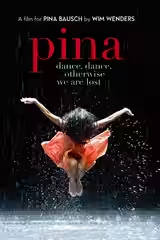
How does Anima compare to Pina?
Anima and Pina both take dance out of the theatre and into a city's streets and trams, but Pina is a feature-length record of Pina Bausch's company while Anima is a fifteen-minute piece built on three Thom Yorke songs. Pina is the richer film and the better one for anyone who cares about dance; Anima is the tighter and the easier to try without knowing anything first.
What should I watch after Anima?
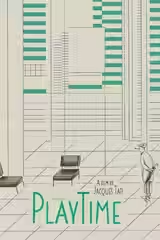
After Anima, try Pina (2011, Fi1m 80): Wenders films Bausch’s dancers in Wuppertal’s streets and trams; the city becomes the stage. Then Playtime (1967, Fi1m 88): Tati’s Paris of glass and grey suits, where the commute itself is the choreography; and The Red Shoes (1948, Fi1m 92): Powell and Pressburger’s ballet film, where the dance takes over the story for a reel.

Cast

If you liked this, try…

  1. Pina (2011, Fi1m 80)Wenders films Bausch’s dancers in Wuppertal’s streets and trams; the city becomes the stage.

  2. Playtime (1967, Fi1m 88)Tati’s Paris of glass and grey suits, where the commute itself is the choreography.

  3. The Red Shoes (1948, Fi1m 92)Powell and Pressburger’s ballet film, where the dance takes over the story for a reel.

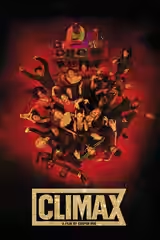
  4. Climax (2018, Fi1m 73)Noé’s dance troupe, a spiked punchbowl and one long night; the opening number is pure pleasure.

  5. Lemonade (2016) · not reviewed yetBeyoncé’s hour-long film to an album, the fullest recent case for music as cinema.