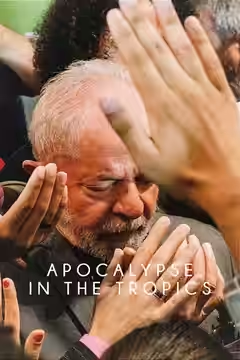
Petra Costa makes a gripping account of religion’s influence on Brazilian politics, helped by close access to public figures. We recommend it for that proximity, with reservations about how little it tells us about ordinary believers.
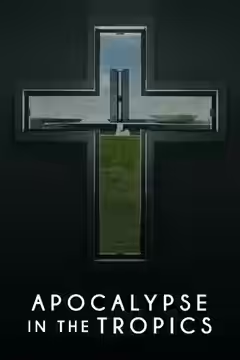
Apocalypse in the Tropics is a gripping political documentary that gives ordinary voters too little time. Petra Costa examines religious populism in Brazil through crowds, public performance and close access to political figures. We recommend it for the encounters she records, rather than as a full explanation of evangelical Christianity’s political appeal. The distinction matters increasingly as we watch: being allowed near the people who command attention does not necessarily bring us closer to understanding their followers.
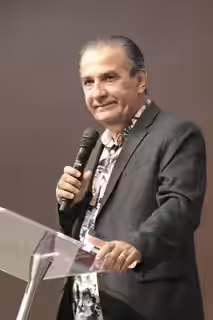
Pastor Silas Malafaia gives the director a subject who needs little assistance making an impression. His angry public manner and evident satisfaction in his own importance make him compelling to watch, even when his behaviour is exhausting. We found his anger frightening, because religious authority and personal grievance seem so closely entangled in his public appearances. The film shows why such a figure can command attention, though attention alone cannot explain why anyone comes to believe him.
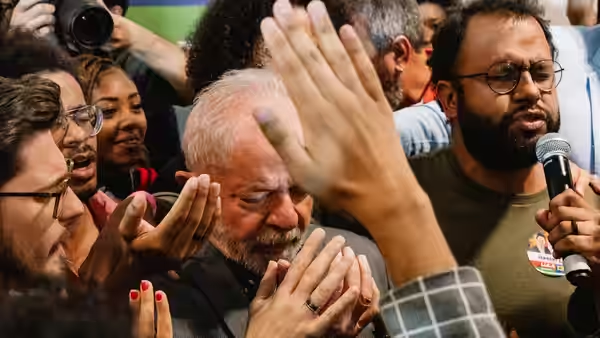
The cinematography is credited to Pedro Urano, João Atala, Ricardo Stuckert and Murilo Salazar, and the shifts in scale do useful work. Broad views of crowds establish the movement’s size; intimate political access gives individuals room to reveal themselves. We can register how many people are involved without losing sight of those seeking to direct them. These changes of distance keep a potentially remote subject immediate, although the crowd images cannot supply the understanding that individual conversations might have offered.
Editors David Barker, Victor Miaciro, Tina Baz, Nels Bangerter, Eduardo Gripa and Jordana Berg keep the movement between crowds and individuals clear. That clarity matters in a film combining political reporting with the director’s personal enquiry, and it helps sustain the tension without making the subject difficult to follow. Rodrigo Leão supplies the music, though its contribution feels secondary beside the public fury being recorded. The preacher can make us uneasy without much assistance.
The weakness is in the time and curiosity afforded to ordinary voters. The director’s distance from them leaves too much of the appeal of evangelical politics to be inferred from its most visible advocates. A crowd shows that a preacher has followers, but tells us little about what each follower thinks they are being offered. We wanted more people explaining their own convictions, and fewer occasions on which a prominent figure had to stand for everyone behind him.
As a political documentary, it is strongest when it allows a public personality to become uncomfortable company. The personal enquiry also gives us a way into the subject beyond merely identifying which politician stands where. That makes the film involving, even when we want it to pause and listen more carefully to people outside its privileged encounters. Give it an evening if politics is your subject, but do not take the loudest people here as the last word on belief.