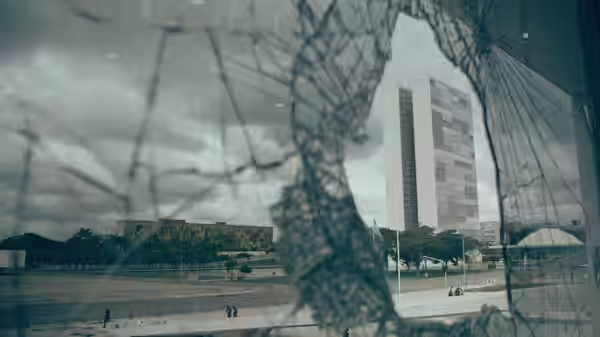
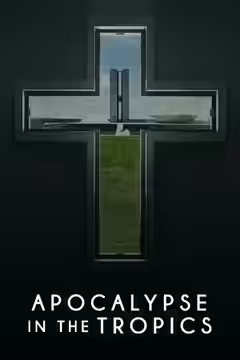
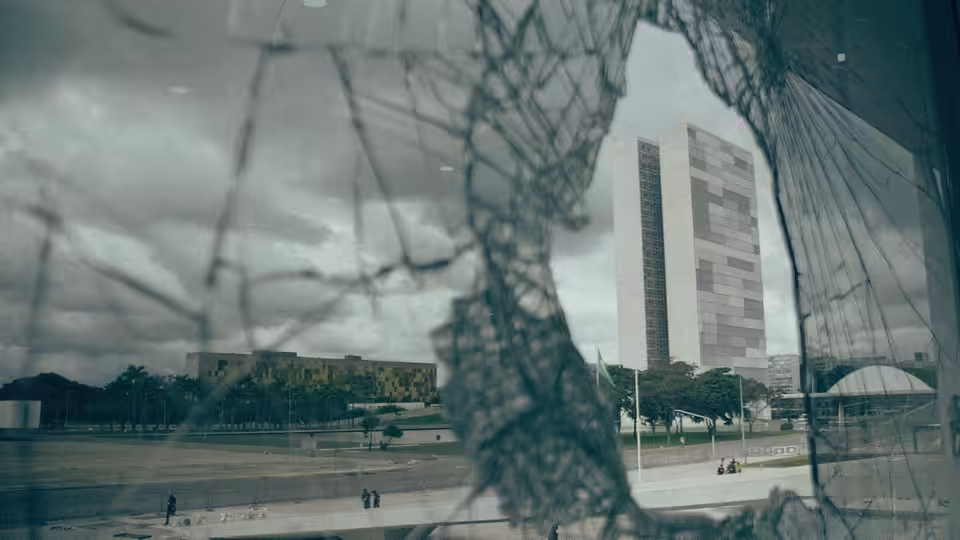
The National Congress buildings stand beyond cracked glass and a broad reflecting pool
Film review

Apocalypse in the Tropics

2025 · Directed by Petra Costa · 1h 49m

In a sentenceThe crowds are vast; we would still have liked to hear more from the people in them

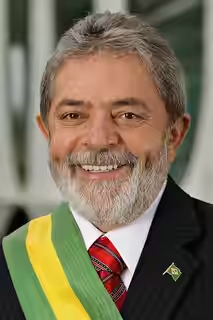
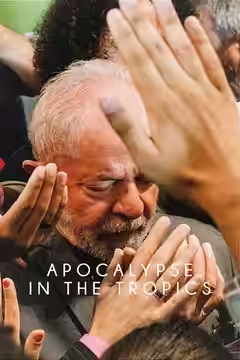
Filmmaker Petra Costa examines the influence of evangelical Christianity on politics in Brazil, following religious leaders and the public attention they command. Pastor Silas Malafaia is a central presence, with Jair Bolsonaro and Luiz Inácio Lula da Silva also appearing as themselves. She moves between crowds and close encounters with political figures as she asks how faith acquires political power. Her investigation brings personal enquiry into contact with the public behaviour of religious and political leaders. The focus is the relationship between belief, religious populism and a democracy under pressure.

Plays from YouTube when you press play; nothing loads from them until then.

Fi1m review

Petra Costa makes a gripping account of religion’s influence on Brazilian politics, helped by close access to public figures. We recommend it for that proximity, with reservations about how little it tells us about ordinary believers.

Apocalypse in the Tropics is a gripping political documentary that gives ordinary voters too little time. Petra Costa examines religious populism in Brazil through crowds, public performance and close access to political figures. We recommend it for the encounters she records, rather than as a full explanation of evangelical Christianity’s political appeal. The distinction matters increasingly as we watch: being allowed near the people who command attention does not necessarily bring us closer to understanding their followers.

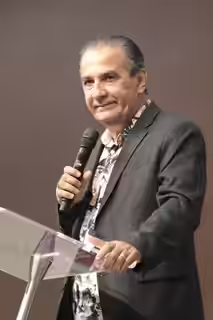
Pastor Silas Malafaia gives the director a subject who needs little assistance making an impression. His angry public manner and evident satisfaction in his own importance make him compelling to watch, even when his behaviour is exhausting. We found his anger frightening, because religious authority and personal grievance seem so closely entangled in his public appearances. The film shows why such a figure can command attention, though attention alone cannot explain why anyone comes to believe him.

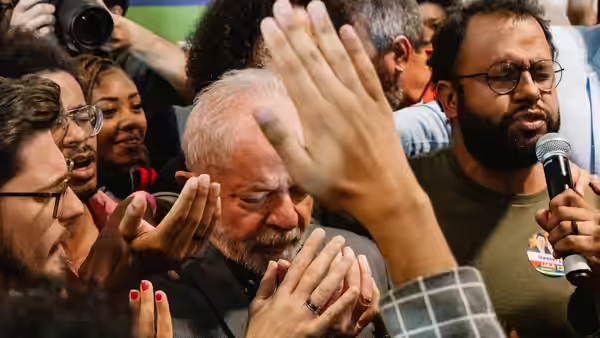
The cinematography is credited to Pedro Urano, João Atala, Ricardo Stuckert and Murilo Salazar, and the shifts in scale do useful work. Broad views of crowds establish the movement’s size; intimate political access gives individuals room to reveal themselves. We can register how many people are involved without losing sight of those seeking to direct them. These changes of distance keep a potentially remote subject immediate, although the crowd images cannot supply the understanding that individual conversations might have offered.

Editors David Barker, Victor Miaciro, Tina Baz, Nels Bangerter, Eduardo Gripa and Jordana Berg keep the movement between crowds and individuals clear. That clarity matters in a film combining political reporting with the director’s personal enquiry, and it helps sustain the tension without making the subject difficult to follow. Rodrigo Leão supplies the music, though its contribution feels secondary beside the public fury being recorded. The preacher can make us uneasy without much assistance.

The weakness is in the time and curiosity afforded to ordinary voters. The director’s distance from them leaves too much of the appeal of evangelical politics to be inferred from its most visible advocates. A crowd shows that a preacher has followers, but tells us little about what each follower thinks they are being offered. We wanted more people explaining their own convictions, and fewer occasions on which a prominent figure had to stand for everyone behind him.

As a political documentary, it is strongest when it allows a public personality to become uncomfortable company. The personal enquiry also gives us a way into the subject beyond merely identifying which politician stands where. That makes the film involving, even when we want it to pause and listen more carefully to people outside its privileged encounters. Give it an evening if politics is your subject, but do not take the loudest people here as the last word on belief.
Critical consensus AI synthesised

69
Positive
3
Mixed
3
Negative
0

The available verdicts lean favourable towards Apocalypse in the Tropics, with praise clustering around Costa’s filmmaking and access to political figures. Critics describe an engaging, often troubling account of religion’s influence on Brazilian politics, particularly the pressure that rightwing Christian fundamentalism places on democracy. The strongest notices praise the movement between crowd imagery and intimate political encounters, alongside Costa’s balance of personal exploration, cultural portrait and political thriller.

The main disagreement concerns how much that access explains. IndieWire admires the imagery and finds the documentary engaging, but considers its analysis superficial and faults its distance from ordinary voters. That reservation contrasts with the richer, more layered account described by the film’s supporters: the available assessments range from enthusiastic to mixed, rather than hostile. Two of the six listed reviews have no accessible verdict, limiting how firmly the wider consensus can be described.

The Hollywood Reporter
29 August 2024 · festival review · Jordan Mintzer
80*

Mintzer finds the documentary riveting and a must-see for those interested in politics and religion. He praises Costa’s shifts between sweeping crowd imagery and intimate political access.

Read the full review →
The Guardian
9 July 2025 · Peter Bradshaw
75*

Bradshaw finds the documentary a chilling warning about Brazilian democracy’s vulnerability to rightwing Christian fundamentalism. He singles out Pastor Silas Malafaia’s angry, self-aggrandising public persona as a vivid example of the movement’s influence.

Read the full review →
Vulture
11 July 2025 · Bilge Ebiri
70*

Ebiri finds the documentary gripping and richly layered, while warning that its account of religion’s political power leaves Brazil’s future troubling and uncertain. He praises Costa’s filmmaking and her balance of personal exploration, cultural portrait, and political thriller.

Read the full review →
Screen Daily
29 August 2024 · festival review · Jonathan Romney
64*

The accessible page gives no verdict because the review is behind a paywall. Its standfirst identifies the film’s focus as religious populism in Brazilian politics.

Read the full review →
IndieWire
29 August 2024 · C · Guilherme Jacobs
57

Jacobs finds the documentary engaging but ultimately superficial in its analysis of evangelical Christianity and Brazilian politics. He praises its striking imagery and access to political figures, while faulting its distance from ordinary voters.

Read the full review →
The Playlist
31 August 2024 · festival review
64*

The page is identified as a review, but its text is blocked, so the critic’s verdict cannot be established. The accessible page provides no specific praise or complaint.

Read the full review →

Straight answers AI written, from our review

Is Apocalypse in the Tropics worth watching?
Apocalypse in the Tropics is worth watching if political documentaries are your subject; we score it 73 for its gripping access to religious and political leaders in Brazil. We recommend it for those close encounters, but it gives ordinary believers too little time to explain their convictions and leaves important questions about evangelical politics unanswered.
How long is Apocalypse in the Tropics, and what is it rated?
Apocalypse in the Tropics runs 1h 49m. It is a documentary film.
Where can I watch Apocalypse in the Tropics in Greece?
Apocalypse in the Tropics is streaming on Netflix in Greece. Availability is checked daily; the links above go straight to each service.
How violent or frightening is Apocalypse in the Tropics, and is it suitable for children?
Apocalypse in the Tropics carries a UK 12A certificate, and its angry religious rhetoric can be frightening. We found Pastor Silas Malafaia’s public anger disturbing because religious authority and personal grievance seem closely entangled. The certificate allows children under 12 with an adult, but we would steer this political documentary towards older teenagers interested in the subject.
How does Apocalypse in the Tropics compare to Collective?
Apocalypse in the Tropics offers unsettling proximity to religious and political leaders, while Collective is our stronger recommendation for a clear investigation into public accountability. Both use access to officials effectively, though Collective loses some grip when it changes protagonist. We recommend Costa’s film specifically for its examination of faith and political power, with reservations about how little ordinary believers are heard.
What should I watch after Apocalypse in the Tropics?
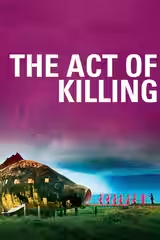
After Apocalypse in the Tropics, try Collective (2019, Fi1m 88): Another documentary where access to officials exposes the limits of public accountability. Then The Act of Killing (2012, Fi1m 88): Powerful men reveal themselves on camera, with far more disturbing results.

Cast

If you liked this, try…

  1. The Edge of Democracy (2019) · not reviewed yetAnother personal route through Brazilian politics, with democratic institutions under strain.

  2. Jesus Camp (2006) · not reviewed yetFor a closer look at belief being taught, practised and politicised.

  3. A Grin Without a Cat (1977) · not reviewed yetPolitical movements and their disappointments, examined across several countries and decades.

  4. Collective (2019, Fi1m 88)Another documentary where access to officials exposes the limits of public accountability.

  5. The Act of Killing (2012, Fi1m 88)Powerful men reveal themselves on camera, with far more disturbing results.