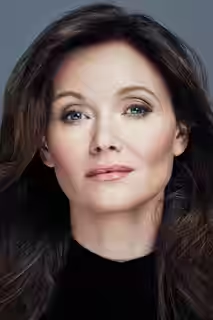
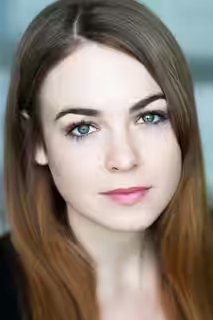
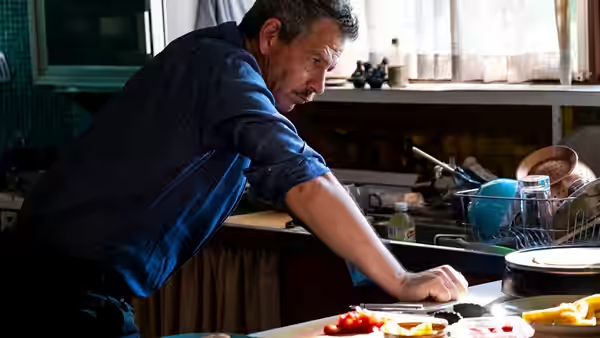
Milla (Eliza Scanlen) sits beside a swimming pool, looking upward
Film review

Babyteeth

2020 · Directed by Shannon Murphy · 1h 58m

In a sentenceCancer does not make a teenager’s taste in boyfriends any easier to discuss over dinner

Milla (Eliza Scanlen), a teenager with cancer, wants to experience first love. She becomes involved with Moses (Toby Wallace), an older drug dealer whose presence gives the people around her another reason to worry. Anna (Essie Davis) and Henry (Ben Mendelsohn) must deal with Milla’s determination to pursue the relationship and the risks that come with it. A dinner brings the discomfort into the open, with affection and anxiety making ordinary conversation difficult. Milla wants room to make choices of her own, while those close to her struggle to decide how much freedom they can allow.

Plays from YouTube when you press play; nothing loads from them until then.

Fi1m review

Shannon Murphy makes a moving, darkly funny drama from young love and serious illness, with Eliza Scanlen refusing every invitation to look saintly. The decorative flourishes sometimes get in her way; the performances are worth staying for.

Babyteeth has a difficult job: making a teenager’s hunger for experience matter when cancer threatens to dominate every conversation about her. Shannon Murphy gives Milla room to be impatient, attracted to trouble and difficult to protect. The film is funny enough to make its darker moments hurt, and we recommend it despite an occasional fondness for showing how unusual it can be. Moses is an older drug dealer, so the adults’ concerns are reasonable. That makes Milla’s attachment awkward in ways that a straightforward story of forbidden love would avoid.

Eliza Scanlen makes that attachment convincing without asking us to approve of every choice. Milla can be selfish, impatient and frightened, and the performance does not tidy those feelings into a sequence of lessons learned. Toby Wallace gives Moses enough tenderness to explain the attraction without making his presence feel safe. Their scenes have the uncertainty of two people working out what they want from each other, which makes the romance persuasive even when we worry about it.

The family scenes give Essie Davis and Ben Mendelsohn room to be frightened and ridiculous at once. We laughed at the dinner scene, then felt uncomfortable about laughing. Rita Kalnejais puts the characters’ awkward attempts to manage one another beside the fear nobody can quite manage, and the actors keep both visible. The meal works because their affection does not make them any less embarrassing, or much better at knowing what to say.

Andrew Commis moves between daylight, shadow and neon to keep the photography responsive to Milla’s experience. Brightness is allowed even when the subject is grim, which saves the film from looking as though everyone has agreed to be miserable in advance. Sherree Phillips’s production design helps sustain that bright palette, but the pastel prettiness sometimes feels too carefully arranged around the distress. We could do with less of that insistence on colour once the performances have made the household’s unease plain.

Amanda Brown’s music belongs to a soundtrack willing to change mood rather abruptly, and the children’s choir is an especially effective choice. It allows innocence into the film without making Milla behave innocently. The dancing is less consistently useful: repetition begins to turn her pleasure into something underlined for us. Stephen Evans’s editing leaves too many of these passages in place, when we already understand her determination to enjoy herself.

Teenage illness dramas can make the young person so admirable that there is little left for an actor to do. Babyteeth avoids that trap whenever it trusts Eliza Scanlen to be wilful, needy or simply interested in Moses. She makes the prospect of being protected from every mistake feel stifling, even when the protection comes from love. Watch it for her, with some patience for a director who occasionally decorates a scene that was already doing its job.

Critical consensus AI synthesised

76
Positive
20
Mixed
6
Negative
0

Most critics find Babyteeth moving and refreshingly unsentimental, with praise centred on Eliza Scanlen’s vivid, resilient performance and the cast’s handling of complicated family relationships. The reviews repeatedly credit Shannon Murphy with balancing dark humour, first love and serious illness without reducing Milla to her diagnosis. There is also appreciation for the lively visual style and eclectic soundtrack, though the performances draw the most consistent approval across a broadly positive reception.

Reservations concern overworked quirks, repetition and passages that feel twee or meandering; enthusiasm ranges from wholehearted praise to qualified approval, with no outright negative verdicts. The Hollywood Reporter finds the early comedy strained but considers the conclusion affecting, while The AV Club admires the dark humour yet finds the ending sentimental. That disagreement captures the main divide: most critics feel the film earns its emotional force, but some find its stylistic flourishes or more insistent moments distracting.

The Guardian
16 August 2020 · ★★★★★ · Wendy Ide
100

Ide calls the film joyous and life-affirming, praising its fearless, lively filmmaking. She especially singles out the eclectic soundtrack and its unexpectedly apt use of a children’s choir.

Read the full review →
Variety
4 September 2019 · festival review · Guy Lodge
86*

Lodge finds the film an arresting, intensely moving coming-of-age drama that builds to a powerful final act. He especially praises the quartet of performances, singling out Eliza Scanlen and Toby Wallace’s finely attuned work.

Read the full review →
Sight and Sound
7 September 2019
85*

The critic finds the film a compelling, unsentimental portrait of first love amid suffering. They especially praise its nuanced performances and its deft balance of humour and tragedy.

Read the full review →
The i Paper
13 August 2020 · Joseph Walsh
85*

Walsh finds the film tonally rich and moving, praising its refusal of sentimental clichés. He especially singles out the dinner scene for its balance of squeamish humour and emotional tension.

Read the full review →
IndieWire
4 September 2019 · B+ · David Ehrlich
83

Ehrlich praises the film as an honest, moving drama that balances hope and despair without becoming mawkish. He singles out Eliza Scanlen’s feral, resilient performance and the cast’s ability to make the characters’ vulnerability feel raw.

Read the full review →
Empire
10 August 2020 · Christina Newland
80*

Newland finds the film deeply moving and refreshing, though it sometimes veers into twee or overemphasised moments. She especially praises the powerful performances and the nuanced family relationships.

Read the full review →

Straight answers AI written, from our review

Is Babyteeth worth watching?
Babyteeth is worth watching for its moving, darkly funny treatment of teenage love and serious illness, and we score it 82. We recommend it especially for Eliza Scanlen’s wilful, unsaintly Milla and the awkward family scenes, though the decorative colour and repeated dancing sometimes distract from performances that need little assistance.
How long is Babyteeth, and what is it rated?
Babyteeth runs 1h 58m. It is a drama and comedy film.
Where can I watch Babyteeth in the Philippines?
Babyteeth is not on any streaming or rental service in the Philippines at the moment. It is available in 16 other countries; change your country at the top of the page to see where. Availability is checked daily.
How violent or frightening is Babyteeth, and is it suitable for children?
Babyteeth has a UK 15 certificate and is not suitable for children under 15. Its teenager’s cancer, relationship with an older drug dealer and frightened family make it emotionally difficult material, even with the dark humour. We would approach it cautiously if serious illness is a sensitive subject; the certificate alone does not establish how violent or frightening individual scenes are.
How does Babyteeth compare to Fish Tank?
Babyteeth is the warmer, more openly comic choice beside Fish Tank, though both follow headstrong teenagers whose desire for freedom troubles the adults around them. We favour Babyteeth for awkward family humour and a persuasive romance under the pressure of illness; Fish Tank better suits an appetite for tense encounters and dance scenes that work more consistently.
What should I watch after Babyteeth?
After Babyteeth, try Fish Tank (2009, Fi1m 85): Another headstrong teenager whose wish for freedom makes the adults around her uncomfortable. Then Harold and Maude (1971, Fi1m 81): An unlikely romance with morbid humour and a stubborn appetite for living.

Cast

Awards

AACTA Award for Best Actor in a Leading Role, 2020

Won
AACTA Award for Best Actor in a Leading Role

AACTA Award for Best Actor in a Supporting Role, 2020

Won
AACTA Award for Best Actor in a Supporting Role

AACTA Award for Best Actress in a Leading Role, 2020

Won
AACTA Award for Best Actress in a Leading Role

AACTA Award for Best Actress in a Supporting Role, 2020

Won
AACTA Award for Best Actress in a Supporting Role

AACTA Award for Best Cinematography, 2020

Nominated
AACTA Award for Best Cinematography

AACTA Award for Best Direction, 2020

Won
AACTA Award for Best Direction

AACTA Award for Best Editing, 2020

Nominated
AACTA Award for Best Editing

AACTA Award for Best Film, 2020

Won
AACTA Award for Best Film

AACTA Award for Best Original Music Score, 2020

Won
AACTA Award for Best Original Music Score

AACTA Award for Best Production Design, 2020

Nominated
AACTA Award for Best Production Design

AACTA Award for Best Sound, 2020

Nominated
AACTA Award for Best Sound

Australian Film Institute Award for Best Screenplay, 2020

Won
Australian Film Institute Award for Best Screenplay

If you liked this, try…

  1. Fish Tank (2009, Fi1m 85)Another headstrong teenager whose wish for freedom makes the adults around her uncomfortable.

  2. Harold and Maude (1971, Fi1m 81)An unlikely romance with morbid humour and a stubborn appetite for living.

  3. Girlhood (2014) · not reviewed yetFor the pleasures and risks of deciding who to become among other people.

  4. A Swedish Love Story (1970) · not reviewed yetFirst love observed closely, with adults who have troubles of their own.

  5. Our Little Sister (2015) · not reviewed yetA quieter family drama that makes affection visible through ordinary shared routines.