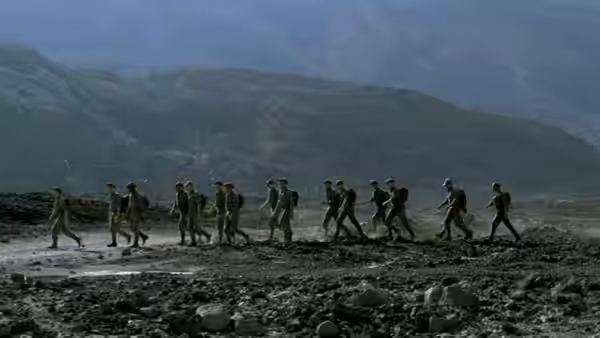
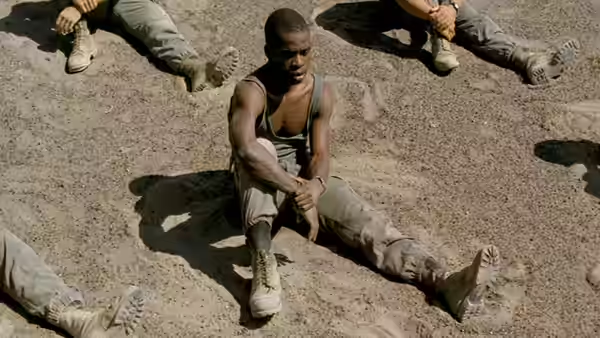
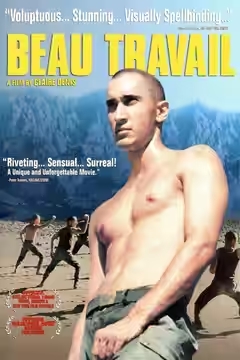
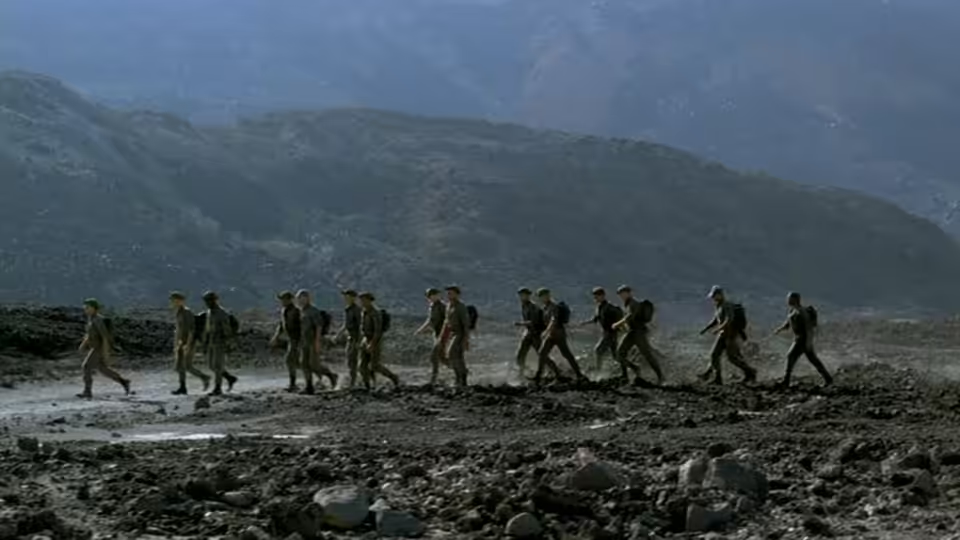
French Foreign Legionnaires march across a rocky landscape beneath distant mountains
Film review

Beau Travail

2000 · Directed by Claire Denis · 1h 33m

In a sentenceAll that military discipline, and still the men cannot stop looking at one another

Galoup (Denis Lavant) belongs to a group of legionnaires whose days are shaped by military exercises. Commander Bruno Forestier (Michel Subor) and Gilles Sentain (Grégoire Colin) are the other men at the centre of his attention. Drills bring the soldiers’ bodies into step, while glances and gestures suggest feelings that their shared routine leaves unspoken. Galoup tries to maintain his composure within this disciplined company, where the bonds between men involve attraction as well as rivalry. There is little talk to explain what passes between them as the exercises continue.

Plays from YouTube when you press play; nothing loads from them until then.

Fi1m review

Claire Denis makes a compelling military drama out of drills, glances and things left unsaid. Denis Lavant is quietly distressing to watch, though the slow, spare storytelling sometimes holds us too far away.

Beau Travail is a demanding, affecting military drama, and we recommend it with one warning: it is much more interested in the men’s physical routines than in keeping the story moving. The legionnaires drill, repeat movements and submit themselves to the group. Claire Denis gives these exercises enough attention for us to start noticing the strain beneath their orderliness. What looks at first like professional discipline becomes uncomfortable to watch.

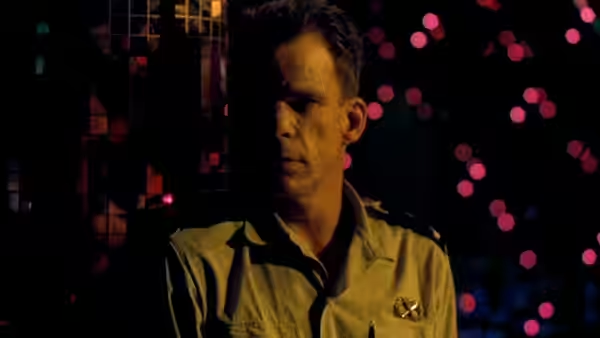
Denis Lavant gives Galoup a composure that seems to require constant effort, and that effort is the performance’s most affecting feature. Alongside Michel Subor’s Commander Bruno Forestier and Grégoire Colin’s Gilles Sentain, he makes us attentive to who is watching whom, and who can appear at ease. There is little dialogue to tidy these relationships into clear statements of allegiance or desire. We have to read the men through the way they carry themselves, which usually tells us enough.

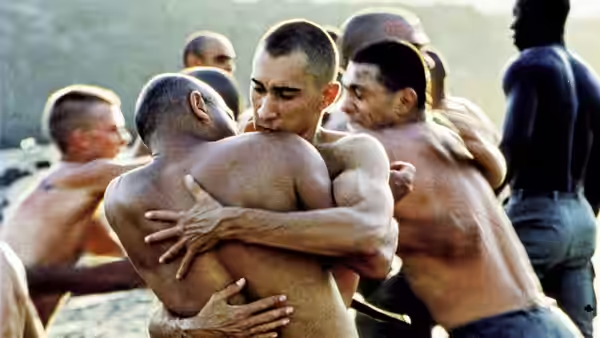
Agnès Godard photographs the drills with a concentration that makes it difficult to look casually at any of the men. The clear colour and emphasis on physical exertion encourage us to appreciate how precisely they move together. Arnaud de Moléron’s production design stays secondary to those arrangements of bodies, which is right for a film so concerned with men watching other men. The images allow pleasure in these bodies without letting us forget how insistently they are being trained.

We felt uneasy watching the drills, because the men move so well together that their obedience starts to look frightening. It is possible to enjoy the precision and dislike what it seems to demand from them. The film allows both responses, and its sympathy for Galoup stops the men becoming illustrations in a lecture about military life. His difficulty in remaining composed is something we can recognise without needing him to explain it.

Nelly Quettier’s editing builds relationships by placing gestures beside one another, leaving us to work out their significance. That gives the physical sequences their accumulating tension, although the same method can make the quieter passages feel remote. The music credited to Eran Zur and Charles Henri de Pierrefeu deepens our unease around the apparently controlled exercises. The combination works because sound and movement keep directing our attention towards men whose feelings are difficult to read, even when their bodies are being watched so closely.

There are limits to this approach, and the film sometimes reaches them. The screenplay by Claire Denis and Jean-Pol Fargeau leaves so much to posture and suggestion that we occasionally struggle to understand how one man feels about another. We wanted a little more of the men beyond their physical presence, particularly when the slow pace allows plenty of time to consider what has been left out. The film’s sympathy for Galoup helps, but does not entirely remove that distance.

At 93 minutes, it can still feel slow; that is worth knowing before settling down. The reward is a performance we keep trying to read, and images that make routine behaviour increasingly troubling. This is a strong recommendation for an evening with few distractions. Do not choose it because a military setting promises a brisk chain of events.
Critical consensus AI synthesised

77
Positive
7
Mixed
3
Negative
0

Most critics respond warmly to Beau Travail, with praise clustering around Denis’s visual storytelling and Agnès Godard’s cinematography. The military drills and ritualised movements are central to that response: the reviews find tension, desire and dehumanisation in the soldiers’ physical routines. Several critics value the way gesture and juxtaposition carry emotion with little dialogue, while Denis Lavant’s shifts from composure to frustration receive particular praise. The film’s elusive storytelling is generally treated as a strength.

Reservations concern how much those images offer viewers seeking plot or more direct emotional expression. Variety admires the photography and choreography but sees the slow pace and restraint as barriers to wider appeal. The Evening Standard is more doubtful, finding an aestheticised life-class with little story beneath its ballet-like treatment of the legionnaires. The available verdicts therefore range from strong admiration to qualified scepticism, though two inaccessible reviews limit any fuller account of the dissent.

Slant Magazine
2 May 2001 · ★★★★/4 · Ed Gonzalez
100

Gonzalez sees the film as a potent allegory of military dehumanization, while remaining sympathetic to Galoup. He praises Denis and cinematographer Agnès Godard for rendering the men’s relationship as an intensely physical, existential struggle.

Read the full review →
Sight and Sound
· Simran Hans
90*

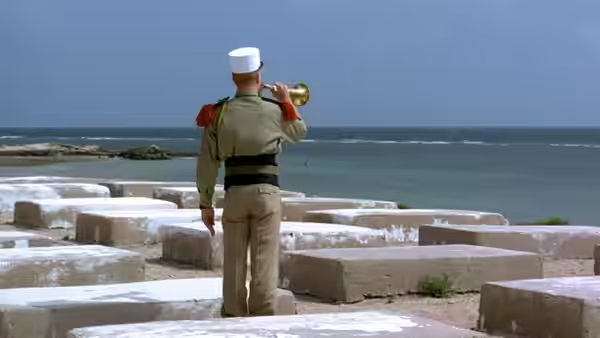
Hans presents the film as an enduring, emotionally resonant work. She especially praises Denis’s ability to evoke feeling through gesture and juxtaposition, culminating in the final scene.

Read the full review →
Los Angeles Times
2 June 2000 · Kevin Thomas
85*

Thomas gives the film a strongly positive verdict, calling it Denis’ most stylized and venturesome work to date. He praises its sensual imagery and ritualized performances for exposing the hollowness beneath the legionnaires’ furious activity.

Read the full review →
The AV Club
29 March 2002 · Scott Tobias
85*

Tobias calls the film a major achievement, finding that its elusive, mood-driven approach ultimately succeeds. He especially praises Denis’s mastery of sight and sound, including the hauntingly beautiful military drills and the film’s provocative ending.

Read the full review →
The Guardian
16 July 2000 · Philip French
85*

French finds the film riveting, praising its lyrical imagery and layered reworking of Billy Budd. He especially singles out the camera’s loving attention to the legionnaires and the film’s exploration of homoerotic camaraderie.

Read the full review →
Empire
1 January 2000 · Clark Collis
75*

Collis recommends the film, finding its result worthwhile despite its sparse dialogue. He singles out Denis Lavant’s performance, especially its shifts from rugged calm to explosive frustration and disco dancing.

Read the full review →

Straight answers AI written, from our review

Is Beau Travail worth watching?
Beau Travail is worth watching for its quietly distressing central performance and the tension Claire Denis finds in military routines; we score it 86. We recommend it to viewers comfortable reading feelings through glances and gestures, with the warning that its slow, spare storytelling sometimes keeps the men too far away.
How long is Beau Travail, and what is it rated?
Beau Travail runs 1h 33m. It is a drama film.
Where can I watch Beau Travail in Panama?
Beau Travail is not on any streaming or rental service in Panama at the moment. It is available in 6 other countries; change your country at the top of the page to see where. Availability is checked daily.
How violent or frightening is Beau Travail, and is it suitable for children?
Beau Travail carries a UK 15 certificate and is not suitable for children under 15. We find its military drills unsettling because the men’s precise obedience begins to look frightening; attraction and rivalry also shape their relationships. Expect psychological unease, though the certificate alone does not establish how graphic any violence is.
How does Beau Travail compare to Happy Together?
Beau Travail offers a more physically focused study of male desire and resentment than the painful, repeatedly renewed romance of Happy Together. We favour Beau Travail for the tension built through drills and glances, and Happy Together for its more directly expressed relationship struggles. Both demand patience: the former can feel remote, while the latter’s fractured storytelling sometimes repeats itself.
Is Beau Travail based on a true story or a book?
Beau Travail is based on a novel by Herman Melville, rather than a true story. We would approach it without requiring knowledge of the source: the film establishes attraction, rivalry and strained composure through the legionnaires’ movements and glances, although its sparse dialogue can leave the precise feelings between them difficult to read.

Cast

Awards

César Award for Best Cinematography, 2001

Won
César Award for Best Cinematography

Chlotrudis Award for Best Cinematography, 2001

Won
Chlotrudis Award for Best Cinematography

European Film Award for Best Cinematographer, 2000

Nominated
European Film Award for Best Cinematographer

National Society of Film Critics Award for Best Cinematography, 2000

Won
National Society of Film Critics Award for Best Cinematography

If you liked this, try…

  1. Merry Christmas, Mr. Lawrence (1983) · not on Fi1m yetMilitary authority and unspoken attraction make every encounter feel dangerously exposed.

  2. The Red and the White (1967) · not on Fi1m yetBodies move through military formations that offer little protection from arbitrary power.

  3. Happy Together (1997, Fi1m 86)Men struggle with desire and resentment when words offer little help.

  4. The Fits (2015) · not on Fi1m yetGroup discipline and physical movement make belonging feel both desirable and frightening.

  5. The Loneliness of the Long Distance Runner (1962) · not on Fi1m yetRunning gives a young man space to question the discipline imposed on him.