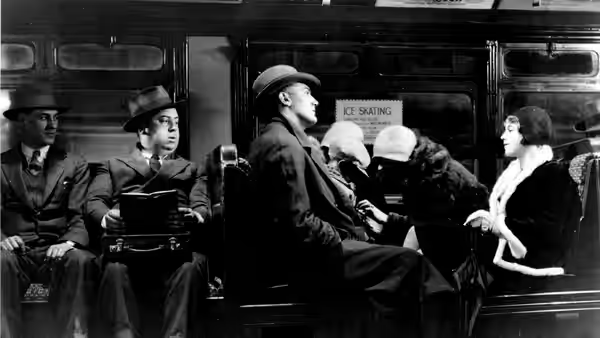
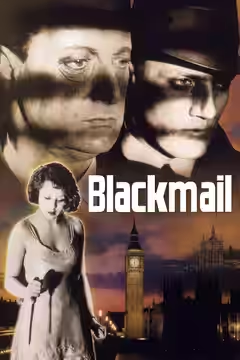
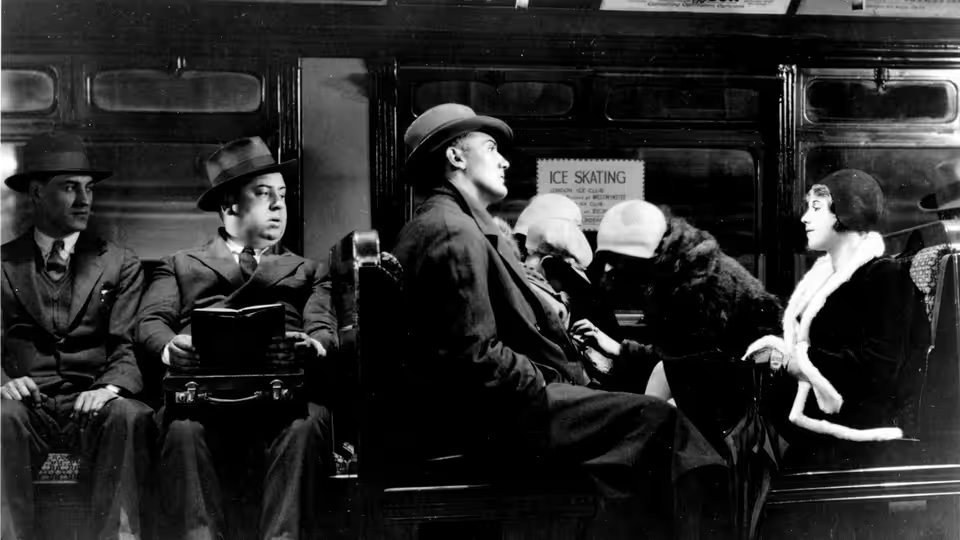
Passengers sit facing one another inside a subway carriage beneath an ice-skating advertisement
Film review

Blackmail

1929 · Directed by Alfred Hitchcock · 1h 26m

In a sentenceAlfred Hitchcock discovers sound and immediately uses it to torment a woman at breakfast

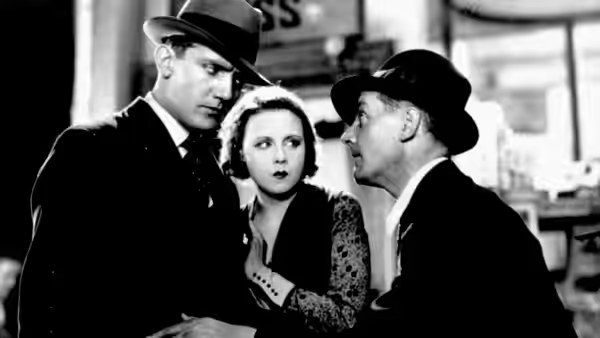
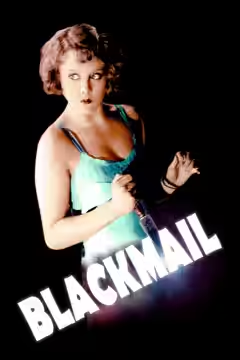
London, the late 1920s. Alice White (Anny Ondra) is stepping out with Detective Frank Webber (John Longden) of Scotland Yard. Frank is late for their date, and the pair quarrel in a tea room. Alice has already arranged to meet an artist (Cyril Ritchard) and, when Frank walks out, she goes with him to his studio. What begins as a flirtation over a canvas and a song at the piano turns into an assault, and Alice kills him with a bread knife. Next morning she must sit through breakfast in the family shop, while Frank is assigned to the case and a stranger named Tracy (Donald Calthrop) arrives with something he saw.

Fi1m review

Alfred Hitchcock’s first sound film is stiff in the joints and slow through the middle, and it still holds two sequences that unsettled us far more than we expected. Anny Ondra, dubbed live from just off camera, somehow keeps it together.

Alfred Hitchcock’s first sound film was begun as a silent one and reworked for talk part way through, and you can hear the join. Blackmail runs 86 minutes and carries a PG, and a fair stretch of the middle is three people around a table waiting for the plot to come back. It is also, at its best, as frightening as anything he made before the war, and we would rather have a creaky film with two sequences like these than a smooth one with none.

The opening reel is pure silent cinema. A police van, a flat above a shop, a man reaching for a gun under his pillow, then fingerprints, a line-up, the cells: nobody says a word and nobody needs to. Then Alice and Frank sit down in a tea room and the sound arrives, and the actors slow as if it weighed something. Anny Ondra’s voice belongs to Joan Barry, who stood out of frame and spoke the lines while Anny Ondra mouthed them, and it should be a disaster; mostly it is not. There is a faint lag between face and word that gives Alice a dazed, not-quite-present quality, and for a woman about to be absent from her own life for an evening, it fits.

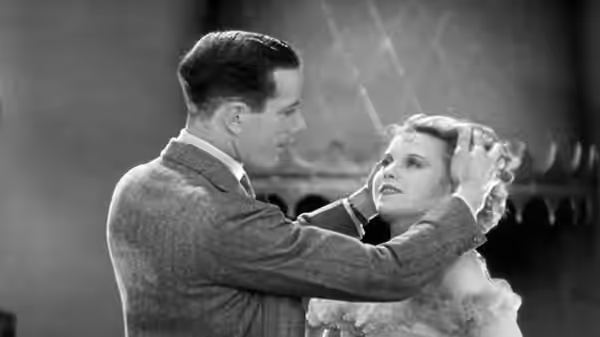
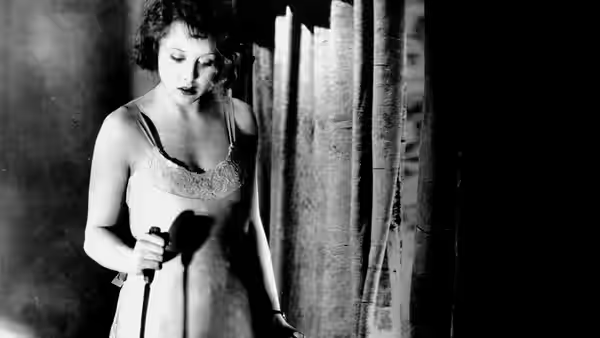
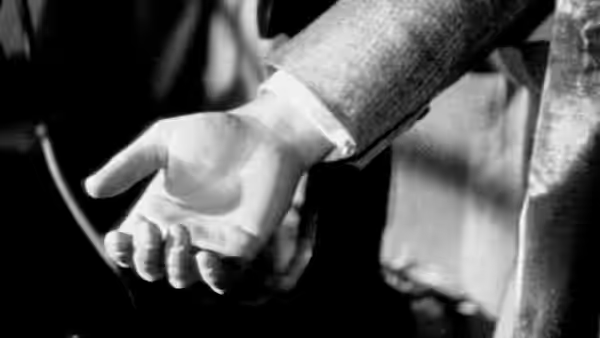
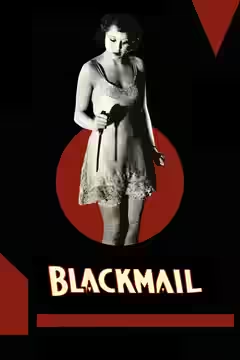
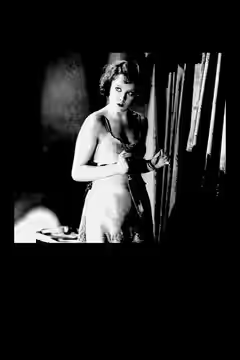
The studio scene is the film’s first great passage. Cyril Ritchard plays the artist as charm with a clock running on it, and the room is full of things that will matter later: a canvas on which he guides Alice’s hand to paint a face on a nude, a painting of a jester laughing straight out at us, a ballad he sings at the piano. Jack E. Cox shoots it warm and close, and then the struggle happens behind a curtain, with only a hand groping out for the bread knife and the curtain going still. We watched it with dread, and we were not sure, for a moment, which of them was going to come out.

What follows is better still. Jack E. Cox tracks Alice through London at night in long takes, and everything she passes seems to hand her back the knife. A sleeping tramp’s arm hangs off the kerb the way the artist’s did. Then breakfast, and a customer in the shop chatters about the murder until her voice thins to mush and the one word knife comes through, again and again, and Alice’s father asks her to cut the bread. We flinched with her.

Donald Calthrop’s Tracy is the best performance in the film. He arrives with a glove, sits at the Whites’ table, helps himself to a cigar and orders a breakfast he cannot pay for, and Donald Calthrop plays him as a small man delighted to have, at last, a large morning. John Longden’s Frank is stiffer, and the script, credited to Alfred Hitchcock with Michael Powell among the writers, hands him a real moral problem and then does little with it. Sara Allgood and Charles Paton bustle about the shop and are exactly as much as the parts need.

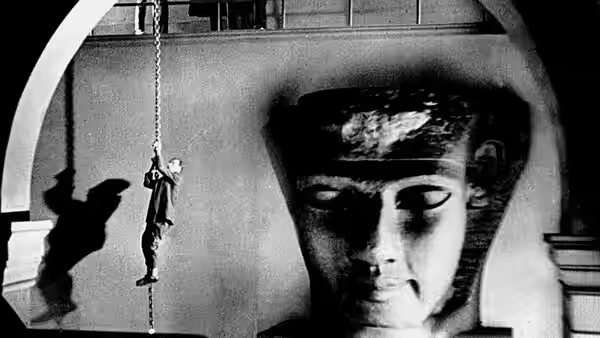
The middle sags. Once Tracy has sat down, the film sits down with him, and Emile de Ruelle’s cutting, brisk in the first reel, goes slack in the parlour talk. Hubert Bath’s music does most of its work at the top and tail and leaves the long conversations to fend for themselves. It moves again for a chase through the British Museum, which we will say nothing more about beyond that it is worth the wait.

The silent version survives and some critics prefer it. We understand why: the images are cleaner and the pacing is less bruised. But the repeated word knife needs sound, and it is what stays with us. Alfred Hitchcock turns up himself on a train, pestered by a small boy, and it is a fair picture of the whole enterprise, a man trying to read while something new keeps tugging at his sleeve. Watch the sound version first, for the knife, and forgive it the parlour.
Critical consensus AI synthesised

63
Positive
3
Mixed
1
Negative
1
The New Yorker
85*

The capsule presents the silent version as a revelation, showing Hitchcock’s visual storytelling at its best. It especially praises the striking canvas scene as a metaphor for his creative method and the film’s carnal undercurrents.

Read the full review →
Slant Magazine
4 October 2019 · ★★★½ · Chuck Bowen
70

Bowen finds the film a sophisticated early work that probes guilt, vulnerability, and the abuse of power. He praises its striking Hitchcockian imagery but criticizes the uneven sound-version restoration, while singling out the silent version’s gorgeous transfer.

Read the full review →
Empire
30 March 2006 · David Parkinson
65*

The review finds the film creaky for modern audiences but still effective and disturbing. It especially praises Hitchcock’s intuitive use of sound, including the psychologically powerful repeated “knife” sequence.

Read the full review →
Variety
31 December 1928 · Variety Staff
25*

The critic finds the film draggy, lacking pace and suspense. Donald Calthrop’s performance and the camera work, especially in the British Museum chase, are singled out for praise.

Read the full review →
Eye for Film
26 February 2007 · festival review · Leanne McGrath
75*

The review finds Blackmail an intriguing early Hitchcock film whose suspense anticipates his later classics. It particularly praises the murder scene and Hitchcock’s inventive use of sound and image.

Read the full review →

Straight answers AI written, from our review

Is Blackmail worth watching?
Blackmail is worth watching for its unsettling use of sound and Anny Ondra’s performance, and we score it 74 out of 100. We recommend it to anyone interested in early sound thrillers, provided they can forgive stiff dialogue and a sagging middle; the studio scene and the repeated word knife at breakfast justify the patience.
How long is Blackmail, and what is it rated?
Blackmail runs 1h 26m. It is a drama and thriller film.
Where can I watch Blackmail in South Korea?
Blackmail is not on any streaming or rental service in South Korea at the moment. It is available in 12 other countries; change your country at the top of the page to see where. Availability is checked daily.
How violent or frightening is Blackmail, and is it suitable for children?
Blackmail carries a UK PG, but its assault scene and sustained dread make it a cautious choice for children. The struggle happens behind a curtain, with a hand reaching for a bread knife rather than explicit injury shown. We find the tension more disturbing than the visible violence, so the certificate should not be taken to mean it suits every child.
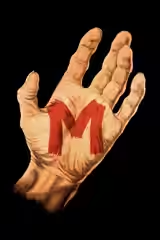
How does Blackmail compare to M?
Blackmail is the creakier choice beside M, which we recommend more strongly for its frightening, humane treatment of a child murderer. Both use sound to unsettle: a repeated word in Hitchcock’s film, a whistle in Lang’s. We favour Blackmail for viewers interested in the awkward transition from silent cinema; M offers the more troubling central performance, though some surrounding characters are overdrawn.
What should I watch after Blackmail?
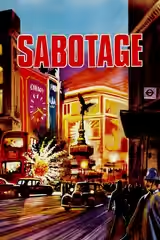
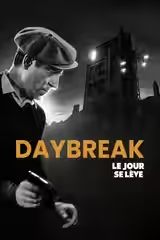
After Blackmail, try M (1931, Fi1m 94): Fritz Lang’s first sound film, and a whistle does what the knife does here. Then Sabotage (1936, Fi1m 77): Alfred Hitchcock returns to a woman, a kitchen and a knife, and finishes the thought; and Le Jour se lève (1939, Fi1m 82): A killer barricaded in a room, a whole night of remembering how he got there.

Cast

If you liked this, try…

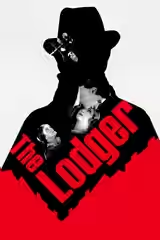
  1. The Lodger (1927) · not on Fi1m yetAlfred Hitchcock two years earlier, silent, with London fog doing the talking.

  2. M (1931, Fi1m 94)Fritz Lang’s first sound film, and a whistle does what the knife does here.

  3. Sabotage (1936, Fi1m 77)Alfred Hitchcock returns to a woman, a kitchen and a knife, and finishes the thought.

  4. Le Jour se lève (1939, Fi1m 82)A killer barricaded in a room, a whole night of remembering how he got there.

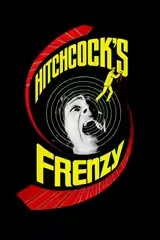
  5. Frenzy (1972) · not on Fi1m yetLate Alfred Hitchcock back in London, colder and crueller, with a market instead of a shop.