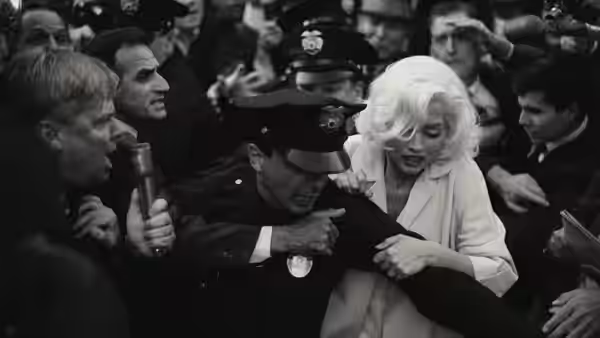
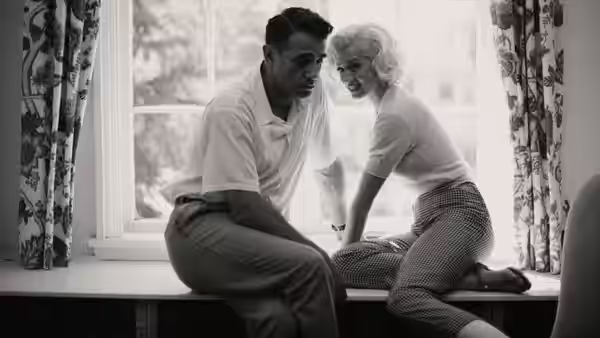
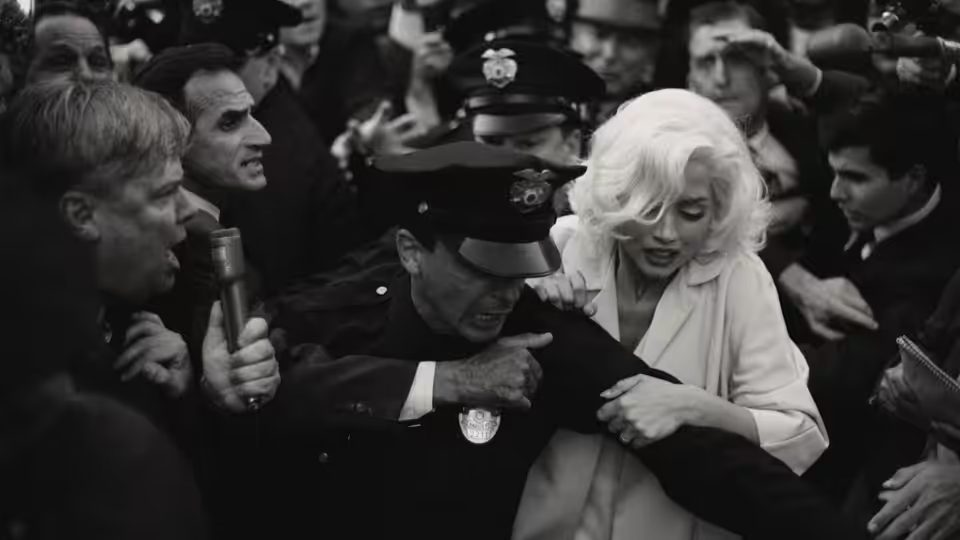
Marilyn Monroe (Ana de Armas) is escorted through a crowd by uniformed police officers
Film review

Blonde

2022 · Directed by Andrew Dominik · 2h 47m

In a sentenceMarilyn Monroe weeps again while everyone takes care to get the picture right

Norma Jeane (Ana de Armas) is an actor whose public identity, Marilyn Monroe, leaves little room for her private needs. She wants to be understood, but other people’s expectations repeatedly take precedence. Gladys (Julianne Nicholson), Cass Chaplin (Xavier Samuel) and Eddy G. Robinson Jr. (Evan Williams) are among the figures in her life. As attention settles on Marilyn’s appearance, Norma Jeane struggles to retain a sense of herself. Drawn from Joyce Carol Oates’s novel, this fictionalised account moves through familiar images of Monroe and experiences of exploitation, following the distance between the woman and her public face.

Plays from YouTube when you press play; nothing loads from them until then.

Fi1m review

Ana de Armas is moving as Marilyn Monroe, but Andrew Dominik gives her too little to play beyond pain. Precise visual reconstructions cannot make 167 minutes of repeated suffering a satisfying portrait.

Andrew Dominik’s Blonde is a punishing, often skilfully made film that gives Marilyn Monroe too little to do beyond suffer. Adapted from Joyce Carol Oates’s novel, it treats her life as material for a nightmare rather than an orderly biography. That is a reasonable choice for a film about a woman overwhelmed by the image other people make of her. What is harder to accept is how seldom this 167-minute account becomes curious about the woman doing the work.

Ana de Armas makes the distance between Norma Jeane and Marilyn Monroe feel painful. Her performance allows us to see vulnerability without mistaking it for stupidity, and there is more sensitivity in her work than the role appears to permit. She gives us reason to want to spend time with this woman when the film seems interested chiefly in watching her be hurt. That is a substantial achievement in a part so restricted by the script.

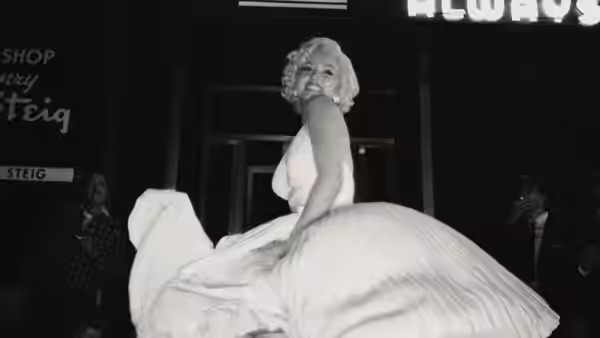
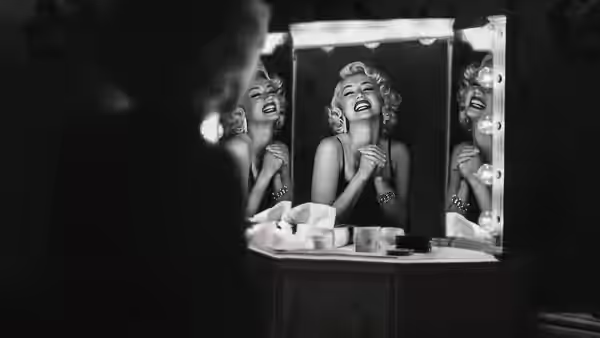
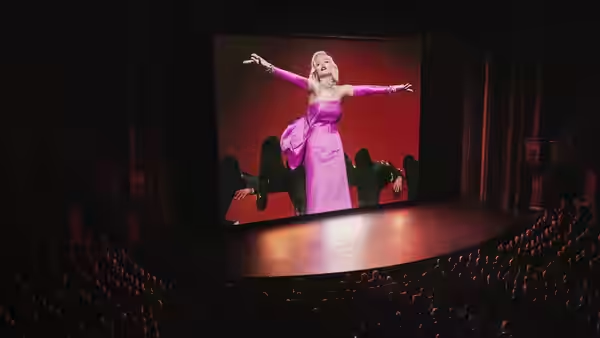
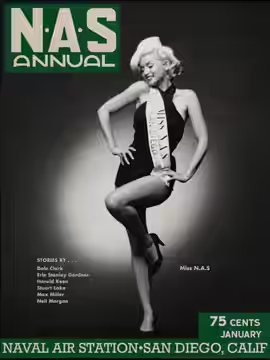
Chayse Irvin’s cinematography gives the recreated Monroe images a troubling familiarity: we recognise the picture before we have considered the person inside it. Florencia Martin’s production design and Jennifer Johnson’s costumes help make that recognition almost immediate. The reconstructions are exacting, and the unsettling effect suits a film about someone whose appearance attracts so much attention. We can appreciate the care without finding the results any more revealing about Monroe.

Adam Robinson’s editing arranges the material as a restless collage, which suits the film’s disturbed view of celebrity. The difficulty is that another passage of suffering tends to confirm what the previous one has already told us, however differently it is presented. Nick Cave and Warren Ellis provide music with more emotional range than the writing gives its central character. The score can make the sadness affecting, but it cannot make each return to it necessary.

We grew angry at the repeated sight of Monroe weeping, because the film gives those tears so much time and her intelligence so little. Suffering belongs in this story; the problem is the narrowness of the part Andrew Dominik has written for her. Humour, curiosity and the satisfaction of being good at a job would complicate that part, and the film seems unwilling to allow much of them. Ana de Armas remains sensitive even when the writing gives her little beyond distress.

The psychological horror in Blonde is forceful. Its cruelty and visual distortions can convey the fear of being watched, judged and used, and a reassuring account of fame would scarcely be more honest. But even a nightmare needs some variation if it is to hold us for this long. The repeated emphasis on helplessness makes the film less disturbing as it goes on, because there is increasingly little left to discover about its subject.

The performance and the care of the reconstruction will be enough for some viewers, and we would not dismiss either. Nor do we need a flattering portrait, or a checklist of professional achievements. We do need a film that can imagine Monroe having an interest beyond her own pain. Come for Ana de Armas only if you can tolerate the repetition.

Critical consensus AI synthesised

50
Positive
10
Mixed
8
Negative
14

The reviews of Blonde lean negative, but praise for Ana de Armas is widespread, including among critics who reject the film around her. Her performance is repeatedly described as committed, vulnerable and humane, giving Marilyn Monroe an emotional presence that even hostile reviews acknowledge. Praise also clusters around Dominik’s visual invention and the meticulous recreation of familiar Monroe images, though critics disagree about what those images reveal.

The central divide concerns the film’s treatment of suffering. Supporters find compassion and psychological force in its brutality; detractors see repetitive exploitation that leaves little space for Monroe’s intelligence, humour or work. The spread is wide: Total Film finds uncomfortable but engaging cinema, while objecting to exploitative imagery; The New Yorker condemns the fixation on victimhood, with de Armas providing its chief redeeming quality. Even favourable reviews concede excess, and several mixed assessments find the visual flourishes more persuasive than the portrait.

Total Film
8 September 2022 · ★★★★★ · Jane Crowther
100

Crowther calls the film uncomfortable but engaging, unbridled cinema that will divide opinion. She praises Ana de Armas’s soulful portrayal, while criticizing the exploitative imagery in the final third.

Read the full review →
Little White Lies
festival review · Leila Latif
70*

Latif finds the film exhilarating and highly accomplished, though its explicit and disturbing choices may alienate viewers. She especially praises Dominik’s anarchic collage of Monroe’s famous images for conveying her unknowability.

Read the full review →
Radio Times
20 September 2022 · Emma Simmonds
70*

The review finds the film compassionate and eye-opening, though its outlandish style sometimes overwhelms its emotional impact. It singles out the film’s compassionate approach as a strength.

Read the full review →
The AV Club
16 September 2022 · B- · Todd Gilchrist
70

The review finds the film uneven and ultimately unsuccessful at bringing Monroe fully into focus, despite much to admire. It especially praises Ana de Armas’s transformative performance and the inventive recreation of Monroe’s iconic screen images.

Read the full review →
Variety
8 September 2022 · Owen Gleiberman
70*

Gleiberman finds the film flawed but haunting, with a powerful understanding of Monroe’s tragic inner life. He especially praises Ana de Armas’s shimmering, candid performance, while faulting some choices, including an over-the-top episode involving two playboys.

Read the full review →
Vulture
8 September 2022 · Bilge Ebiri
70*

Ebiri finds the film beautiful, mesmerizing, and deeply moving, though deliberately alienating and brutal. He praises its visual and sonic imagination and Ana de Armas’s committed performance.

Read the full review →

Straight answers AI written, from our review

Is Blonde worth watching?
Blonde is difficult to recommend beyond Ana de Armas’s moving performance as Marilyn Monroe; we score it 40 out of 100. Its precise visual reconstructions may interest viewers drawn to Hollywood portraits, but 167 minutes of repeated suffering give Monroe too little room for intelligence, humour or life beyond pain.
How long is Blonde, and what is it rated?
Blonde runs 2h 47m. It is a drama film.
Where can I watch Blonde in Vietnam?
Blonde is streaming on Netflix in Vietnam. Availability is checked daily; the links above go straight to each service.
How violent or frightening is Blonde, and is it suitable for children?
Blonde carries a UK 18 certificate and is not suitable for children; its psychological horror, cruelty and repeated suffering make it a punishing adult drama. We find the visual distortions and fear of being watched, judged and used forceful, though viewers sensitive to exploitation or sustained emotional distress may find the repetition especially difficult.
How does Blonde compare to Sunset Boulevard?
Blonde is the less rewarding Hollywood nightmare beside Sunset Boulevard, which we recommend for its sharper writing, vicious humour and more moving portrait. Both examine the damage of celebrity, but Sunset Boulevard pays sharper attention to being forgotten, while Blonde repeatedly returns to Monroe’s helplessness despite Ana de Armas’s sensitive performance.
Is Blonde based on a true story or a book?
Blonde is adapted from Joyce Carol Oates’s novel and offers a fictionalised account of Marilyn Monroe, rather than a factual biography. We would approach it as a nightmare built around her public image and experiences of exploitation; reading the novel is not a prerequisite, but recognising that distinction matters more than familiarity with the source.
What should I watch after Blonde?
After Blonde, try Sunset Boulevard (1950, Fi1m 91): Another Hollywood nightmare, with sharper attention to the damage of being forgotten. Then Persona (1966, Fi1m 89): Two women, unstable identities and faces examined with far more patience; and Perfect Blue (1997, Fi1m 82): An animated account of celebrity and fractured identity that earns its terror.

Cast

Awards

Golden Raspberry Award for Worst Picture, 2022

Won
Golden Raspberry Award for Worst Picture

If you liked this, try…

  1. Sunset Boulevard (1950, Fi1m 91)Another Hollywood nightmare, with sharper attention to the damage of being forgotten.

  2. Persona (1966, Fi1m 89)Two women, unstable identities and faces examined with far more patience.

  3. Perfect Blue (1997, Fi1m 82)An animated account of celebrity and fractured identity that earns its terror.

  4. Mulholland Drive (2001, Fi1m 92)Hollywood longing turns frightening, with room for desire, humour and uncertainty.

  5. Spencer (2021, Fi1m 73)A public woman’s private distress, given more space for anger and resistance.