Lee Hae-jun’s comedy strands a failed suicide on an island in the middle of Seoul and gives him a recluse with a camera for an audience. It is gentle, odd and funnier than its opening suggests. The last stretch leans on a coincidence it has not earned.
Mr Kim (Jung Jae-young) owes money he cannot pay, so he goes to a bridge over the Han River in Seoul and jumps. He does not die. He washes up on a small wooded island directly beneath the bridge, close enough to the city to read the lettering on the blocks of flats, and he cannot swim. His phone works long enough for one call to the 119 emergency line, which decides he is joking and hangs up. Lee Hae-jun, who wrote the film as well as directing it, starts from this and asks a plain question: what does a man do, marooned in sight of a city that is not looking? It is a lovely film, and we recommend it, with one reservation about how it ends.
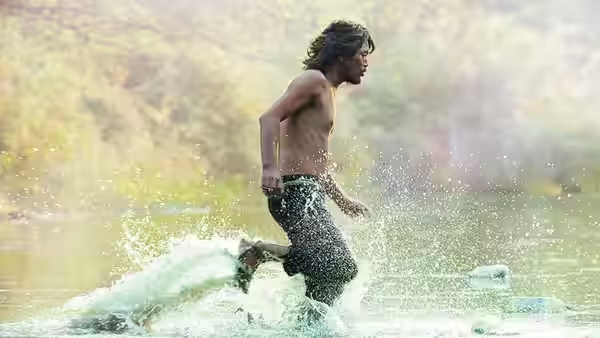
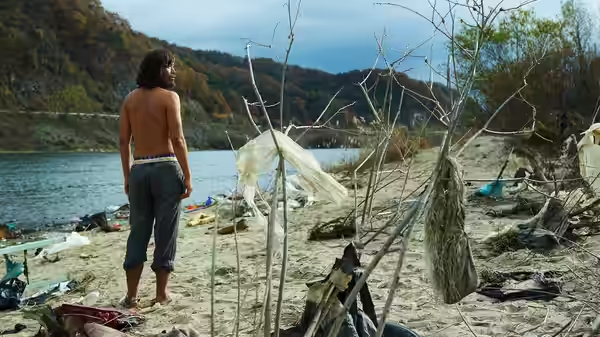
Jung Jae-young carries the first stretch almost alone, and he is good at being watched while he thinks. Kim tries to hang himself with his tie and the branch gives way. He goes through the rubbish on the shoreline like a man at a car boot sale. He finds a swan-shaped pedal boat, overturned, and moves in. He stamps HELP into the sand in letters the size of a bus, and later changes it. Kim Byung-seo shoots the island as a wet, over-bright green and keeps the city behind it slightly soft, so the towers look like a backdrop somebody forgot to take down. The joke is scale, and it stays funny for a long time: a desert island film in which the desert island is under a road bridge.
Then there is the corn. Kim salvages a packet of instant black-bean noodles with the sauce still sealed in its foil and the noodles themselves long gone, and rather than eat the sauce on its own he decides to grow the grain. He finds seeds in bird droppings, clears a plot and waits a season. We did not expect to be moved by a bowl of noodles and we were, close to tears, because by the time he sits down to eat them the film has made us count the days that went into the bowl, and because Jung plays the moment as a man who has forgotten what it is to have something arrive when he hoped it would.
Across the water, Kim Jung-yeon (Jung Ryeo-won) has not left her bedroom in years. Her mother (Yang Mi-kyung) leaves food outside the door. She lives online under a borrowed face, photographs the moon through a long lens because the moon has nobody on it, and one night, tilting the lens down, finds a man on the island. Lee lights her room in dim monitor blue and the island in full daylight, and Nam Na-yeong’s editing starts pairing them: his meals and hers, his message in the sand and her screen. Choi Eui-young’s costumes do a good deal of the storytelling. His suit goes from office to rags over the months. She wears a motorcycle helmet on the few occasions she leaves the flat, which she does only when the streets are emptied for a civil defence drill. Jung Ryeo-won is given the harder part, a character who begins as a set of symptoms, and she makes her a person by the time the first bottle goes over the wall.
Her half is the weaker one all the same. The island gives Lee a problem a minute to solve; the bedroom gives him a diagnosis, and the scenes of Jung-yeon at her computer are staged more than once as the same scene. Yang Mi-kyung’s mother is there to be worried and is given nothing else to do. A delivery man (Park Young-seo) sent across the water on an errand gets the film’s best sight gag. The last twenty minutes tighten into a chase that depends on a coincidence of timing we will not describe, and that we did not quite believe. At 119 minutes it would lose nothing at a hundred.
Korean cinema of the period was good at this mix of slapstick and sorrow, and Lee’s film sits comfortably alongside it without the knives that usually come attached. What it has that the others do not is patience with a single man and a stick. Watch it on a night when you have not left the house either. It is kinder about that than you might expect.