Alfre Woodard makes Clemency a painful, persuasive drama about the work of carrying out executions. Chinonye Chukwu gives her actors room, though a sluggish middle stretch tests our patience with an otherwise affecting film.
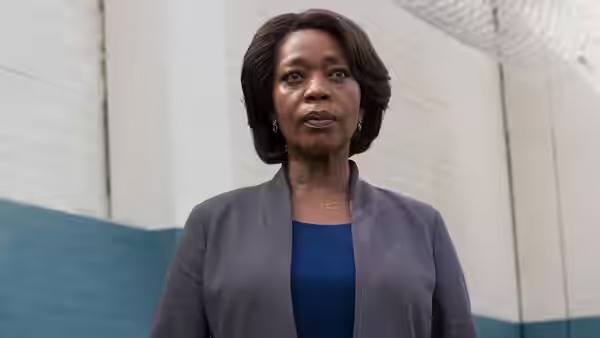
Chinonye Chukwu’s Clemency is a difficult film to recommend for a quiet evening, but we recommend it. Its account of a prison warden administering the death penalty is strongest when Alfre Woodard has almost nothing to say. Writing and directing, Chukwu asks us to consider what repeated participation in executions does to someone expected to remain competent and composed. She also keeps the condemned man’s suffering in view. The film sometimes labours its point, but Woodard makes Bernadine’s determination to carry on credible and painful to watch.
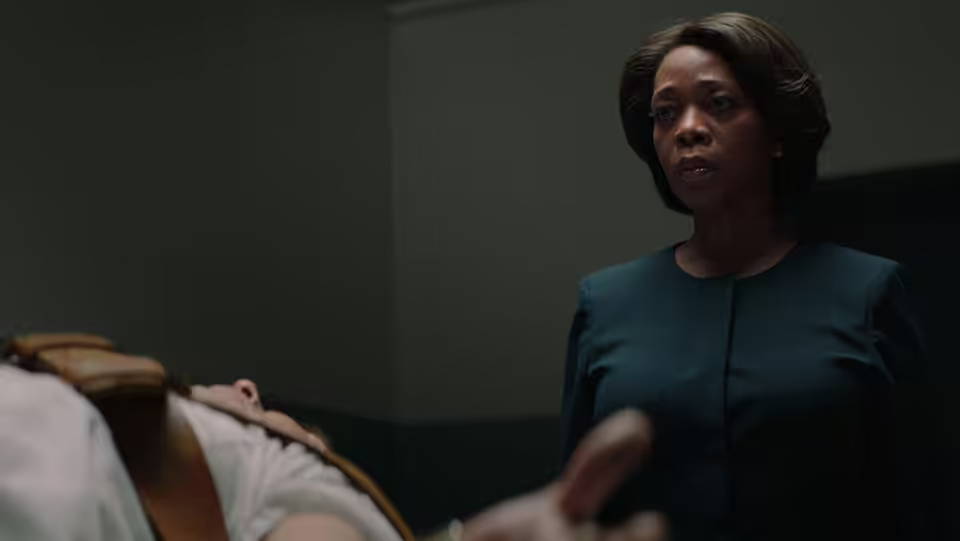
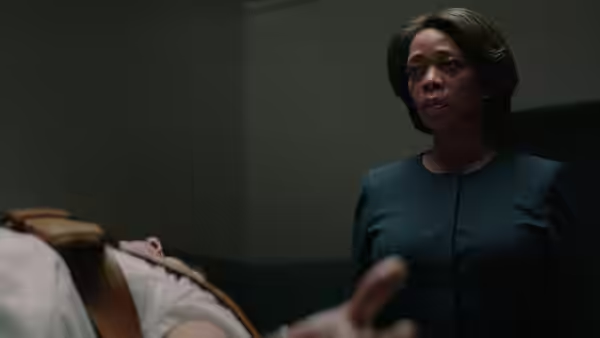
Woodard plays Warden Bernadine Williams as someone for whom showing distress would amount to a failure at work. Her face and posture suggest the effort of keeping a professional manner, without asking us to congratulate Bernadine for enduring it. We found the exchanges with Aldis Hodge’s Anthony Woods hard to bear, particularly the explanation of the execution drugs. Woodard makes the explanation sound like a duty Bernadine knows how to perform, while Hodge gives us the terror of being the person receiving it.
Eric Branco’s cinematography gives Woodard’s face the attention it needs, and the visual restraint suits an actor who can hold us without a speech. Margaux Rust’s production design is similarly unobtrusive. The prison surroundings do their job without competing with the people, keeping our attention on the discomfort of these encounters. That plainness is useful: the procedure is disturbing enough without the setting telling us how to feel about it.
Phyllis Housen’s editing is generous to the actors, allowing the discomfort of an exchange to persist rather than hurrying us towards the next development. This is often exactly right for Woodard and Hodge. Across the middle section, however, the patience becomes a problem: we have understood Bernadine’s distress well before the film finishes showing us its extent. Kathryn Bostic’s music supports the sombre mood effectively, but it cannot supply the movement missing from these passages.
The strain on Bernadine’s marriage should give those passages another direction, and Wendell Pierce brings welcome feeling to Jonathan Williams. Yet Jonathan too often seems to have been written chiefly to demonstrate the damage his wife’s job causes at home. The domestic material gives us another measure of her unhappiness without giving their relationship quite enough life of its own. The writing is more convincing when Bernadine and Anthony have to deal directly with each other.
Within the prison-drama tradition, the choice to give so much attention to the warden could easily leave the condemned man serving as a lesson for someone else. Hodge prevents that. His distress makes Anthony a person we remain concerned about, even when Bernadine’s difficulty doing her work occupies the centre of the film. Chukwu’s interest in the people carrying out executions is worth pursuing, but our sympathy for them should never make their predicament seem equal to that of the person facing death.
Clemency works best when it leaves us with that unequal encounter and lets its actors make us uncomfortable. Its slower passages ask for more patience than they repay. We would still make time for Woodard and Hodge, whose scenes together make the prospect of execution painfully immediate. Choose it for an evening when there is room to sit with something difficult, rather than as a way of shaking off the working day.