Siân Héder’s remake of a French crowd-pleaser is warm, well acted and almost entirely predictable. The Rossi family, played by deaf actors and led by a superb Troy Kotsur, is worth your evening; the story built around them could have been ordered from a catalogue.
Ruby Rossi (Emilia Jones) is up before dawn, hauling nets off the Massachusetts coast with her father Frank (Troy Kotsur) and her brother Leo (Daniel Durant), singing to herself over the engine because nobody on the boat can hear her. She is the only hearing member of a deaf family, and the family runs, in large part, through her: she interprets for her mother Jackie (Marlee Matlin) at the fish market, at the doctor’s and anywhere else a hearing world needs handling. Then she follows a boy, Miles (Ferdia Walsh-Peelo), into the school choir, and the choirmaster, Bernardo Villalobos (Eugenio Derbez), hears something and begins saying the word Berklee. Siân Héder, who wrote and directed, has taken the plan from the French film La Famille Bélier and moved it to a working boat. The plan is the least interesting thing about the film.
You can see every turn coming from the first ten minutes, and it matters less than it should. CODA is a warm, well-made, thoroughly predictable film whose family scenes are good enough to carry the rest. We would recommend it to anyone who wants to be moved and does not mind being steered a little on the way.
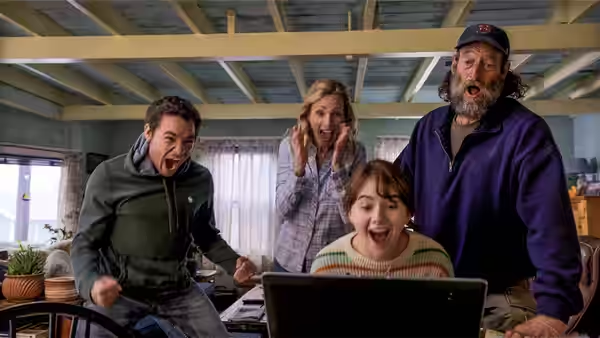
The Rossis are the reason to watch. Kotsur plays Frank as a loud, randy, stubborn man who thinks he is funnier than he is and often is. Matlin’s Jackie is vainer and sharper and keeps score. Durant’s Leo, the older child who is never asked to interpret because he cannot, carries a resentment the film is honest about. They argue in sign at speed, and Héder holds on those arguments with subtitles and no spoken voice, sometimes for whole scenes, trusting us to keep up. Paula Huidobro shoots the boat in flat early light and the house in warm clutter, Diane Lederman has filled that house with the mess of people who actually live in it, and Brenda Abbandandolo’s costumes are oilskins and old hoodies; nobody looks dressed.
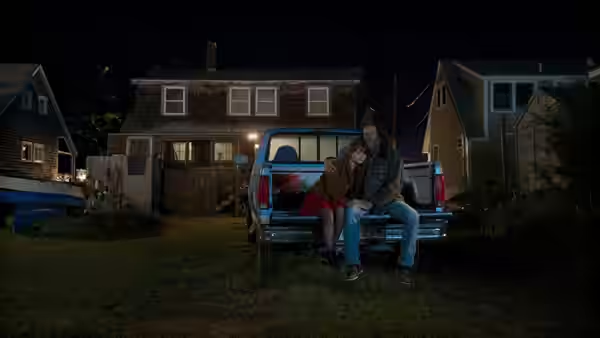
The scene that got us is a small one. Frank, who has never heard his daughter sing, asks her to do it for him in the cab of the truck, and when the sound means nothing to him he puts his hand on her throat and reads her that way. Kotsur’s face does the rest. We were not ready for it, and we suspect the film did not earn it so much as Kotsur simply handed it over. There is a companion moment at a school concert where Héder drops the sound entirely and leaves us where the parents are, watching a hall react to something we cannot hear. It is the boldest thing in the film and it lasts about a minute.
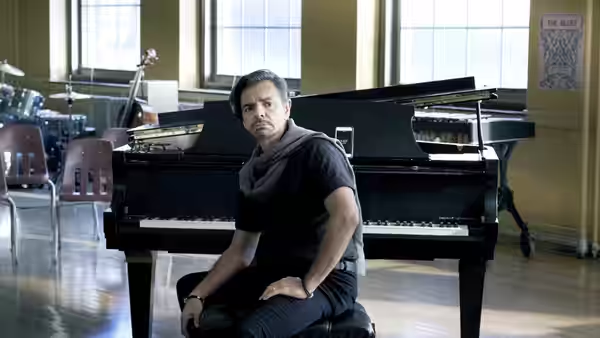
What does not work is most of the plot. Héder piles it on: an observer aboard the boat, a row with the wholesaler Tony Salgado (John Fiore), a new venture on the dock, a boyfriend, a duet, an audition, all landing in the same few weeks and each resolved by the following scene. Derbez’s teacher is a stock eccentric, all flourishes and pep talks, and the choir rehearsals have the shape of a montage even when they are not one. Marius de Vries mostly lets the soul standards do the work, which is right, but the score underneath the family crises nudges us towards the intended tear. Geraud Brisson cuts briskly, which keeps the 112 minutes moving and also means the hard scenes are hurried past before they can hurt.
There is a larger problem, and Leo names it. In one of the best scenes, he tells Ruby the family was fine before she was born and that it is the hearing world that should learn to deal with them. He is right, and the film knows he is right, and then it carries on being a film about the hearing girl. The deaf characters get the funniest lines and the best acting and not the story.
Against the run of teenage-talent films, the ones with a working-class kid, a gruff parent and an audition in a big city, it sits comfortably in the upper middle. It is better than its French source because the deaf roles are played by deaf actors, and you can see the difference in every exchange.
It is a 12A, and the certificate is doing some work: the Rossis’ sex lives are discussed in detail, in sign, at the dinner table, and Ruby has to translate. Watch it with your family if your family can take that. Ours laughed, then went quiet at the truck, which we suspect is the order Héder intended.