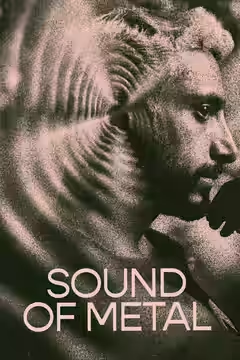
Darius Marder’s first feature puts us inside the head of a drummer going deaf, and for eighty minutes the sound alone would justify your evening. Riz Ahmed is remarkable; the last stretch turns to plot and is not up to what came before.
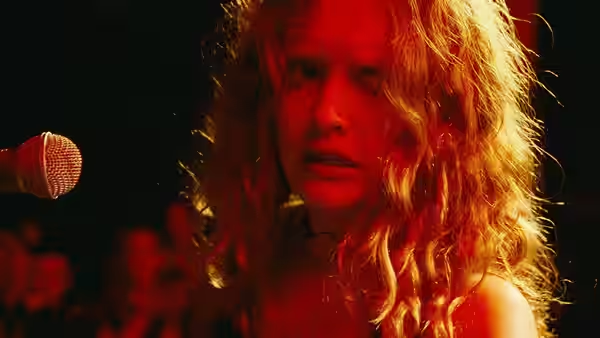
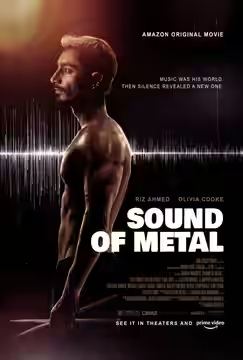
Ruben Stone (Riz Ahmed) plays drums in a two-piece band with his girlfriend Lou (Olivia Cooke), and the film opens on a gig: she screams, he hits things, the room is a wall of noise. They tour in a caravan, make smoothies, do press-ups. Ruben has been clean for four years. Then one morning, with almost no warning, his hearing goes. Darius Marder, directing his first feature from a script written with Abraham Marder and a story shared with Derek Cianfrance, has one large idea, which is to put us in Ruben’s ears for as much of the next two hours as he can bear to. It is a good idea and he sees it through.
The music credit is shared by Nicolas Becker and Abraham Marder, and there is very little you would call a score. What there is instead is Ruben’s hearing. When the film sits inside his head, voices arrive as if through a bedroom wall, a high thin ring sits over everything, and a dropped pan lands as a dull thump. When it steps out, we get the world as Lou hears it. Mikkel E.G. Nielsen cuts between the two so cleanly that we are never confused about whose ears we are using. The scene in the pharmacy, where Ruben stands at a counter trying to read the face of a pharmacist (Michael Tow) who is talking at him, made us panic in a way films rarely manage. We caught ourselves leaning forward, as though we could hear for him.
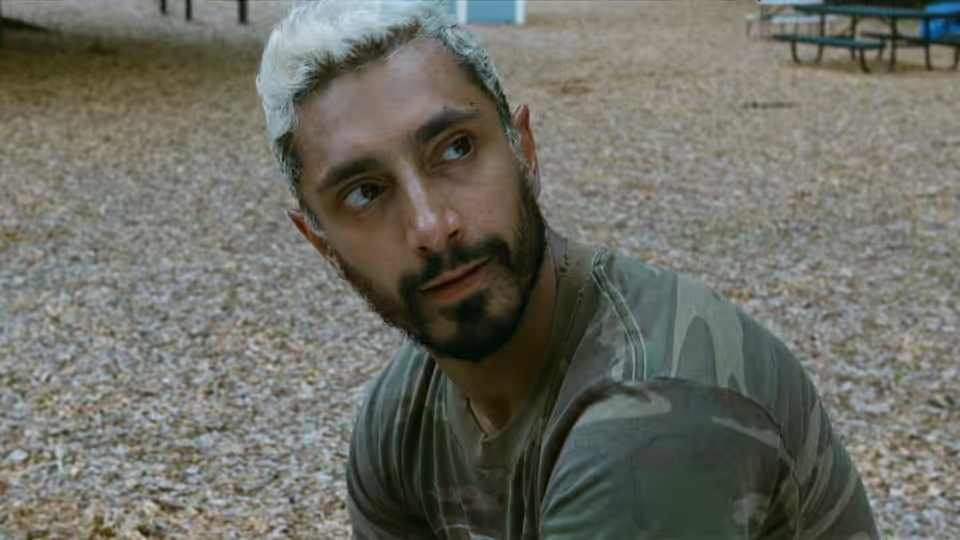
Ahmed carries it. He has bleached his hair and he holds his body like a man waiting to be hit, and for the first half hour he barely stops moving. The performance is in what happens when he has to. Watch him in the audiologist’s office being told how much is gone, doing sums about implants and money, saying he is fine. He is not fine, and Ahmed lets us watch him decide to say it anyway. Cooke has less to do, but the early scenes of the two of them in the caravan, brushing teeth, dancing to a record, are tender enough that the whole film rests on them.
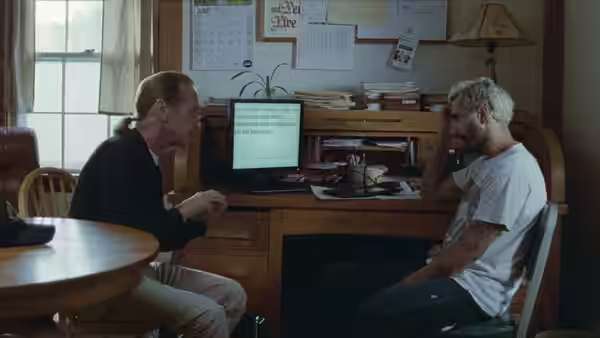
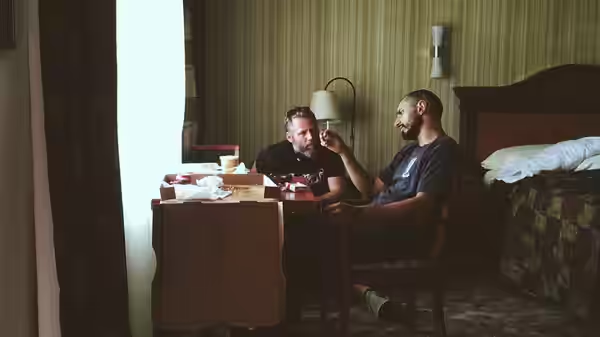
Lou, frightened of what he might do, finds him a place at a rural sober house for Deaf people run by Joe (Paul Raci), a recovering alcoholic who lost his hearing in Vietnam. Joe’s terms are that Ruben stays and Lou goes. Raci is the film’s second great asset: dry, patient, unmoved by charm, with a way of pausing before he signs that makes every sentence land. Jeremy Woodward’s production design gives the house scuffed wooden floors and a kitchen everyone eats in, and Daniël Bouquet shoots it in flat morning light with the camera close on faces, because faces are what Ruben now has to read. Megan Stark Evans keeps everyone in worn flannel and work trousers; nobody here is dressing for anyone.
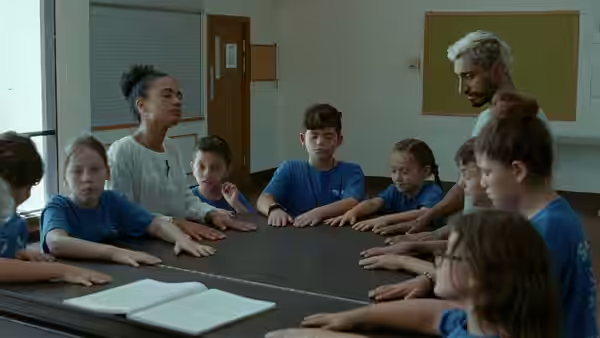
What moved us most was small. Ruben is sent to sit in on Diane’s (Lauren Ridloff) class of Deaf children, useless and fidgeting, and ends up outside with one boy, Michael (Domenico Toledo), the two of them tapping on a metal slide and feeling the rhythm come back through the steel. Nobody explains it. The film’s other good decision is to caption everything, so that when a conversation in sign is left untranslated, we are as far outside it as Ruben is.
Then it starts to move people around. Joe’s view, that deafness is not a thing to be fixed, is a real position and the film holds it sincerely, but it holds it so hard that Ruben’s wish to get his old life back is never argued as well as Joe’s calm is. Mathieu Amalric turns up late in a part we will not describe, and the last forty minutes become a film about where Ruben goes and who he talks to, when the first eighty were a film about what he could hear. Most critics have forgiven this, and so, mostly, have we. It remains the weakest stretch, and it is not short.
For a first feature it is unusually sure about its one idea and sensibly modest about everything else. There is no relapse set piece, no shouting match in the rain, and the addiction is treated as something Ruben lives with rather than something the plot needs. It runs 121 minutes and carries a 15 certificate, mostly for language. See it with the volume up and the house quiet.