Ralph Fiennes puts Shakespeare’s least loved tragedy in fatigues and a rubble-strewn Balkan city, and it mostly holds. Barry Ackroyd’s handheld camera fights the verse as often as it helps it, but Vanessa Redgrave’s Volumnia is worth the evening on her own.
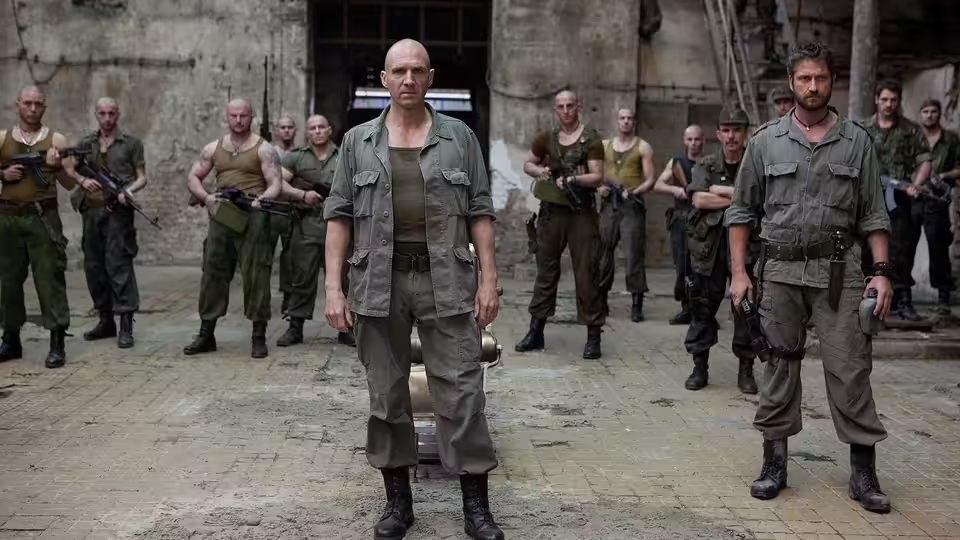
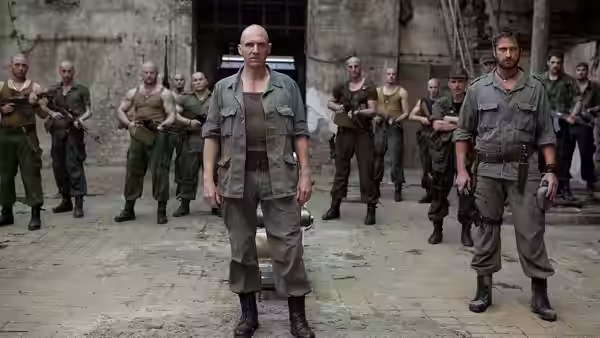
Coriolanus is the Shakespeare tragedy that theatres leave in the drawer. Its hero is a soldier who despises the public and cannot be made to pretend otherwise; there is no ghost, no fool, almost no love story, and a great deal of arguing about grain. Ralph Fiennes, directing for the first time and playing the lead, has taken John Logan’s trimmed screenplay and moved the whole thing to a present-day city that looks like the Balkans a year after a war: concrete estates, checkpoints, riot shields, rolling news. The verse is kept. Most of it holds.
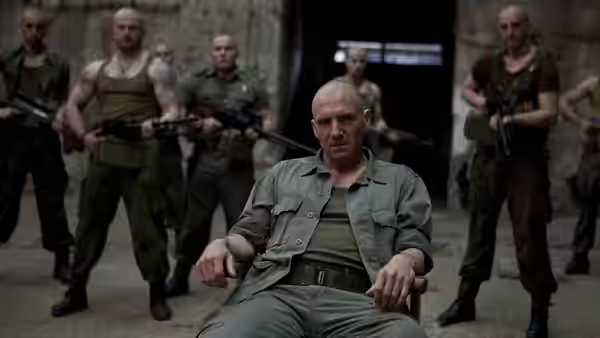
The gamble is that men in fatigues can speak in pentameter without the audience laughing, and Fiennes wins it in his own performance first. His Martius has a shaved head, a scar running up into his scalp and a way of standing still while other people talk, as if waiting for them to finish so he can go back to work. He has been trained to do one thing superbly and is asked, on his return, to do the one thing he cannot: stand in a market and ask ordinary people to like him. Watching him try, the words snagging behind his teeth, we felt something close to pity.
Barry Ackroyd shoots it as he shot The Hurt Locker, handheld and close, the camera jostled by whatever is nearest. In Corioles this is exactly right. The assault on the town is a room-to-room slog through a gutted block of flats, and when Martius finally meets Tullus Aufidius (Gerard Butler) they fight with knives at a range where each can see the other’s fillings. We flinched, more than once, and we were grateful that Nicolas Gaster cuts it so we always know whose blade is where. Ilan Eshkeri’s score stays out of the fight and comes in afterwards, low and unresolved, for the walk home.
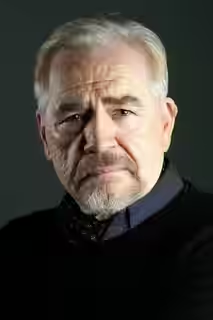
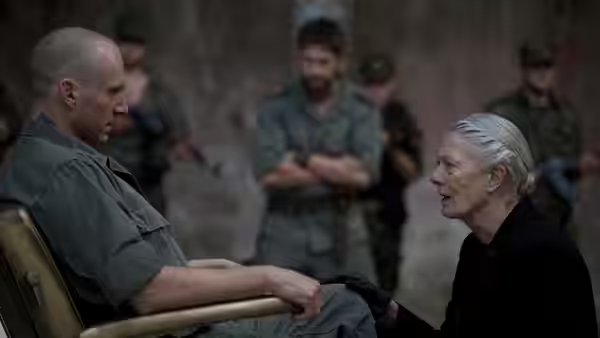
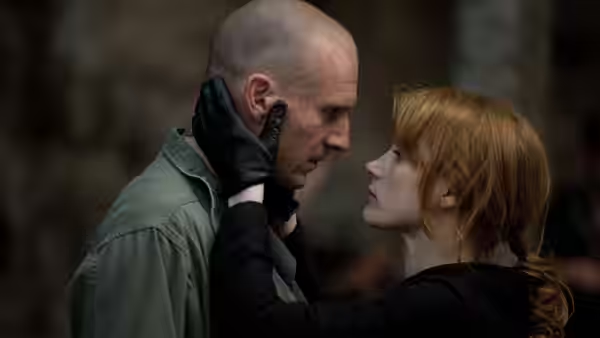
Then Vanessa Redgrave arrives, and the film has its reason to exist. Her Volumnia wears a general’s dress uniform she has plainly never had to fight in, and she greets her wounded son by counting his scars, out loud, with satisfaction. It is a mother doing a stock-take. Redgrave plays every line as plain common sense, which frightens far more than shouting would, and in the two long scenes where she works on her son we sat forward and did not move. Jessica Chastain, as his wife Virgilia, is given almost nothing to say and does a great deal with watching. Brian Cox’s Menenius is the fixer who has eaten at every table in the city and knows what each one costs.
The politics is where the modern dress pays off most and costs most. James Nesbitt and Paul Jesson play the tribunes Sicinius and Brutus as a pair of talk-radio populists in good suits, and the scene in which they coach the crowd on what to be angry about is the sharpest in the film. Lubna Azabal and Ashraf Barhom, as the two citizens who lead the protests, are given faces rather than a mob. But Fiennes also stages a television studio debate in blank verse, complete with newsreader and ticker, and the joke lands once and then keeps being made.
The camera is the larger problem. Ackroyd’s jostle, which serves the war so well, fights the speeches. In the senate we wanted to hear a man think, and instead the frame kept twitching towards whoever moved. Gaster’s cutting in the middle third chops the manoeuvring so fine that we twice lost track of who was against whom, and we were bored for ten minutes at a stretch, which in a story about a coup is a failing. Ricky Eyres has built the senate as a council chamber under strip lighting, and Bojana Nikitović has put everyone in it in the same dark suit, so the faces are all that separate the factions. The camera does not stay on them long enough.
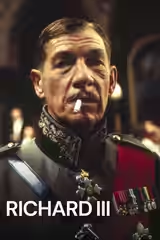
The second half takes the play where the play goes, which we will not describe, except to say that Butler is better than we expected and that there is a late scene between mother and son that justifies the whole enterprise. As Shakespeare films go, this is closer in ambition to Richard Loncraine’s Richard III than in achievement. That film found a world for its play and let it breathe; this one keeps its hand on the play’s throat for 123 minutes.
It is a 15 certificate and earns it inside the first half hour. Watch it for Redgrave, stay for the knife fight, and accept that the middle stretch asks more patience than it repays.