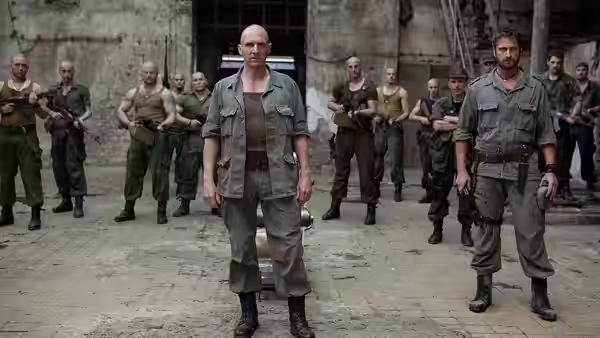
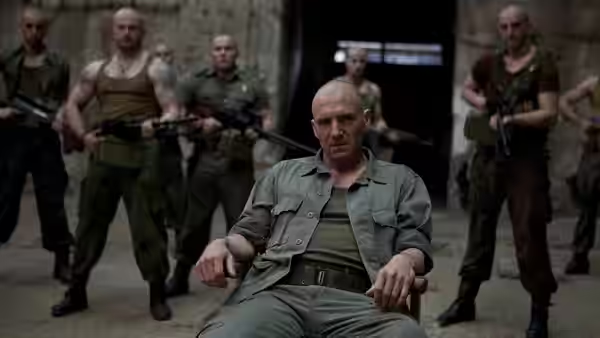
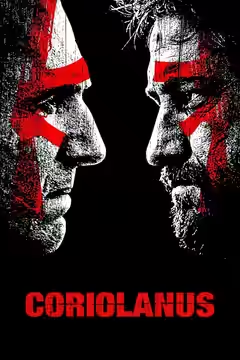
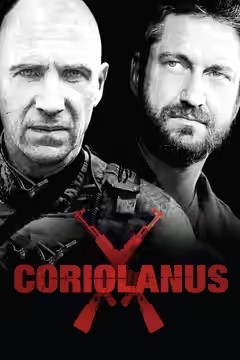
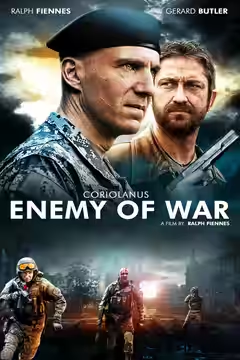
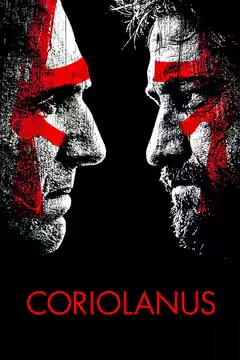
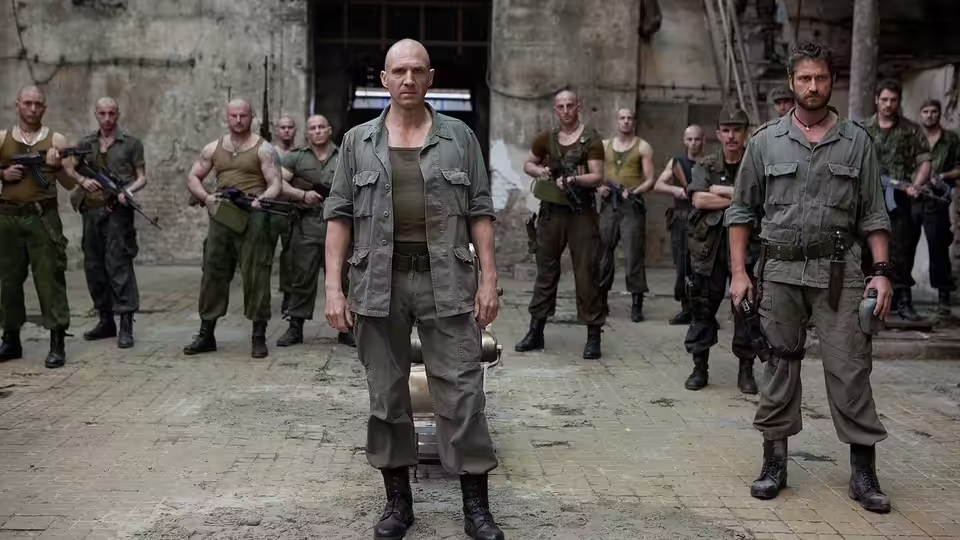
Coriolanus (Ralph Fiennes) stands with armed soldiers in a ruined hall, Aufidius (Gerard Butler) beside him
Film review

Coriolanus

2011 · Directed by Ralph Fiennes · 2h 03m

In a sentenceRome moved to a bombed-out tower block, and the mother is still the most frightening thing in it

In a city calling itself Rome, in something like the present day, the people are queuing for grain and the government is keeping it back. General Caius Martius (Ralph Fiennes) despises them and says so to their faces, on camera. Two citizens, Tamora (Lubna Azabal) and Cassius (Ashraf Barhom), lead the protests. When the neighbouring Volsces, under Tullus Aufidius (Gerard Butler), attack, Martius leads the assault on their city of Corioles, fights Aufidius hand to hand, and comes home with fresh scars and a new name, Coriolanus. His mother Volumnia (Vanessa Redgrave) wants him made consul. His friend Menenius (Brian Cox) coaches him to go into the market and ask the people for their votes. The tribunes Sicinius (James Nesbitt) and Brutus (Paul Jesson) are waiting for him to refuse.

Plays from YouTube when you press play; nothing loads from them until then.

Fi1m review

Ralph Fiennes puts Shakespeare’s least loved tragedy in fatigues and a rubble-strewn Balkan city, and it mostly holds. Barry Ackroyd’s handheld camera fights the verse as often as it helps it, but Vanessa Redgrave’s Volumnia is worth the evening on her own.

Coriolanus is the Shakespeare tragedy that theatres leave in the drawer. Its hero is a soldier who despises the public and cannot be made to pretend otherwise; there is no ghost, no fool, almost no love story, and a great deal of arguing about grain. Ralph Fiennes, directing for the first time and playing the lead, has taken John Logan’s trimmed screenplay and moved the whole thing to a present-day city that looks like the Balkans a year after a war: concrete estates, checkpoints, riot shields, rolling news. The verse is kept. Most of it holds.

The gamble is that men in fatigues can speak in pentameter without the audience laughing, and Fiennes wins it in his own performance first. His Martius has a shaved head, a scar running up into his scalp and a way of standing still while other people talk, as if waiting for them to finish so he can go back to work. He has been trained to do one thing superbly and is asked, on his return, to do the one thing he cannot: stand in a market and ask ordinary people to like him. Watching him try, the words snagging behind his teeth, we felt something close to pity.

Barry Ackroyd shoots it as he shot The Hurt Locker, handheld and close, the camera jostled by whatever is nearest. In Corioles this is exactly right. The assault on the town is a room-to-room slog through a gutted block of flats, and when Martius finally meets Tullus Aufidius (Gerard Butler) they fight with knives at a range where each can see the other’s fillings. We flinched, more than once, and we were grateful that Nicolas Gaster cuts it so we always know whose blade is where. Ilan Eshkeri’s score stays out of the fight and comes in afterwards, low and unresolved, for the walk home.

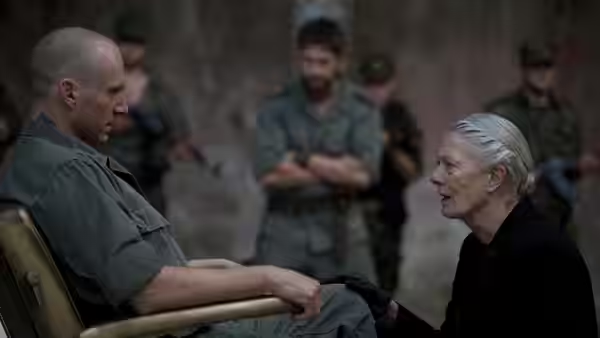
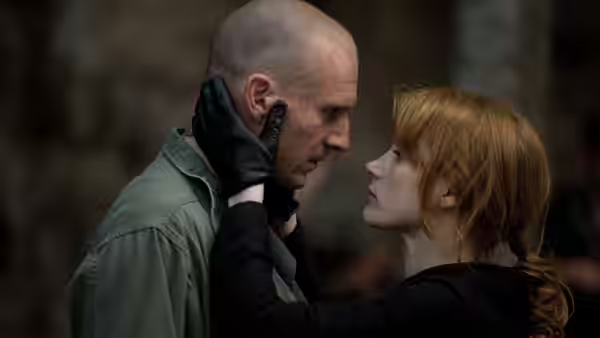
Then Vanessa Redgrave arrives, and the film has its reason to exist. Her Volumnia wears a general’s dress uniform she has plainly never had to fight in, and she greets her wounded son by counting his scars, out loud, with satisfaction. It is a mother doing a stock-take. Redgrave plays every line as plain common sense, which frightens far more than shouting would, and in the two long scenes where she works on her son we sat forward and did not move. Jessica Chastain, as his wife Virgilia, is given almost nothing to say and does a great deal with watching. Brian Cox’s Menenius is the fixer who has eaten at every table in the city and knows what each one costs.

The politics is where the modern dress pays off most and costs most. James Nesbitt and Paul Jesson play the tribunes Sicinius and Brutus as a pair of talk-radio populists in good suits, and the scene in which they coach the crowd on what to be angry about is the sharpest in the film. Lubna Azabal and Ashraf Barhom, as the two citizens who lead the protests, are given faces rather than a mob. But Fiennes also stages a television studio debate in blank verse, complete with newsreader and ticker, and the joke lands once and then keeps being made.

The camera is the larger problem. Ackroyd’s jostle, which serves the war so well, fights the speeches. In the senate we wanted to hear a man think, and instead the frame kept twitching towards whoever moved. Gaster’s cutting in the middle third chops the manoeuvring so fine that we twice lost track of who was against whom, and we were bored for ten minutes at a stretch, which in a story about a coup is a failing. Ricky Eyres has built the senate as a council chamber under strip lighting, and Bojana Nikitović has put everyone in it in the same dark suit, so the faces are all that separate the factions. The camera does not stay on them long enough.

The second half takes the play where the play goes, which we will not describe, except to say that Butler is better than we expected and that there is a late scene between mother and son that justifies the whole enterprise. As Shakespeare films go, this is closer in ambition to Richard Loncraine’s Richard III than in achievement. That film found a world for its play and let it breathe; this one keeps its hand on the play’s throat for 123 minutes.

It is a 15 certificate and earns it inside the first half hour. Watch it for Redgrave, stay for the knife fight, and accept that the middle stretch asks more patience than it repays.

Critical consensus AI synthesised

76
Positive
16
Mixed
2
Negative
0

Most critics like Coriolanus, and the praise settles in the same two places: Ralph Fiennes as director, in his first film, and Fiennes as the general himself. The reviews credit him with making Shakespeare’s language sound natural amid tanks and automatic weapons, and with setting the play in a Balkan-style war zone, with rolling-news inserts, without the update feeling like a stunt. Vanessa Redgrave’s Volumnia is singled out almost everywhere, with Brian Cox and Gerard Butler close behind, and the combat scenes are widely called shattering.

The spread is narrow. No review is negative, and the two mixed notices still admire the acting. The reservations cluster around the handheld camerawork, which Slant Magazine finds a misstep and Time Out thinks falls short in the vérité action; The New Yorker finds the modern media touches forced, Variety struggles to follow the political manoeuvring, and Screen Daily notes second-act wordiness and an overlong finale.

The AV Club
19 January 2012 · A- · Keith Phipps
90

The critic commends the film as a brutal and bleak adaptation that uses a contemporary setting to accentuate Shakespeare's themes of politics, war, and class. It singles out Fiennes' intense performance as Coriolanus for capturing the character's emotional stuntedness and commitment to military honor.

Read the full review →
Los Angeles Times
2 December 2011 · Betsy Sharkey
85*

Fiennes' ambitious directorial debut thrillingly updates the tragedy with operatic scale, gritty warfare, and standout performances from Redgrave, Cox, and others, making it memorable and prescient.

Read the full review →
The Guardian
15 February 2011 · Peter Bradshaw
85*

The critic calls Fiennes's directorial debut a triumph for reconfiguring the play as a study of modern warfare with news inserts. He singles out the film's clarity, intelligence, and shattering combat scenes along with careful narrative attention.

Read the full review →
Empire
8 January 2012 · Angie Errigo
81*

The critic finds Fiennes on firm footing with this political thriller and praises its assured direction and timely themes. She singles out the contemporary resonance in modern dress and Balkan-style war zones, along with strong performances from Redgrave and Butler.

Read the full review →
The Hollywood Reporter
17 February 2011 · festival review · Ray Bennett
80*

The critic praises Fiennes' directorial debut for turning the Shakespeare play into a modern, bloody action picture with tanks and automatic weapons while keeping the original language natural. It highlights strong performances, especially by Fiennes, Redgrave, Cox, and Butler, calling it a tough, violent, and moving tragedy.

Read the full review →
The New York Times
1 December 2011 · Manohla Dargis
80*

Fiennes delivers a thrilling performance as the title character in his directorial debut, bringing fierce intensity to the modernized Shakespearean tragedy set amid contemporary warfare and political intrigue.

Read the full review →

Straight answers AI written, from our review

Is Coriolanus worth watching?
Coriolanus is worth watching if you can take Shakespeare's verse spoken by men in fatigues, and we scored it 74. Ralph Fiennes moves the play to a bombed-out modern city and mostly makes it hold, with Vanessa Redgrave's Volumnia the reason to see it. The middle third, chopped fine and shot with a restless camera, asks more patience than it repays.

How long is Coriolanus, and what is it rated?
Coriolanus runs 2h 03m. It is a drama and thriller film.
Where can I watch Coriolanus in Romania?
Coriolanus is not on any streaming or rental service in Romania at the moment. It is available in 18 other countries; change your country at the top of the page to see where. Availability is checked daily.
How violent or frightening is Coriolanus, and is it suitable for children?
Coriolanus is a 15 certificate in the UK and earns it inside the first half hour, so it is not for children. The assault on Corioles is a room-to-room slog through gutted flats, and the knife fight between Martius and Aufidius is close enough to make us flinch. Older teenagers who can follow blank verse will manage; the squeamish should look away from the war scenes.
How does Coriolanus compare to The Hurt Locker?
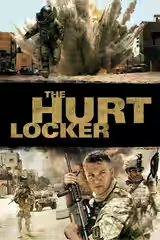
Coriolanus borrows Barry Ackroyd's handheld camera from The Hurt Locker, and the earlier film is the better use of it. Bigelow's bomb disposal thriller follows one soldier who only knows how to work, and the jostle makes his danger clear; in Fiennes's Shakespeare the same camera serves the battle but fights the speeches. Choose The Hurt Locker for tension, Coriolanus for Redgrave and the verse.

Cast

Awards

BAFTA Film Awards, 2012

Nominated
Best Newcomer

British Independent Film Awards, 2011

Won
Best Supporting Actress

Satellite Award for Best Supporting Actress – Motion Picture, 2011

Nominated
Satellite Award for Best Supporting Actress – Motion Picture

If you liked this, try…

  1. Richard III (1995) · not on Fi1m yetShakespeare in 1930s fascist dress, with Ian McKellen enjoying every syllable of the villainy.

  2. Throne of Blood (1957) · not on Fi1m yetKurosawa’s Macbeth in fog and armour, where the ambitious wife is the real terror.

  3. Titus (1999) · not on Fi1m yetJulie Taymor’s Titus Andronicus, louder and stranger than this, with Anthony Hopkins carving.

  4. Chimes at Midnight (1965) · not on Fi1m yetOrson Welles as Falstaff, and a muddy battle nobody has bettered on film.

  5. The Hurt Locker (2008, Fi1m 86)Ackroyd’s camera in the war it was made for, following one man who only works.