The available critical accounts suggest accomplished animation but disagree about whether the film earns our affection. Our provisional assessment is mixed: reported visual care gives it appeal, but concerns about the drama prevent a recommendation.
Our provisional verdict on David is mixed: an animated family musical with persuasive reports of visual care, but a substantial complaint that it feels generic and emotionally remote. That is enough to acknowledge its craft without recommending it. This assessment rests on the available critical accounts rather than a viewing. The animation and songs offer reasons to be interested, though the disagreement about their emotional effect matters more than the polish.
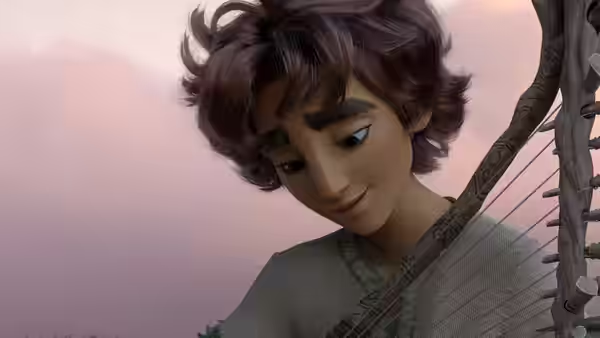
Phil Cunningham and Brent Dawes direct, with Dawes also credited for the screenplay. The clearest shared praise concerns the animation: the critical accounts describe polished images, with particular attention to textiles and the staging of action within the frame. We were heartened by that reported care over cloth and staging, because it suggests thought about what will hold our attention beyond the next plot event. Those are useful specifics, pointing to care over both surfaces and how the audience follows a scene. They give us a stronger reason to be interested than a general assurance that the film looks expensive.
The disagreement becomes sharper around the music and feeling. One account finds the songs catchy and well integrated, and responds warmly to the film’s sincerity; another finds the experience generic and emotionally remote despite the quality of the images. We would give that disagreement more weight than a simple average of the scores, because it concerns what a family musical needs to accomplish throughout its running time. Attractive animation can sustain attention, but songs also need to make the people singing them worth following. The available accounts do not agree that David manages that.
Joseph Trapanese is credited with music, while Tom Scott is the editor. Those credits identify their contributions without telling us which musical choices work, how individual sequences are paced or where the film might drag. It would be easy to turn the praise for songs into a claim about Trapanese’s score, but those are different judgements. Equally, a running time of 109 minutes tells us nothing reliable about Scott’s handling of a scene. Neither credit supplies the missing evidence for a detailed craft assessment.
Brandon Engman voices Young David, Brian Stivale voices Samuel and Hector voices Jesse, with Miri Mesika as Nitzevet and Lauren Daigle as Rebecca. The available critical summaries give us no performance detail substantial enough to judge their work individually. We therefore cannot fairly praise one performer for warmth or blame another for a character who fails to register. For the same reason, assigning particular strengths or weaknesses to Dawes’s dialogue would go beyond what these accounts establish.
Our provisional score gives weight to the reported visual finish and musical appeal, both substantial virtues in a family musical. Sincerity is also a reasonable ambition, and a film should not be marked down simply for wanting to move its audience plainly. But the complaint that David feels generic and emotionally remote concerns something essential, and praise for finely rendered textiles does not answer it. The balance supports a mixed judgement rather than a dismissal: there is enough craft here to warrant interest, but insufficient evidence of satisfying drama to warrant our recommendation. An appetite for polished animation would need to carry the evening.