Chen Sicheng gets real laughs from an outsized airport brawl, but the case is less rewarding. A muddled mystery and awkward melodrama keep this busy detective comedy short of a recommendation.
Detective Chinatown 3 is a mixed evening: lively physical comedy attached to a mystery that struggles to hold our attention. Chen Sicheng gives Wang Baoqiang’s Tang Ren and Liu Haoran’s Qin Feng plenty of commotion to work through, and occasionally the sheer excess is funny. But the case needs more care than the film gives it. At 136 minutes, there is too much time between those moments of pleasure.
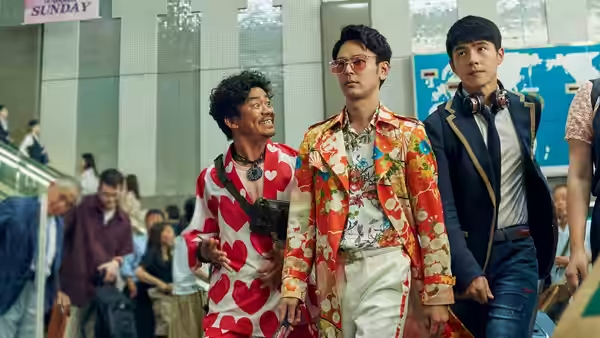
The airport brawl is the main reason to persist. We laughed at its sprawling slapstick, because the size of the disturbance becomes part of the joke. Du Jie’s cinematography makes good comic use of the airport’s scale, giving the action room to spread. There is a welcome confidence to this sequence: it knows what is funny about filling a public space with this much trouble, and lets us enjoy it without requiring much thought about the investigation.
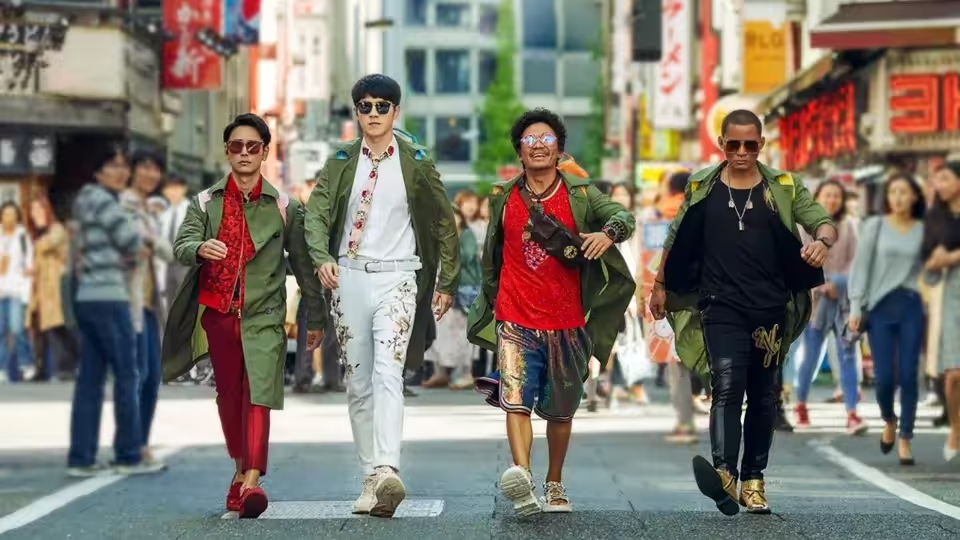
The chaos at Shibuya Crossing is another passage in which the film’s appetite for spectacle pays off. Editor Tang Hongjia helps these set pieces move with the punch missing from the detective story, though the briskness is less useful when there is information to absorb. The trouble is that a lively sequence can only distract us from a confused plot for so long. Once we start trying to follow the case again, the enjoyment becomes harder work.
The writing is credited to Zhang Chun, Yan Yining and Chen Sicheng, and it is where the film most needs a firmer hand. The case demands close attention without making that attention rewarding. Comic mysteries can afford to be a little untidy; they still need the business of discovery to be interesting. Here the detective work too often feels like something to get through before another fight, even with Wang Baoqiang and Liu Haoran to carry us along.
Nathan Wang and Hu Xiao’ou’s score cannot smooth out the film’s awkward move from broad absurdity to melodrama. The change asks for an emotional investment the detective story has done too little to earn. There is no reason a comedy should remain cheerful throughout, and a more serious passage might have given these characters some weight. Here it arrives as another demand on our attention, when the plot has already used up rather too much of it.
We can see the appeal of a detective comedy that treats a city as a playground, and the airport sequence shows the care that has gone into the physical staging. There are stretches when its willingness to be ridiculous is enough, particularly if solving the case is not the main attraction. The trouble is the amount of film separating those stretches. We would not give it 136 minutes for the fights alone.