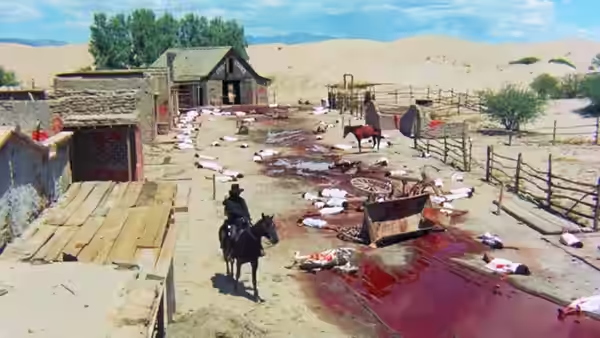
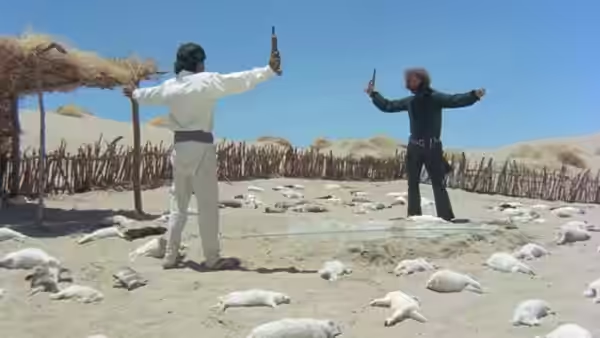
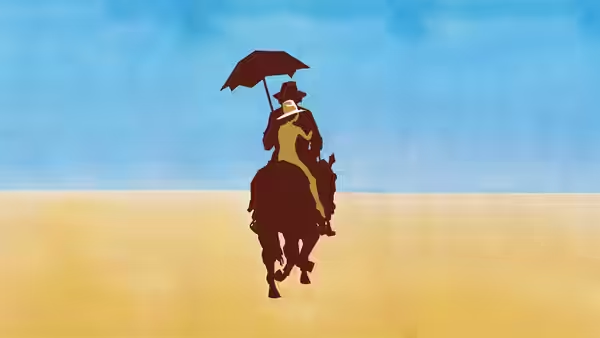
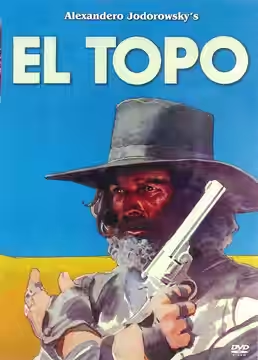
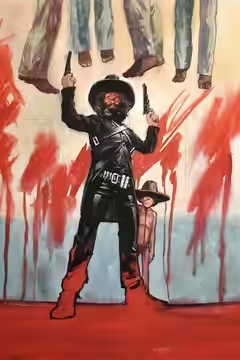
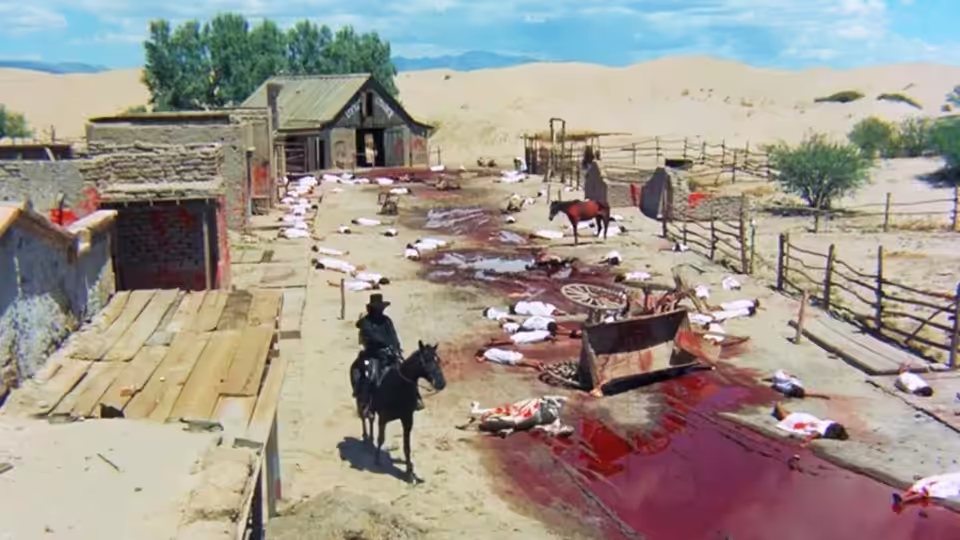
A lone rider approaches a dusty settlement strewn with bodies and blood
Film review

El Topo

1970 · Directed by Alejandro Jodorowsky · 2h 05m

In a sentenceA western that makes getting lost in the desert seem the straightforward option

El Topo (Alejandro Jodorowsky) is the central figure in a desert western that combines adventure, drama and allegory. His son is played by Brontis Jodorowsky; Marah / The Woman (Mara Lorenzio) and The Colonel (David Silva) also feature. The desert imagery sits alongside scenes of cult horror, with symbols that draw the film away from straightforward western storytelling. Its characters inhabit a story shaped by a private mythology, where trying to understand the images is part of following what happens on screen.

Fi1m review

Alejandro Jodorowsky’s desert western has images that unsettle us and symbolism that wears us down. We recommend it for its strange conviction, with the warning that its 125 minutes can feel longer.

El Topo is worth seeing for its desert imagery and Alejandro Jodorowsky’s hypnotic presence, provided a western need not make much sense to keep us interested. Its bewilderment is often productive: we look harder because we cannot quite explain what we are looking at. But it also asks for patience it does not always repay. Across 125 minutes, the accumulation of symbols becomes tiring.

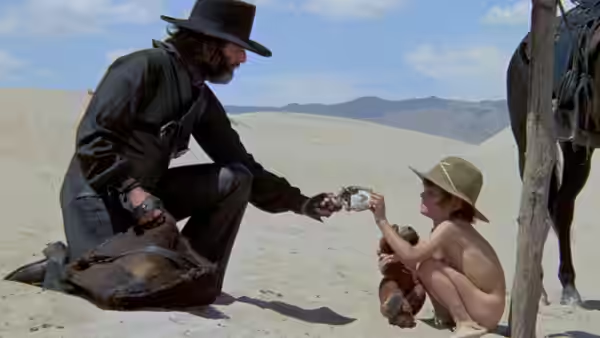
Rafael Corkidi’s cinematography gives us the strongest reason to persist. The desert images have a scale that makes the people seem vulnerable, and their force survives the effort to work out what they mean. We were unsettled by those landscapes, more than by the insistence of the cult-horror imagery. There is something persuasive about the desert itself, and the film is at its most absorbing when that is enough to hold our attention.

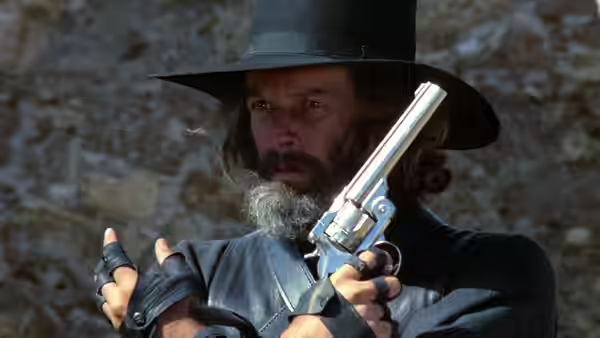
Alejandro Jodorowsky writes, directs and plays El Topo, bringing an assurance to the central performance that helps hold the film together. He can make its absurdity seem quite reasonable while we are watching him. That matters in a film whose private mythology gives us so little firm ground. His conviction keeps us watching, although we sometimes wanted another sensibility to question the importance he attaches to all this.

He also handles production design and costume design, so his control extends to what surrounds and clothes the performers. The resulting profusion of symbols is often intriguing, and there is pleasure in looking without immediately understanding. Too often, though, the images compete for attention. It becomes difficult to give any one of them much thought before we are asked to consider the significance of another.

The editing by Federico Landeros has to contend with that crowded material, and the film’s unevenness is partly the cost of preserving so much of it. Some of the bewilderment is invigorating, especially when an image catches us unprepared. Repeated exposure becomes wearing, however, and the length gives us time to notice the habit. We do not need every symbol explained, but we do need a reason to keep giving each new one our attention.

Alejandro Jodorowsky’s music helps sustain the film’s hypnotic quality, but it gives us little relief from the pressure of the images. The writing compounds the problem by making so much of its symbolism difficult to follow. Much of the critical enthusiasm rests on the force of those images, and we share it up to a point. We are less persuaded that difficulty alone makes the film worth sustained interpretation.

As a western, this asks us to accept unfamiliar priorities, and there is no reason the genre should be confined to orderly adventures. We can welcome the invention while remaining impatient with the self-indulgence. The film’s conviction and visual force make it worth the effort for anyone drawn to symbolic storytelling. Choose it for an evening when being baffled is an acceptable part of the entertainment.

Critical consensus AI synthesised

68
Positive
5
Mixed
4
Negative
0

Most critics lean positive on El Topo, with praise centring on its startling imagery and dense, conflicting symbols. The favourable reviews find its difficulty part of the appeal: the private mythology can be bewildering, but it also gives the film an immersive force. Jodorowsky’s direction and performance draw praise for their invention and hypnotic energy, while the desert imagery offers something concrete to admire amid the allegory.

The divide concerns how much that fascination compensates for obscurity and self-indulgence. Eye for Film acknowledges dated aspects but finds intelligence in the handling of clashing symbols; The Guardian is less persuaded by the film’s reputation, though its symbolism and disturbing cult-horror scenes still exert a pull. The spread runs from enthusiasm to qualified disappointment, with no wholly negative assessments in the supplied tally. Even the warmer accounts leave room for bewilderment.

Empire
30 March 2007 · David Parkinson
80*

The critic praises the film as a vital, visionary cult classic, despite its difficulty. He singles out its dense allegory and imagery for continuing to challenge and intrigue.

Read the full review →
Slant Magazine
11 December 2006 · ★★★/4 · Fernando F. Croce
75

Croce sees the film as a delirious, inscrutable work whose impact depends on whether its private mythology connects with the viewer. He praises its immersive force and its memorable, often startling imagery.

Read the full review →
RogerEbert.com
70*

The page is identified as a Great Movies review, but its verdict cannot be determined from the blocked content. No praised or criticized element is available to report.

Read the full review →
Sight and Sound
9 January 2020 · Philip Strick
70*

Strick finds the film absurd and bewildering, but ultimately energetic and inventive. He singles out Jodorowsky’s inventive direction and hypnotic performance for praise.

Read the full review →
The New Yorker
20 November 1971 · Pauline Kael
66*

The archive identifies this as Pauline Kael’s review of “El Topo,” but the review itself is unavailable here. The accessible listing does not reveal her verdict or what she singles out for praise or complaint.

Read the full review →
Time Out
3 April 2007 · Ben Walters
65*

The available description notes the film’s formidable reputation as a seminal midnight movie, but does not reveal the critic’s verdict. No specific element is singled out for praise or complaint in the accessible text.

Read the full review →

Straight answers AI written, from our review

Is El Topo worth watching?
El Topo is worth watching for its unsettling desert imagery and Alejandro Jodorowsky’s hypnotic presence, provided we can accept bewilderment as part of the entertainment; we score it 67/100. It suits viewers drawn to symbolic storytelling, but the crowded imagery and difficult-to-follow mythology become tiring across 125 minutes.
How long is El Topo, and what is it rated?
El Topo runs 2h 05m. It is an adventure and drama film.
Where can I watch El Topo in Mexico?
El Topo is available to rent from Apple TV from MX$60.00. Availability is checked daily; the links above go straight to each service.
How does El Topo compare to Dead Man Walking?
El Topo offers a bewildering, symbolic western, while Dead Man Walking is a capital-punishment drama we recommend more warmly for its performances and earned emotion. The latter’s debate sometimes feels too carefully arranged, but Susan Sarandon and Sean Penn’s difficult encounters provide a clearer reason to stay involved. Choose El Topo if strange imagery matters more than straightforward storytelling.

Cast

Awards

International Submission to the Academy Awards, 1972

Nominated
International Submission to the Academy Awards

If you liked this, try…

  1. The Shooting (1966) · not on Fi1m yetA western whose desert journey becomes harder to understand and harder to escape.

  2. A Field in England (2013) · not on Fi1m yetFor more hostile landscapes, occult ceremony and men losing their bearings.

  3. Onibaba (1964) · not on Fi1m yetIts rural horror gives bodily fear priority over explaining the supernatural.

  4. Dead Man (1995, Fi1m 84)Another western willing to wander, with more humour and less insistence.

  5. The Colour of Pomegranates (1969) · not on Fi1m yetCeremonial images reward close attention without requiring a conventional story.