Hala Matar’s 85-minute con game has a handsome house, a sharp cast and a script that keeps promising a sting it never quite delivers. Maria Bakalova is reason enough to stay for a drink; the plot is not reason enough to stay for dinner.
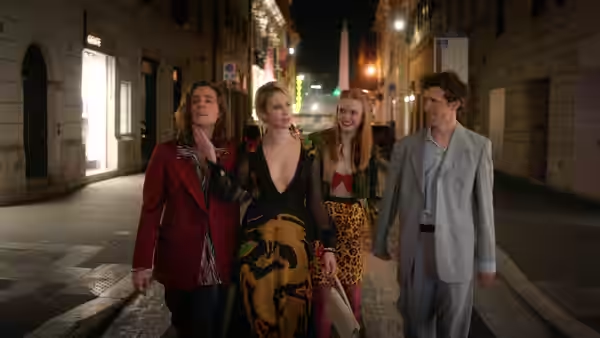
Hala Matar’s Electra belongs to a small and agreeable genre: the house-guest thriller, in which strangers arrive somewhere grand and sunlit and spend the running time deciding how badly to behave. A journalist, Dylan, and his girlfriend Lucy turn up to interview a rock star, Milo, at his villa, and it is quickly clear that the interview is cover for something else. Matar, who wrote the script with Daryl Wein and Paul Sado, has the right ingredients and the right length. What she does not have is a second act that builds on the first.
The cast is the film’s best argument. Maria Bakalova plays Francesca, the woman of the house, with a stillness that reads as boredom until you notice how much she is taking in, and she gets the film’s only properly good lines, delivered as if she were slightly embarrassed to be the cleverest person at the table. Jack Farthing’s Milo is a faded star who talks about himself in the past tense and expects to be interrupted with praise. Farthing is funny about this without tipping into caricature, and the scenes where Bakalova and Farthing circle each other have a tension the rest of the film borrows from.
Wein, who also wrote the screenplay, plays Dylan as the sort of man who is sure he is the cleverest person present and has never once been right. It is a brave thing to write yourself and then play, and he does it with some honesty. Abigail Cowen’s Lucy has the harder job, because the script cannot decide whether she is Dylan’s accomplice, his conscience or his victim, and Cowen plays all three in turn, well enough that we wished the writers had picked one.
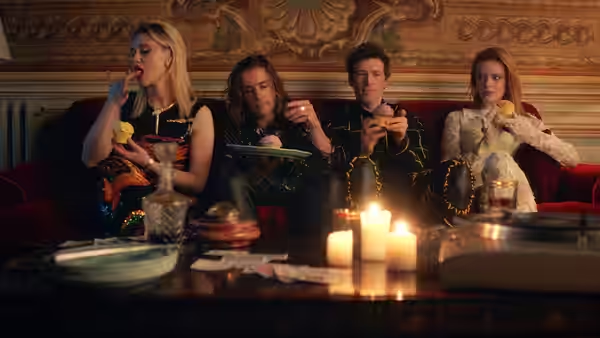
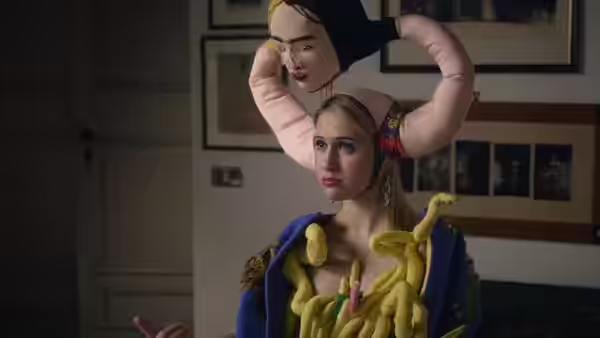
Michael Alden Lloyd shoots the villa with warm, soft light through tall windows and a pool that looks cold even at noon, and he keeps the camera close enough to faces that the house never becomes a travelogue. Alessandro Cicoria’s production design gives Milo’s rooms the look of money spent a long time ago and not since: good furniture, dusty, a few things on the walls that the visitors keep glancing at. Ali Helnwein’s score is sparse, a few plucked strings and a low hum under the dinners, and it is better the less of it there is. Matt Berardi and Spencer Rollins cut the first half hour with an easy rhythm that lets scenes breathe; the back half is cut more nervously, as if the editors knew something was missing and were trying to hurry past it.
Something is missing. A con film owes us a con, and Electra keeps deferring its own. Scenes of drink and flirtation that were charming at the twenty-minute mark are still going at the fifty, and the thing the guests came for recedes rather than approaches. We found ourselves, around an hour in, doing what the characters should have been doing: working out the plan, because the film had not. It is a particular kind of disappointment, watching good actors wait for a script to give them a move, and we felt it as impatience first and then as a mild sense of having been had, which is presumably not the sense the film wanted us to have.
The second half takes a turn we will not describe, and the turn is better than the road to it. There is one scene late on between Bakalova and Cowen, two women who have been talked over all evening finally talking to each other, that is quiet and sharp and shows what the film might have been. It lasts a few minutes. Then the plot remembers it has to end and does so briskly.
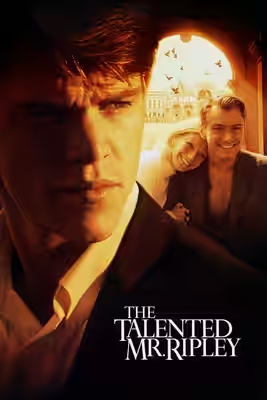
Against the genre’s best, La Piscine or The Talented Mr Ripley, this is thin stuff; those films knew that the house is only ever the setting and that wanting is the story. Matar has the house and the wanting and has not yet learned how to make one press on the other. At 85 minutes it does not outstay its welcome, and with a glass of something in hand and low expectations it passes pleasantly. Watch it for Bakalova. She is the only person in the villa who seems to know what she is there for.