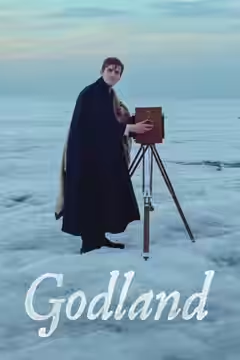
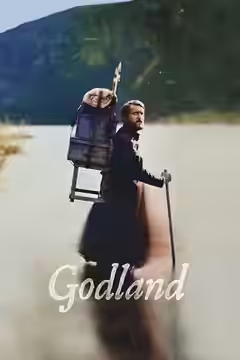
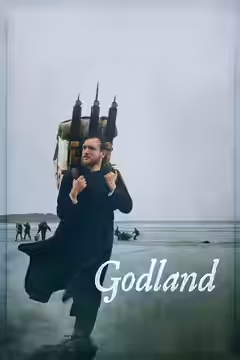
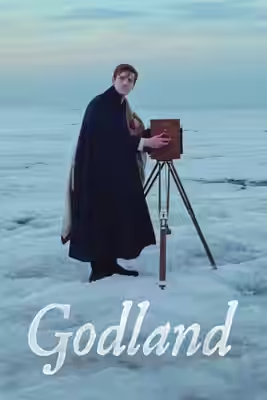
Godland poster

Godland

2022 · Directed by Hlynur Pálmason
2h 23mDrama12A
84
Fi1m score
80
Critics · 15
Audience · not yet

Where to watch in the UK

Checked 10 September at 22:29. Prices and availability change; the service’s page is the last word.

Plays from YouTube when you press play; nothing loads from them until then.

Synopsis

Denmark, in the second half of the nineteenth century. Lucas (Elliott Crosset Hove), a young Lutheran priest, is sent by his superior Vincent (Waage Sandø) to Iceland, then a Danish possession, to build a church in a remote settlement and photograph the people he finds there. He insists on landing early and crossing the island on horseback rather than sailing round, so that he can photograph the country on the way. With him go a translator (Hilmar Guðjónsson) and a guide, Ragnar (Ingvar E. Sigurðsson), who speaks no Danish and has little use for a priest. At the far end wait Carl (Jacob Lohmann), a Danish farmer, and his daughters Anna (Vic Carmen Sonne) and Ida (Ída Mekkín Hlynsdóttir). Hlynur Pálmason writes and directs, in Danish and Icelandic.

Fi1m review

In a sentenceA priest walks across Iceland to save it; Iceland is not asked and does not agree

Hlynur Pálmason’s film about a Danish priest crossing Iceland to build a church is severe, patient and, to our surprise, often funny. Maria von Hausswolff’s square-framed photography does most of the talking, and at 143 minutes the film could have talked a little less.

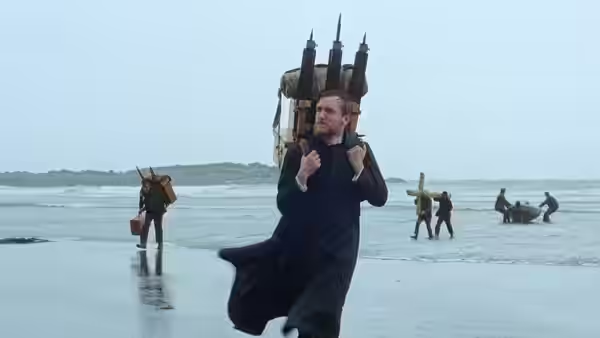
Lucas (Elliott Crosset Hove) is a young Danish priest with a mission and a camera. Vincent (Waage Sandø), the superior who sends him, tells him to sail round to a settlement on Iceland’s far coast, build a church before winter and photograph the people. Lucas decides instead to land on the near side and cross the island on horseback, to photograph it on the way. Everyone he meets thinks this is foolish, and they are right. Hlynur Pálmason’s film is a fine one and a long one, and we recommend it with the plain warning that it moves at the pace of a loaded horse.

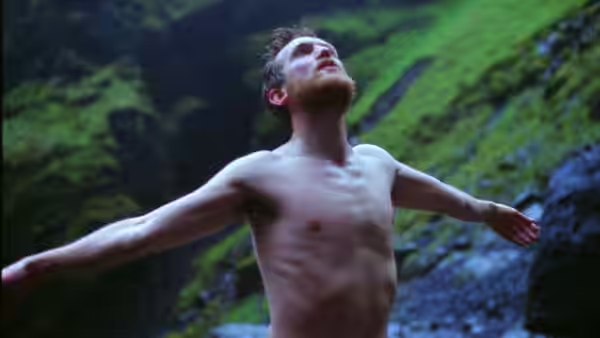
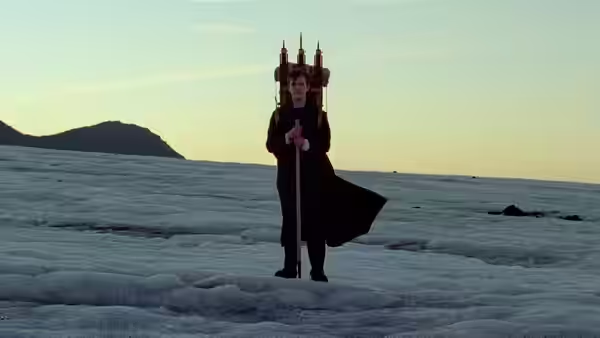
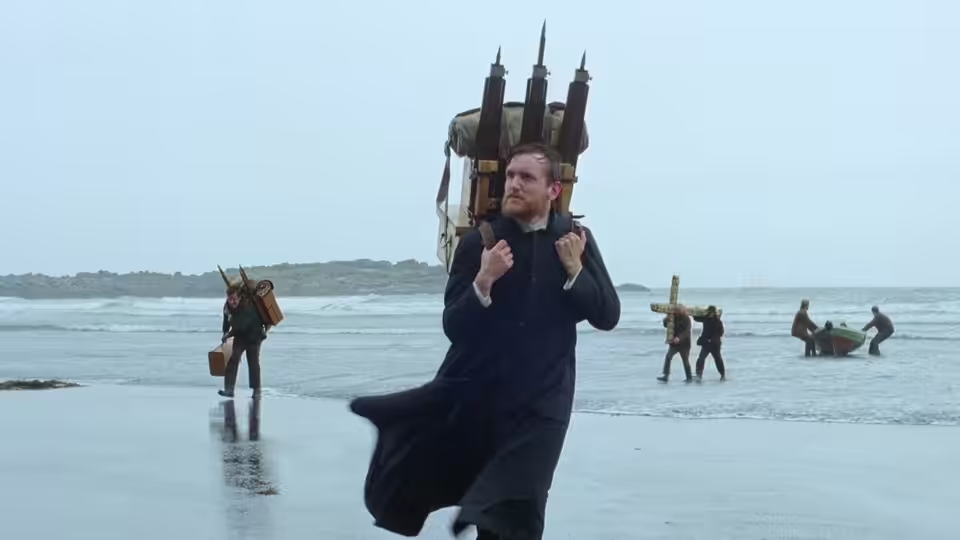
Maria von Hausswolff shoots on 35mm in the near-square Academy ratio, and the shape of the frame does much of the arguing. A widescreen Iceland would have looked like a holiday. This one looks like a wall: rock, moss, cloud and river stacked one on top of the other, and the men crossing the bottom of it take up almost nothing. Julius Krebs Damsbo cuts without hurry and with dry timing: a wide shot of the party picking across a valley, held until it starts to feel like a painting, then the same party in the next shot, not visibly further along.

Lucas’s photographs are a separate matter. The camera he has carried over the sea is heavy, the plates take minutes to expose, and Pálmason stages each one as a small ceremony, the subject holding still while the priest fusses under his cloth. The film’s own look is modelled on photographs of this kind. Ragnar (Ingvar E. Sigurðsson), the Icelandic guide, submits to the lens the way a horse submits to a bridle.

Ragnar is the best thing in the film. He speaks no Danish, Lucas speaks no Icelandic, and a translator (Hilmar Guðjónsson) stands between them tidying up what each has said. Sigurðsson plays him as a man who made up his mind about the priest in the first ten minutes and sees no reason to revisit it. We laughed more than we expected, mostly at him, because he has a gift for doing exactly what Lucas has asked in the way least likely to please him. Hove lets Lucas thin out: the collar goes grey, the cheeks go hollow, and the certainty stays put long after the body has given up on it.

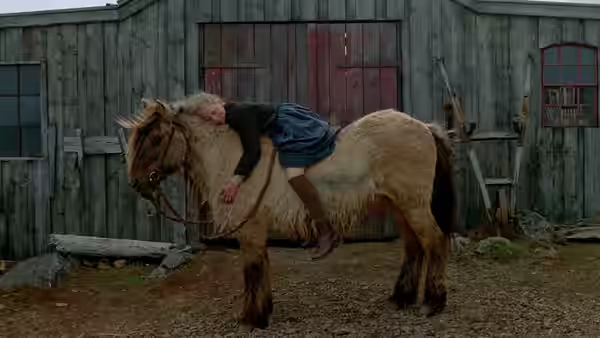
The scene that frightened us is a river crossing. The water is brown and fast and up to the horses’ chests, the camera sits down near the surface, and there is no music, only water and breathing and tack creaking. We were sure someone would go under. Elsewhere Pálmason leaves his camera on a dead horse and lets the seasons pass over it in a minute. It is the bleakest image in the film, and we found it oddly steadying. The country takes everything back and is in no hurry.

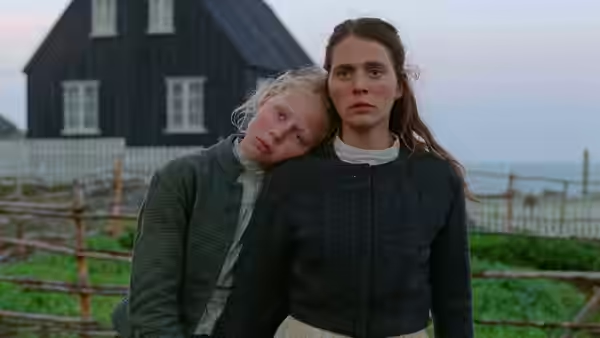
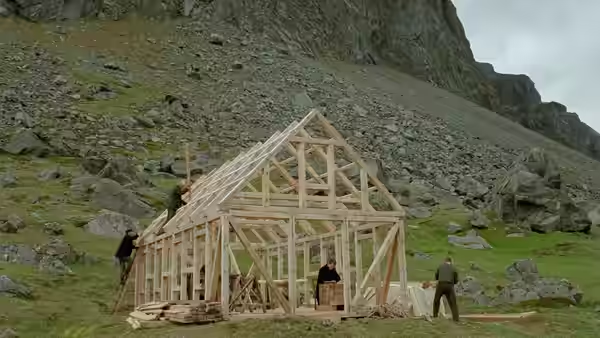
The second half reaches the settlement, where Carl (Jacob Lohmann), a Danish farmer, lives with his daughters Anna (Vic Carmen Sonne) and Ida (Ída Mekkín Hlynsdóttir). Frosti Fridriksson’s production design gives Carl a low turf-roofed house and, going up plank by plank beside it, a timber church that plainly belongs to another country. Nina Grønlund dresses the settlers in oiled wool and the priest in black cloth that the weather steadily unpicks. Alex Zhang Hungtai’s score is a handful of long, low tones that arrive rarely enough to count as events. Sonne’s Anna is watchful and unimpressed, the only person who treats Lucas as neither a nuisance nor a superior. What follows between priest, guide and family takes turns we will not describe.

We would cut ten minutes. A wedding in the settlement, with its accordion and dancing, runs on past the point where it has told us what it needs to, and a few of the second-half landscapes are there for their own sake. The story, once its pieces are in place, goes more or less where you think it will. It matters less than it might, because the film is not asking whether Lucas will fail but how long he can go on believing he is the hero of a place that has not noticed him.

Films about men who walk into a wilderness and come apart usually give the wilderness at least one shot as an ally. Pálmason never does. See this on the biggest screen you can find, with your phone in another room. It asks for two hours and twenty-three minutes of your patience and pays most of them back.
Critical consensus AI synthesised

80
Positive
14
Mixed
1
Negative
0

Most critics agree on where Godland’s strength lies: the landscape photography. Nearly every review singles out the way Hlynur Pálmason’s film renders 19th-century Iceland, with the Academy ratio and the period-photograph look mentioned again and again, and several treat the country itself as the real antagonist. The priest’s slow undoing, from arrogance into illness and madness, is the other point of praise, along with the lead performance and a streak of dry humour that a few reviewers did not expect from something this stern. Reservations are few and cluster around pace: several describe it as slow and deliberate, Screen Daily finds it slightly overlong, and RogerEbert.com calls it uneven. The one mixed notice, from Time Out, admires the visuals but suspects the languid pacing will test some viewers. The spread is otherwise narrow, with most reviews landing between four stars and outright acclaim, and no publication dismisses it.

Los Angeles Times
9 February 2023 · Justin Chang
90*

The bleak and beautiful drama is a stunning epic of a 19th-century Danish priest on an arduous, misguided journey across Iceland, undone by arrogance and spiritual hubris. It excels as a withering chronicle of colonialism and man's confrontation with nature, elevated by magisterial cinematography.

Read the full review →
Variety
24 May 2022 · Critics Pick · Peter Debruge
85*

The visually striking and emotionally austere film sees a Danish priest's faith tested by Iceland's unforgiving landscape and colonial history, evoking an Arctic 'There Will Be Blood.' It offers rich material rendered with unique pacing and attention to detail.

Read the full review →
Empire
7 April 2023 · Pamela Hutchinson
80*

An idealistic Danish priest on a mission in remote Iceland gradually disintegrates amid harsh conditions and local hostility. The critic praises the austere, rigorous direction, vintage photographic style, and visceral lead performance.

Read the full review →
Financial Times
6 April 2023 · Danny Leigh
80*

The critic highlights how the film renders Iceland's stark landscape and climate so vividly that viewers feel immersed without effects. It singles out the double-edged 'terrible and beautiful' quality of the country and the indelible images.

Read the full review →
Little White Lies
4 April 2023 · 4/4/4 · Josh Slater-Williams
80

The review calls it a darkly comic epic that is much funnier than expected amid the harshness, delivering another elliptical and elemental treat from a major European filmmaker. It highlights the cultural clash and the priest’s crisis of faith in the second half.

Read the full review →
Radio Times
★★★★ · James Mottram
80

The review describes a stern, rigorous arthouse drama requiring patience for its deliberate pace, but rewarding with beauty amid the bleakness. It singles out the stormy landscape shots and the tale of cultural opposites clashing.

Read the full review →

Cast

Stills

Awards

European Film Award for Best Actor, 2022

Nominated
European Film Award for Best Actor

Gold Hugo, 2022

Won
Gold Hugo

Nordic Council Film Prize, 2022

Nominated
Nordic Council Film Prize

If you liked this, try…

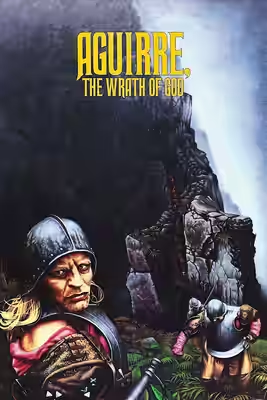
Aguirre, the Wrath of God poster

Aguirre, the Wrath of God

1972 · Another European with a plan and a river, and the jungle keeps the plan.

Meek's Cutoff poster

Meek's Cutoff

2010 · Settlers, a guide nobody trusts, and a landscape that will not be hurried.

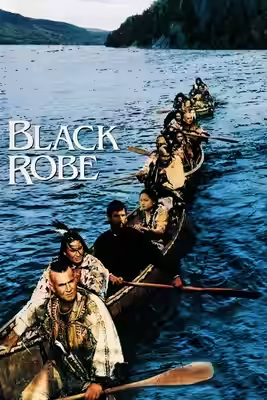
Black Robe poster

Black Robe

1991 · A Jesuit in seventeenth-century Canada learns his faith travels worse than he does.

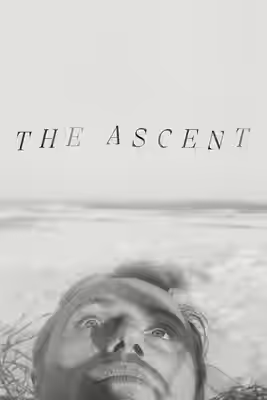
The Ascent poster

The Ascent

1977 · Two Soviet partisans in the snow; belief tested to breaking, shot in hard black and white.

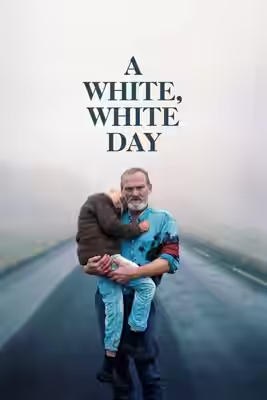
A White, White Day poster

A White, White Day

2019 · Pálmason’s previous film: a grieving Icelandic policeman, the same patience, a smaller frame.