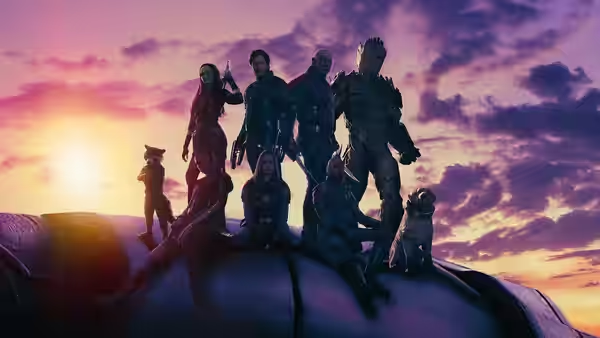
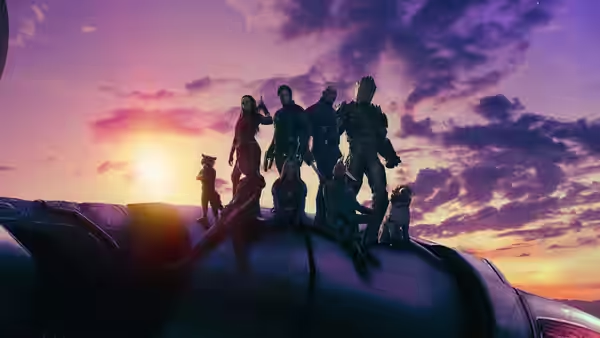
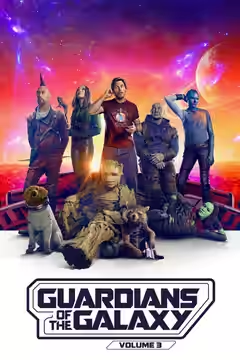
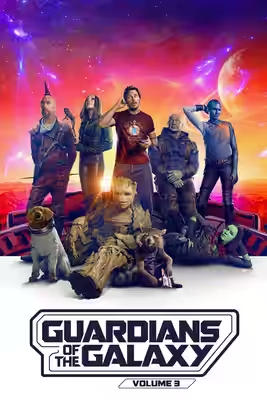
James Gunn’s farewell to the Guardians gives Rocket a past so cruel it stopped us cold, then builds a loud, funny, overlong rescue around it. The villain shouts and the middle sags, but the raccoon earns every minute he is given.
James Gunn ends his trilogy by taking the joke seriously. Rocket, the raccoon with the guns and the mouth, has been the punchline since 2014; this film asks where he came from and answers in detail, and the answer is not a kind one. Around that it wraps a rescue mission, a golden idiot, a shouting scientist and 150 minutes, which is a good half hour more than the story needs. It is the best of the three and it is also the longest, and the length costs it.
Here is what we felt. The first time the film cut away to Rocket’s past, a small animal in a cage in a bright room, we stopped laughing and did not start again for some minutes. We had not expected a Marvel film to upset us, and it did, and we were slightly resentful about it. Gunn shoots these scenes without decoration: white light, steel, animals talking to each other in the dark after the men have gone. Sean Gunn voices the young Rocket and Bradley Cooper the grown one, and neither plays it for pity. Cooper’s work here is the best acting in the series, done by a man we never see.
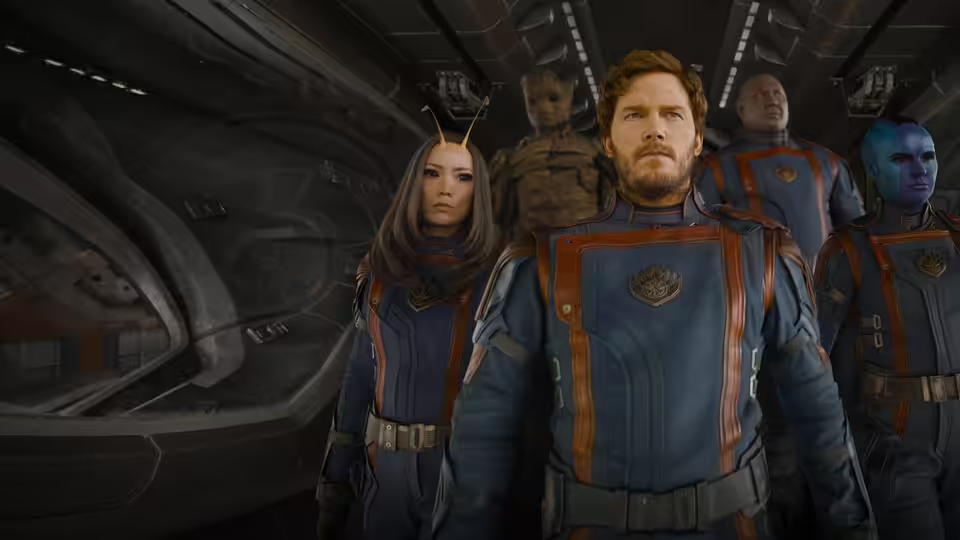
Chukwudi Iwuji plays the High Evolutionary at full volume from his first scene, a man who builds worlds, judges them imperfect and burns them, and who wants nothing except to be right. It is one note, but the note is hateful, and the film needs him hated more than it needs him understood. Beth Mickle’s production design gives him places to be hateful in: an orbiting headquarters built of flesh, with corridors like intestines and doors that pucker instead of opening, and a suburb where animal-human hybrids drive estate cars and watch television. Henry Braham lights it in hot pinks and sick yellows, and the crew go in wearing Judianna Makovsky’s padded, sweet-wrapper spacesuits, so the frame looks like a bag of pick-and-mix dropped in an abattoir. We mean that as praise.
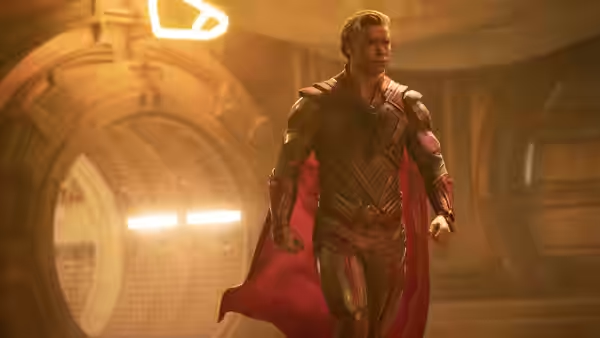
The cutting is the trouble. Three editors are credited, Fred Raskin, Tatiana S. Riegel and Greg D’Auria, and the film moves like something settled at a meeting. The flashbacks land exactly where they should; the present-day plot between them doubles back, stops for fights nobody asked for, and in the middle hour repeatedly reaches the end of a scene and then carries on. Will Poulter’s Adam Warlock, a golden man-child who hits first and thinks never, is funny in every scene he has and has hardly any, and the film keeps mislaying him in a way that suggests he is here because a contract said so. John Murphy’s score is capable and mostly buried under the pop songs, which are, as before, the film’s real music; only in Rocket’s past does a quiet piano line get room to work.
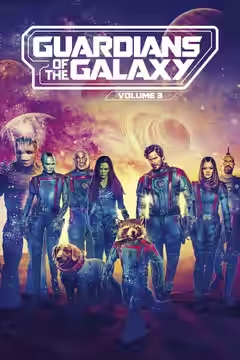
Chris Pratt’s Quill is drunk, sad and less funny than before, and that is the point. His scenes with Zoe Saldaña, playing a Gamora who owes him nothing and says so, are the most grown-up writing in the film: a man trying to pick up a relationship with a woman who was never in it. Dave Bautista and Pom Klementieff are the double act, Drax’s cheerful literalism against Mantis’s worn-out patience, and whenever the plot stalls Gunn sends them off together to be stupid, and it works every time. Karen Gillan’s Nebula spends the film as the only adult aboard, snapping at everyone. There is a corridor fight late on, staged as one long moving shot with the whole team in it, that is the best piece of action the series has managed, and we grinned through all of it.
The first Guardians of the Galaxy (2014) got away with its sentiment by never resting on it. Vol. 2 (2017) rested on it and went sticky. This one earns its sentiment and then keeps asking for more: the closing stretch goes on well past the point it has made, and somewhere in it we were looking at our watch, and felt rotten about it, given what the film had done to us an hour earlier.
The reviews have mostly been warm, and we are with them on the raccoon and against them on the length. See it, and if you have children, or a dog, know that the flashbacks are harder than a 12A usually allows. At home you can pause it, which helps, both for the length and for the flashbacks. It runs 150 minutes.