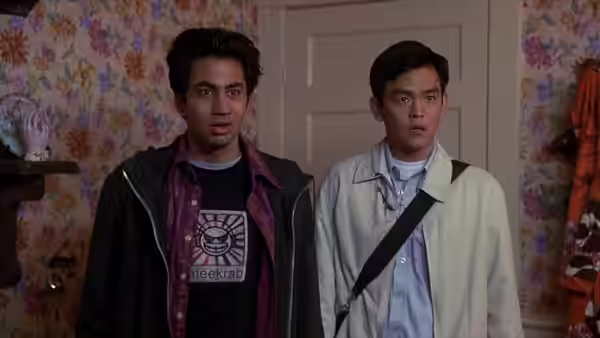
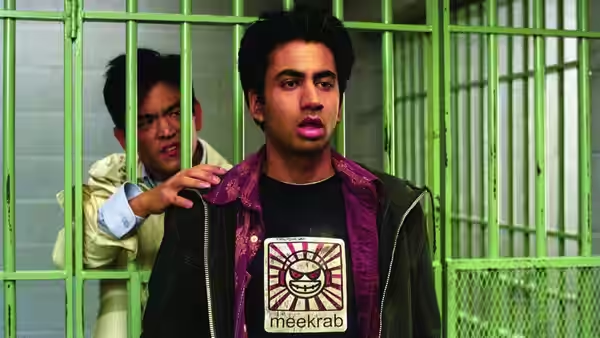
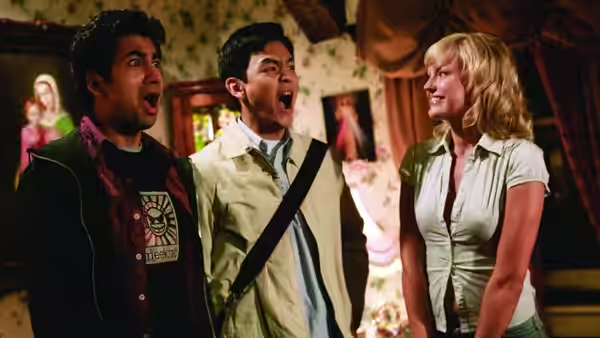
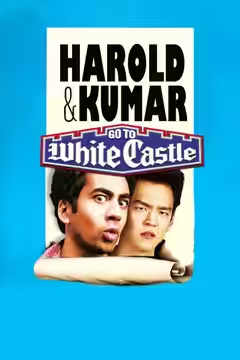
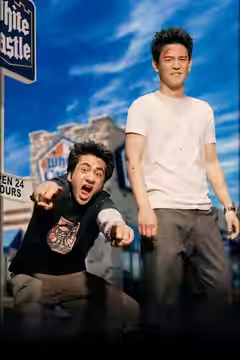
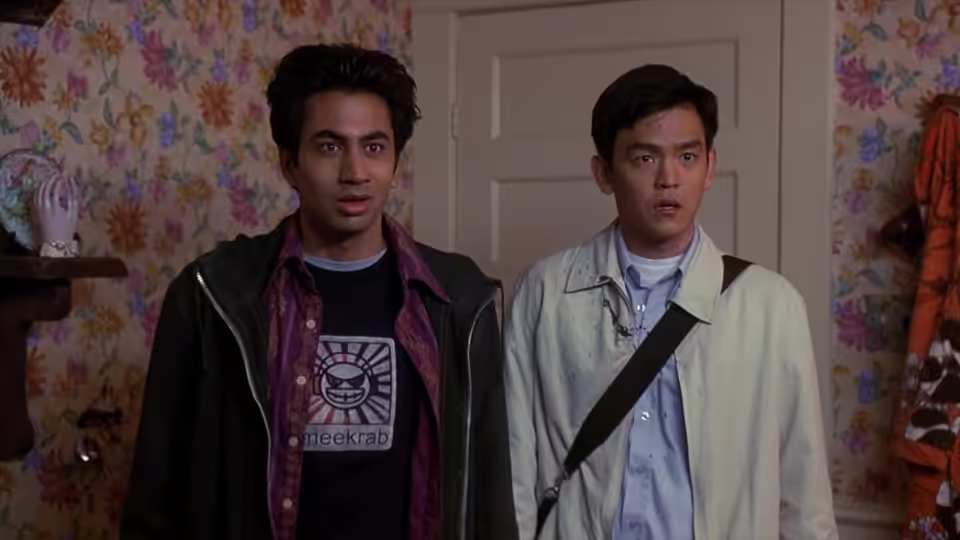
Harold (John Cho) and Kumar (Kal Penn) stand startled in a flowered room
Film review

Harold & Kumar Go to White Castle

2004 · Directed by Danny Leiner · 1h 28m

In a sentenceA Korean banker and an Indian medic refuse to be the joke, so everyone else in New Jersey volunteers

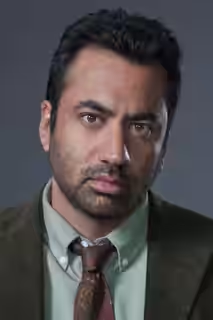
New Jersey, a Friday evening. Harold Lee (John Cho), a junior analyst at an investment bank, has just been handed two colleagues’ weekend work because they assume the quiet Korean guy will not refuse. His flatmate Kumar Patel (Kal Penn) has spent the afternoon wrecking a medical school interview with Dr. Willoughby (Fred Willard) so that he will never have to be the doctor his father wants. Harold, meanwhile, cannot get a sentence out in front of Maria (Paula Garcés), the neighbour he shares a lift with. The two get high, see a White Castle advert, and set out for a sack of sliders. The nearest branch has closed, so they point the car at Cherry Hill, and the night slips away from them.

Plays from YouTube when you press play; nothing loads from them until then.

Fi1m review

A stoner road comedy with a sharper idea than its lavatory jokes suggest. John Cho and Kal Penn are the two sane men in New Jersey, and the film’s best joke is that everyone they meet has already decided who they are.

Danny Leiner’s previous film, Dude, Where’s My Car? (2000), was about two idiots looking for something. This one is about two clever men looking for something, and the difference turns out to be most of what matters. Harold & Kumar Go to White Castle is a stoner comedy in the Cheech and Chong line, 88 minutes long, built around one night’s drive across New Jersey for a bag of small square hamburgers. It has an idea the genre had not tried: its heroes are a Korean-American and an Indian-American, and the film is about how everybody else notices that before they notice anything else. It is good. It is also crude in ways that do not help it, and it is far more interested in race than in anything else, including women.

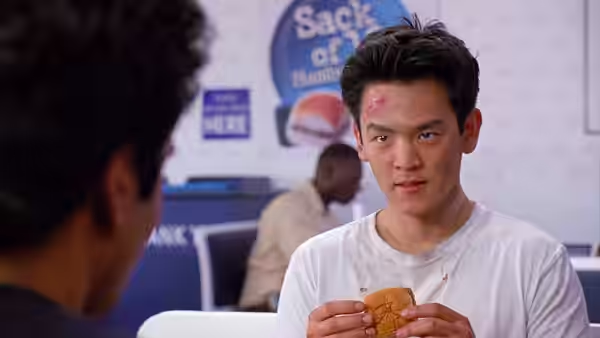
John Cho plays Harold as a man who has said yes to every imposition in his life and is still waiting to be thanked for it. His colleagues dump their weekend work on him because they assume the quiet Asian analyst will take it, and he does. Kal Penn’s Kumar has the opposite problem: he is plainly brilliant, could be a doctor tomorrow, and would rather set fire to the interview than give his father the satisfaction. The pair argue like a married couple, and the script by Jon Hurwitz and Hayden Schlossberg gives every stranger they meet a theory about them. The punks who harass them cannot work out which country to insult. The joke is never that Harold and Kumar are Asian. The joke is the people who think that is the joke.

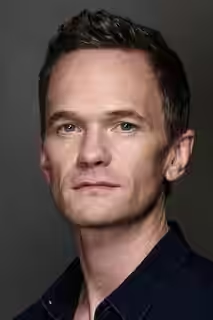
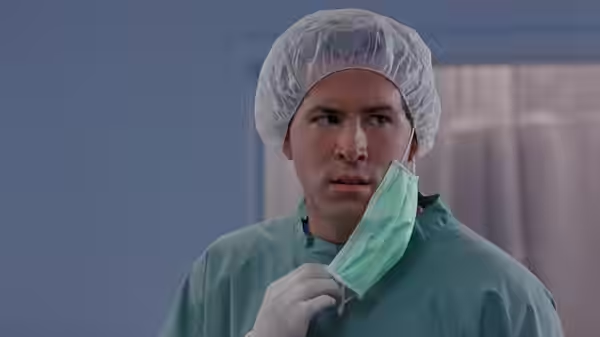
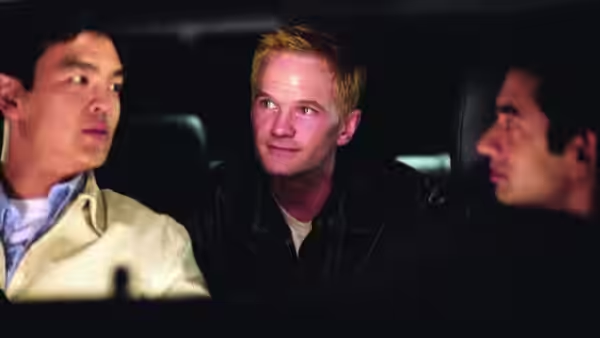
The road takes in a Princeton campus, a raccoon, an emergency room, a boil-covered stranger called Freakshow (Christopher Meloni) and his wife Liane (Malin Akerman), and Neil Patrick Harris as a version of himself we will leave you to meet. Not all of it lands. The Freakshow stretch goes on a minute past its best gag, and the Princeton lavatory scene, which puts Christy (Kate Kelton) and Clarissa (Brooke D’Orsay) in adjacent cubicles for a contest we will not describe, made us laugh and then wish we had not. Ryan Reynolds has two minutes as a nurse and uses every second of them.

We laughed hardest in the hospital. Kumar, who has spent the whole film refusing to be a doctor, is handed the instruments and turns out to be superb, and Penn plays him as a man furious at how much he is enjoying it. It is a joke and a piece of character at the same time, which the film does not often manage, and it told us more about Kumar than any of his speeches. Harris got us too, for reasons that have nothing to do with craft and everything to do with nerve.

Leiner directs flatly. Bruce Douglas Johnson shoots the night like a car advert, orange streetlamps and clean faces, and nothing in the frame cost more than it had to. Jeff Betancourt keeps every episode short, which rescues two or three that would have died at full length. David Kitay’s score hums under the driving and stays out of the dialogue, which is the right call. Steve Rosenzweig’s one piece of design that matters is the restaurant itself, which appears in adverts and daydreams lit like a chapel. Alex Kavanagh keeps Harold in his office shirt and tie all night, so he looks like a man who has not been allowed to stop working, which is what he is.

Two things count against it. The film is also an 88-minute advertisement for a hamburger chain and does not pretend otherwise. And Maria (Paula Garcés), the neighbour Harold cannot speak to, has about four lines and a lift to stand in. She is a prize, like the burgers. The neighbours Goldstein (David Krumholtz) and Rosenberg (Eddie Kaye Thomas), off on a hot dog errand of their own, get more to do than she does.

Cheech and Chong’s films were about being stoned. This one is about two stoned men trying to get somewhere, and that gives it a spine the genre usually lacks. It reached British cinemas on 4 March 2005 with a 15 certificate. Watch it late, with company, and with food in the house, because by the end you will want some.

Critical consensus AI synthesised

68
Positive
3
Mixed
5
Negative
0

Most critics like it, and none dislike it outright: three positive reviews, five mixed, nobody negative. The praise clusters on the jokes, which several reviewers find funnier and more inventive than the usual gross-out stoner comedy, and on John Cho and Kal Penn, who are repeatedly described as a well-matched pair. Variety calls them a perfectly matched comic duo, and the film’s playful, pointed treatment of racism is counted as a strength by more than one critic.

The reservations are about evenness and familiarity. The Guardian finds dull stretches between the horribly funny moments; Empire thinks the toilet humour holds back a warmer, richer comedy; Slant Magazine, the lowest score, finds it hard to tell apart from earlier stoner films and is troubled by the White Castle promotion and the handling of Asian stereotypes. The spread is moderate rather than wide, from one outright rave to a shrug, and two reviews could not be fully read, so the picture is incomplete.

Time Out
23 April 2008 · DA
90*

The critic calls the stoner comedy one of the funniest films they have seen in years. The visible text singles out its humor for praise.

Read the full review →
Variety
20 June 2004 · festival review · Robert Koehler
80*

Koehler finds the comedy energetic, clever, and more inventive than a conventional gross-out film. He especially praises John Cho and Kal Penn as a perfectly matched comic duo.

Read the full review →
IndieWire
28 July 2004 · eug
75*

The critic finds the film very funny despite its lack of political correctness. The review singles out the outrageous encounters along Harold and Kumar’s burger-seeking adventure as a source of comedy.

Read the full review →
Screen Daily
27 July 2004 · Andy Bailey
64*

The page identifies this as a review, but its criticism is hidden behind a paywall. No verdict or specific praise or complaint is visible in the available text.

Read the full review →
The New York Times
30 July 2004
64*

The page could not be read, so the critic’s verdict cannot be established. Its headline suggests a focus on the film’s treatment of stereotypes, but the review’s specific praise or complaints are unavailable.

Read the full review →
Empire
1 January 2000 · Damon Wise
60*

Wise finds the comedy warm, inventive and often hysterical, but says it is held back by toilet humour and falls short of its promise. He particularly praises its richer characters and its playful treatment of racism.

Read the full review →

Straight answers AI written, from our review

Is Harold & Kumar Go to White Castle worth watching?
Harold & Kumar Go to White Castle is worth watching if a stoner road comedy is your idea of a Friday night, and we scored it 71. John Cho and Kal Penn are the two sane men in New Jersey, and the best joke is that everyone they meet has already decided who they are. It is crude in ways that do not help it, and its women get almost nothing to do.
How long is Harold & Kumar Go to White Castle, and what is it rated?
Harold & Kumar Go to White Castle runs 1h 28m. It is a comedy and adventure film.
Where can I watch Harold & Kumar Go to White Castle in Romania?
Harold & Kumar Go to White Castle is not on any streaming or rental service in Romania at the moment. It is available in 7 other countries; change your country at the top of the page to see where. Availability is checked daily.
How violent or frightening is Harold & Kumar Go to White Castle, and is it suitable for children?
Harold & Kumar Go to White Castle carries a UK 15 certificate and is not for children, though it is crude rather than violent or frightening. The content is drug use, lavatory humour and a contest between two women in adjacent cubicles that made us laugh and then wish we had not. Older teenagers and adults who can take that sort of thing will be fine.
How does Harold & Kumar Go to White Castle compare to Up in Smoke?
Harold & Kumar Go to White Castle is the sharper and better-built film, while Up in Smoke is slower, sillier and happy to go nowhere at all. Cheech and Chong are good company in a two-shot but their picture stalls whenever it has to move; Harold and Kumar are trying to get somewhere, and that gives their film a spine. Choose the earlier one for the duo, the later one for the story.
What should I watch after Harold & Kumar Go to White Castle?
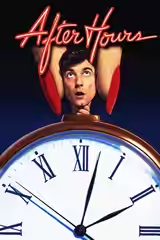
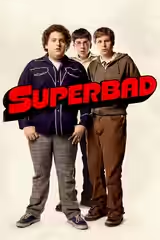
After Harold & Kumar Go to White Castle, try Up in Smoke (1978, Fi1m 56): Cheech and Chong set the template; slower, sillier and happy to go nowhere at all. Then After Hours (1985, Fi1m 80): Scorsese’s one-night odyssey across Manhattan, where every stranger makes things worse; and Superbad (2007, Fi1m 82): Two friends, one errand, a night that refuses to cooperate; the same shape, sharper on friendship.

Cast

If you liked this, try…

  1. Harold & Kumar Escape from Guantanamo Bay (2008) · not reviewed yetThe sequel turns the race joke into the whole plot, with mixed but lively results.

  2. Up in Smoke (1978, Fi1m 56)Cheech and Chong set the template; slower, sillier and happy to go nowhere at all.

  3. After Hours (1985, Fi1m 80)Scorsese’s one-night odyssey across Manhattan, where every stranger makes things worse.

  4. Human Traffic (1999) · not reviewed yetCardiff’s answer to the stoner night out, loud, warm and fond of its idiots.

  5. Superbad (2007, Fi1m 82)Two friends, one errand, a night that refuses to cooperate; the same shape, sharper on friendship.