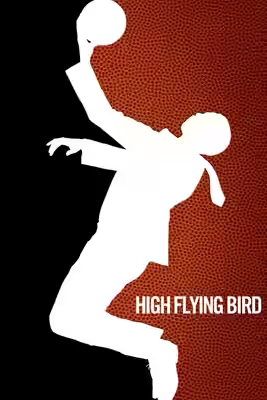
High Flying Bird poster

High Flying Bird

2019 · Directed by Steven Soderbergh
1h 30mDrama15
78
Fi1m score
76
Critics · 17
Audience · not yet

Where to watch in the UK

Checked 10 September at 22:29. Prices and availability change; the service’s page is the last word.

Plays from YouTube when you press play; nothing loads from them until then.

Synopsis

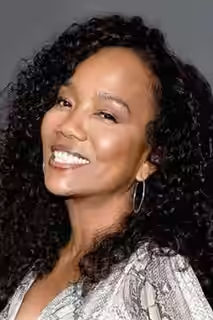
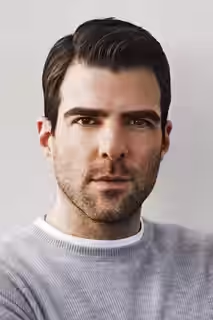
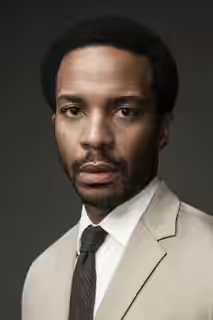
The NBA is in a lockout, and nobody is being paid. Ray Burke (André Holland), a sports agent in New York, has a rookie client, Erick Scott (Melvin Gregg), who has been drafted but has yet to play a game or see a cheque. Ray’s own agency, run by David Starr (Zachary Quinto), is cutting costs. Between the owners, represented by David Seton (Kyle MacLachlan), and the players’ association, in the shape of Myra (Sonja Sohn), Ray sees a gap. With his former assistant Sam (Zazie Beetz) and an old coach, Spence (Bill Duke), who trains kids in a gym, he sets out to play, as he puts it, the game on top of the game. Written by Tarell Alvin McCraney and directed by Steven Soderbergh.

Fi1m review

In a sentenceNinety minutes of smart people in tall buildings arguing about a game nobody is allowed to play

An agent tries to turn an NBA lockout against the owners, in ninety minutes of quick, dense talk written by Tarell Alvin McCraney and shot by Steven Soderbergh on a phone. Sharp, well acted and a little cold, and it ends a scene early.

The first thing that happens in High Flying Bird is a card being declined. Ray Burke (André Holland), a sports agent, is buying lunch for his rookie client Erick Scott (Melvin Gregg), and the corporate card comes back dead, because the league is in a lockout and the agency has stopped paying for lunches. Ray talks his way through it without raising his voice, which is the film in miniature. Steven Soderbergh directs, shoots and edits; Tarell Alvin McCraney writes; and for 90 minutes people in suits talk, quickly, about money and who gets to keep it. It is good. There is one game of basketball in it, and it is played in a gym.

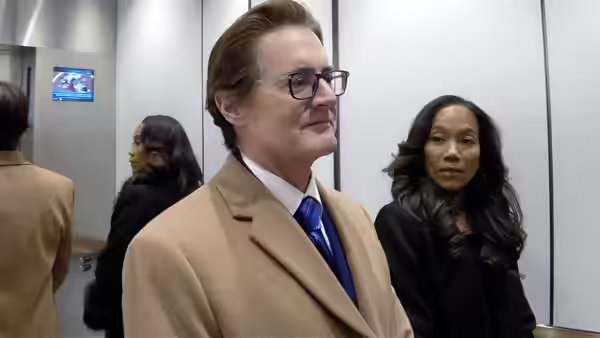
McCraney’s script is the reason to watch. Ray moves between the owners, represented by David Seton (Kyle MacLachlan); the players’ association, in the shape of Myra (Sonja Sohn); his boss, David Starr (Zachary Quinto), who wants the lockout over; and Sam (Zazie Beetz), his former assistant, who has left for a better job and still takes his calls. Every conversation is a negotiation with a second one underneath it. Holland delivers the lines at the pace of a man who has thought three moves ahead and is bored waiting for you to catch up. The back half has the shape of a heist, except that the thing being stolen is leverage.

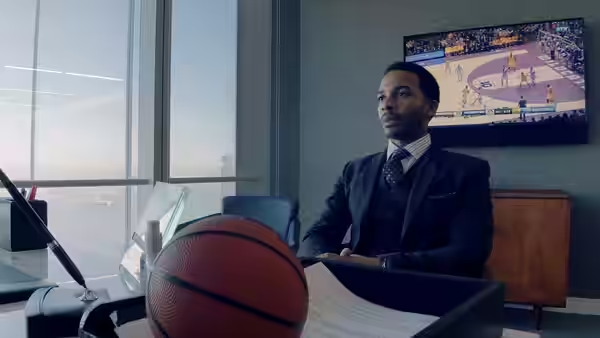
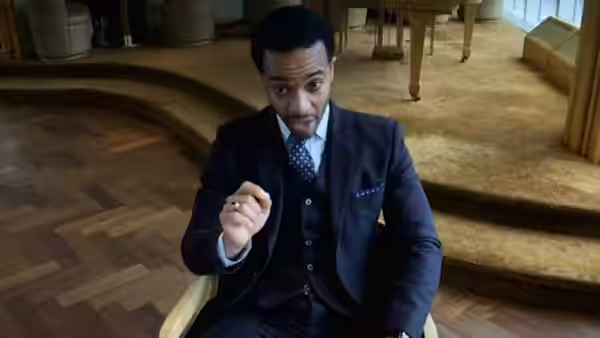
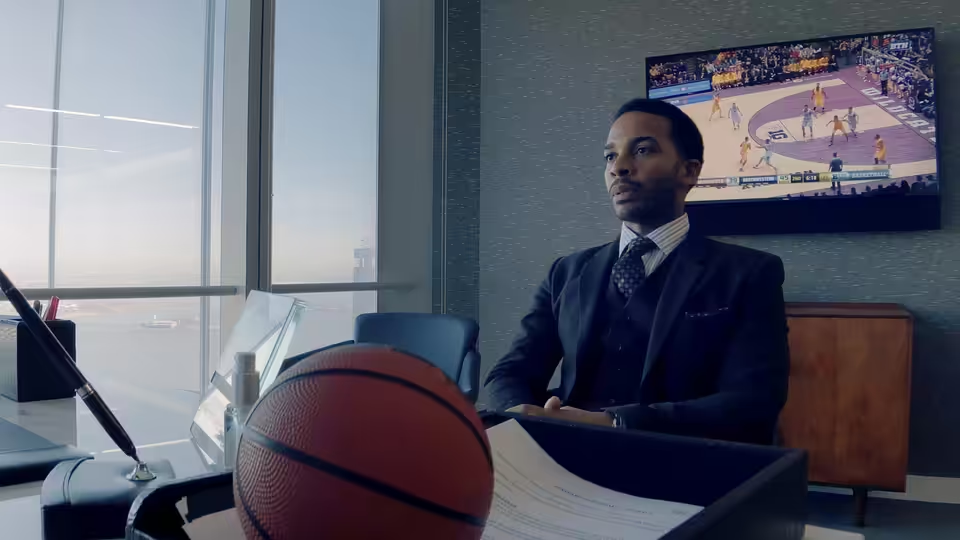
Soderbergh shot it on an iPhone, and it shows in every frame. The lens is wide, so the corners of rooms bend and a man at the far end of a table looks a long way off. Andy Eklund’s production design gives him glass, steel and grey carpet, offices where the city is always behind somebody’s head, and the phone flattens it all into a cold, even sheen. That suits a film about people always on the way to a meeting. Outdoors in daylight, though, the image goes thin and we wished for a proper camera. Marci Rodgers dresses Ray in narrow suits that fit better than anyone else’s, a joke about how much money he does not have. David Wilder Savage’s score is a small electronic pulse under the walking and stays out of the arguments.

The scenes that got to us are the ones away from the offices. Bill Duke plays Spence, an old coach who runs a gym for kids and has a rule that anyone who compares the league to slavery must say a set phrase of penance out loud. It is a laugh the first time and not the second. Duke sits still and says little, and a late conversation between him and Ray, two black men of different generations working out what the game has cost them, moved us more than anything said in a boardroom. Soderbergh also cuts in interviews with real young players talking plainly about being drafted, and those few minutes weigh more than some of the plotting around them.

The talk is the pleasure and also the problem. McCraney writes in jargon and does not slow down for us. We kept up, mostly, but there were stretches where we followed the mood of a scene and not what was agreed in it. A few speeches, Sohn’s in particular, are addressed to a room rather than a person and sound it. And the ending is softer than the build-up. Ray’s scheme is the engine of the film, and we will not describe where it lands, except that the last ten minutes are quieter than an hour of plotting had led us to expect. We were a little let down, and we suspect that is partly the point. It does not make those minutes land any harder.

Soderbergh has made lighter films about clever people robbing institutions; this is the one where the robbery is an idea and nobody has a good time. It is nearer his cheap, fast, talky pictures than to Ocean’s Eleven, and it shares their virtue, that 90 minutes is the right length, and their flaw, that they can feel like a well-run meeting.

Turn the subtitles on and put your phone face down. The film was shot on one, and that is enough phones for one evening.
Critical consensus AI synthesised

76
Positive
14
Mixed
2
Negative
1

Most critics like High Flying Bird, and they like it for the same reasons. The praise clusters on Tarell Alvin McCraney’s script, with its fast, dense, jargon-heavy dialogue, and on André Holland’s performance as the sports agent at the centre of it, which The Ringer calls star-making. Soderbergh’s decision to shoot on an iPhone is mostly treated as a strength, giving the film immediacy and intimacy, though Radio Times suspects some viewers will find the images flat. The ideas draw warm notices: race, labour and who owns the game are taken seriously. The reservations are about shape. Vulture finds the storytelling unshapely and wants more actual basketball; Collider thinks the small scale leaves the themes cramped. The spread is narrow, with most scores between 75 and 85. The one clear dissent comes from Screen Daily, which finds it an unconvincing, stagy exercise with little to say about the business it examines.

IndieWire
27 January 2019 · festival review · David Ehrlich
85*

Shot on an iPhone and working off a killer script by Tarell Alvin McCraney, this is vintage Soderbergh carried by André Holland. It soars as a brilliant Netflix basketball drama.

Read the full review →
Los Angeles Times
7 February 2019 · Kenneth Turan
85*

The critic finds the film a welcome and unexpected dazzling examination of issues in pro basketball, with immediacy, drama, and smart dialogue. The savvy McCraney script, with its iconoclastic ideas and fast-paced dialogue, is singled out for praise alongside Holland's energetic performance.

Read the full review →
Little White Lies
7 February 2019 · 4/4/4 · Adam Woodward
80

The critic praises the film's understated brilliance and its examination of race, sport, and money in America, highlighting Soderbergh's radical methods and the script's avoidance of sentimentality. It singles out the insightful portrayal of the sports agent's moral integrity and the innovative iPhone shooting style.

Read the full review →
Slant Magazine
5 February 2019 · Chuck Bowen
80*

Soderbergh's film considers modern media as a vehicle for revising white patriarchal capitalism while acknowledging the allure of the game rather than changing its rules. It dramatizes a scheme to upend the distribution of sporting events and give more power to players amid endemic racism.

Read the full review →
The Guardian
7 February 2019
80*

The critic calls the film a sharp and layered drama about basketball and power dynamics in the NBA, another slam dunk for Soderbergh and Netflix. It singles out the bold take on race and sport, passed between the director and screenwriter Tarell Alvin McCraney, for praise.

Read the full review →
The New Yorker
7 February 2019 · Richard Brody
80*

The review calls the film a boldly creative D.I.Y. look at the business and politics of sports, particularly race and economic inequalities. It highlights Soderbergh's low-budget freedoms and the script's focus on changing the system through a sports agent's scheme.

Read the full review →

Cast

Melvin Gregg
Erick Scott
Zachary Quinto
David Starr
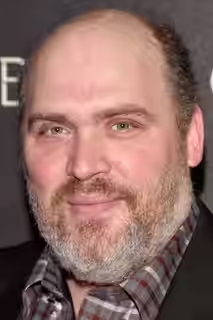
Glenn Fleshler
Intimidating Seton Colleague
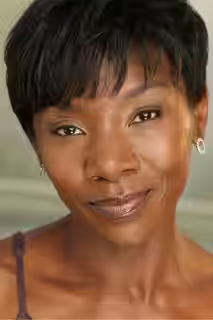
Jeryl Prescott
Emera Umber

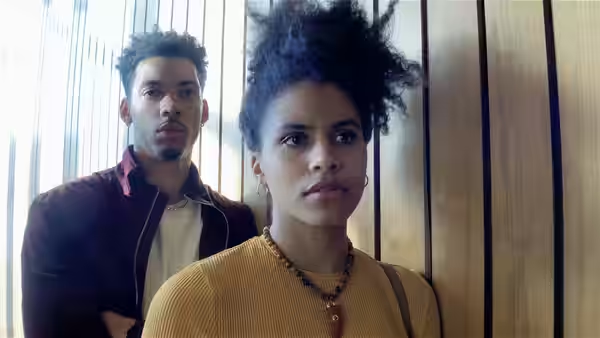
Stills

If you liked this, try…

Sweet Smell of Success poster

Sweet Smell of Success

1957 · New York, night, men in suits talking faster than they can think; the ancestor.

Hoop Dreams poster

Hoop Dreams

1994 · Three hours on where the rookies come from, and what it costs them to arrive.

He Got Game poster

He Got Game

1998 · Spike Lee on the draft as a market, with a father and son as the goods.

The Damned United poster

The Damned United

2009 · One clever, arrogant man against a boardroom, and the boardroom wins; football, not basketball.

Margin Call poster

Margin Call

2011 · A single night in glass offices, all talk, about money that is not really there.