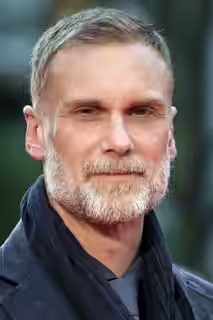
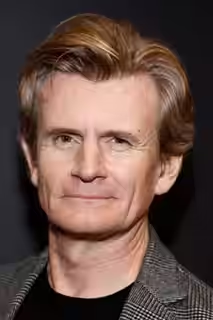
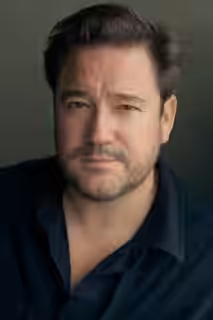
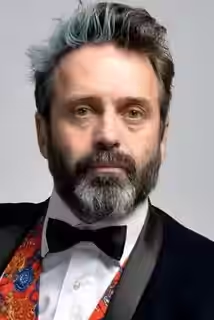
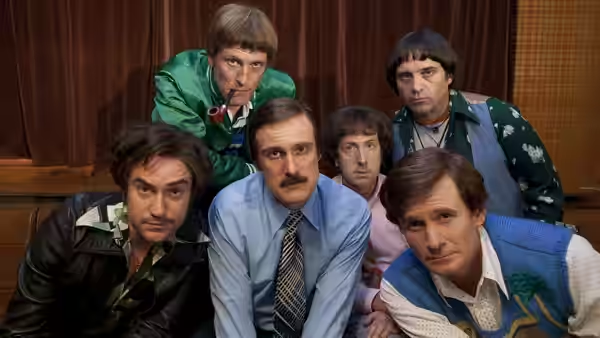
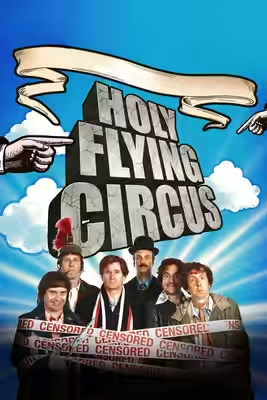
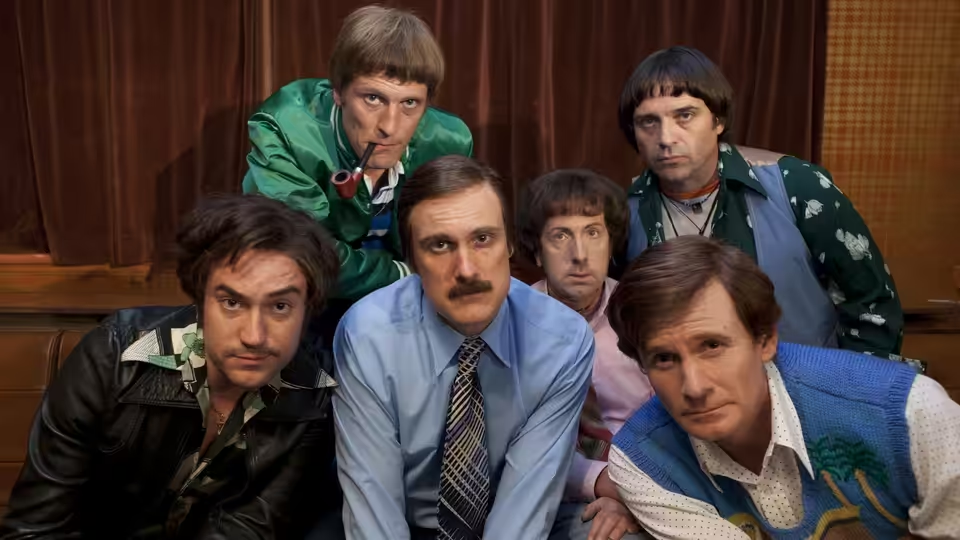
Six men in varied suits and costumes lean together in a wood-paneled room, facing forward
Film review

Holy Flying Circus

2011 · Directed by Owen Harris · 1h 29m

In a sentenceA film about the funniest men in Britain that keeps interrupting them to do their act less well

London, 1979. Monty Python have made Life of Brian and the letters of complaint have started. Michael Palin (Charles Edwards) would like the fuss to go away; John Cleese (Darren Boyd) would like a fight. Andrew Thorogood (Mark Heap) leads the protesters gathering outside the BBC with placards, the corporation’s Head of Rude Words (Alex Macqueen) counts the swearing, and God (Stephen Fry) looks in now and then to offer an opinion. Terry Jones (Rufus Jones), Terry Gilliam (Phil Nichol), Eric Idle (Steve Punt) and Graham Chapman (Tom Fisher) argue round a table about whether to defend the film at all. The BBC proposes a live television debate against the Church, and Palin and Cleese are the two who will have to go on.

Plays from YouTube when you press play; nothing loads from them until then.

Fi1m review

Charles Edwards and Darren Boyd make a fine Palin and Cleese, and the film keeps cutting away from them to do Python sketches that the Pythons did better. Fond, well cast and about a third as funny as it means to be.

Tony Roche writes and Owen Harris directs an 89-minute comedy about the weeks in 1979 when Monty Python’s Life of Brian came out and a number of people who had not seen it decided it was blasphemous. The tagline promises something completely untrue, and that is the method: the Pythons are played by lookalikes, God is played by Stephen Fry, and the story is told in the style of the people it is about, with cutaway animations, men in frocks and a tramp who wanders in to comment. It is affectionate and well cast. The decision to do the Pythons’ act for them is the thing that holds it back.

Charles Edwards is the reason to watch. His Michael Palin is a man so anxious to be reasonable that he apologises to people who are shouting at him, and Edwards gets the voice, the forward lean and the look of someone who would rather be anywhere else, without once tipping into impression. Darren Boyd plays John Cleese as a long, cross man who regards rudeness as a kind of honesty and would like the argument to come to him so he can win it. The two of them together, in corridors and taxis, working out what they actually think, are the film at its best. We laughed properly five or six times, and every time it was at one of them saying something plainly rather than at a sketch.

The sketches are where it goes wrong. Roche keeps interrupting his story to do a Python bit: Fry’s God, Tom Fisher’s Graham Chapman doubling as a tramp, an animated interlude, a scene that announces itself as a scene. The Pythons did these things first and did them better, and a film that borrows their manner to tell their story invites a comparison it cannot win. We were irritated, and more irritated when a character turned to the camera to apologise for the detour, as if that fixed it. That is the one trick the film keeps in reserve, and it reaches for it often.

Harris and Richard Mott shoot the BBC of the period flat and bright, as if the whole thing were being made in a studio on a Thursday evening, which suits it. Lisa Hall’s production design is the brown and cream of a 1970s office block, and the frocks and wigs are deliberately a little wrong. Billy Sneddon cuts quickly between the main story and the interludes and cannot disguise how often the interludes stop the story. Jack C. Arnold’s music leans on brass and a jaunty march, and is at its best when it stops being a pastiche and simply plays under a conversation.

The supporting cast is mostly asked to do turns, and does them well. Mark Heap’s Andrew Thorogood, the campaigner leading the protest, is pinched and furious and never without a placard nearby. Alex Macqueen’s Head of Rude Words, a BBC man with a clipboard counting the swearing, is the best of the invented characters and the funniest idea Roche has. Rufus Jones, Phil Nichol and Steve Punt, as the other Pythons, get a few lines each and a good deal of sitting at tables. Fisher’s Chapman is written as the one who notices the film he is in, and that joke is told more than once too.

The whole thing builds towards a live television debate between the Pythons and the Church, and we will not say how it goes. What we can say is that when the film stops imitating its subjects and lets Palin and Cleese argue about whether being offended entitles anyone to anything, it is a better and more serious piece of work than the first half suggests. Roche has a view on free speech and states it clearly. The cleverness falls away, two actors talk, and the film is suddenly about something.

Most critics landed close to where we have, finding it fond and well acted and more interesting than funny, with one review a good deal warmer. We can see what that reviewer saw; there are enough good lines here to carry a generous viewer. There were not quite enough to carry us. At 89 minutes it does not outstay anything, and if you know Life of Brian well you will enjoy watching Edwards and Boyd worry their way towards it. If you do not, start there, and come back to this as a footnote with some good jokes in it.

Critical consensus AI synthesised

48
Positive
1
Mixed
1
Negative
2
The AV Club
8 April 2012 · Phil Dyess-Nugent
45*

The critic sees an imaginative, affectionate effort that is often more interesting than funny. He praises the performances, especially Charles Edwards as Michael Palin, but finds the Python-style jokes and debate less effective than their originals.

Read the full review →
Empire
5 March 2012 · William Thomas
40*

The critic finds the telefilm’s approach undermines its fascinating subject. The performances are praised, while its mythic, postmodern comedy is singled out as a weakness.

Read the full review →
The Guardian
19 October 2011 · Sam Wollaston
35*

Wollaston finds the drama too self-conscious and says its clever detours obscure a fascinating story. He praises Charles Edwards’s portrayal of Michael Palin, but wishes the film had focused more directly on the controversy surrounding Life of Brian.

Read the full review →
Den of Geek
9 February 2012 · ★★★★ · Andrew Blair
80

Blair calls the film a hilarious, stimulating triumph. He praises its high hit rate of jokes and the thought-provoking discussion of freedom of speech beneath the comedy.

Read the full review →

Straight answers AI written, from our review

Is Holy Flying Circus worth watching?
Holy Flying Circus is worth watching only for those who already know Life of Brian well and want to see Michael Palin and John Cleese worried into a fight, and we scored it 56. Charles Edwards and Darren Boyd are the reason to stay; the Python-style sketches that keep interrupting them are the reason you may not.
How long is Holy Flying Circus, and what is it rated?
Holy Flying Circus runs 1h 29m. It is a comedy and drama film.
Where can I watch Holy Flying Circus in Switzerland?
Holy Flying Circus is not on any streaming or rental service in Switzerland at the moment. It is available in 2 other countries; change your country at the top of the page to see where. Availability is checked daily.
How violent or frightening is Holy Flying Circus, and is it suitable for children?
Holy Flying Circus is a 15-certificate comedy with no violence or frightening scenes to speak of, and the certificate comes from the swearing and the blasphemy jokes rather than anything on screen. It is a film about grown men arguing over a film, so it is not for children, and under-15s would be bored before they were offended.
How does Holy Flying Circus compare to Life of Brian?
Holy Flying Circus is a comedy about the row over Life of Brian, and the earlier film is the better of the two by some distance. The Pythons did the sketches, the frocks and the cutaway animations first and did them better, so the 2011 film suffers every time it imitates them. See Life of Brian first; this is a fond footnote to it.
What should I watch after Holy Flying Circus?
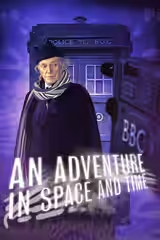
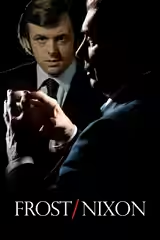
After Holy Flying Circus, try Monty Python's Life of Brian (1979, Fi1m 88): The film that caused all the fuss, and still the better argument for itself. Then An Adventure in Space and Time (2013, Fi1m 80): Another BBC film about the BBC, this time about Doctor Who, and far steadier; and Frost/Nixon (2008, Fi1m 81): A live television confrontation treated as a prizefight, with the nerves shown.

Cast

If you liked this, try…

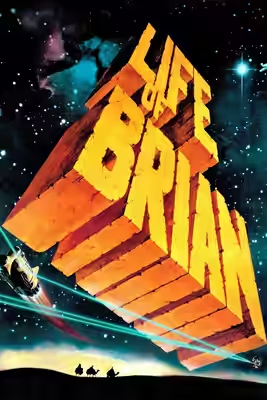
  1. Monty Python's Life of Brian (1979, Fi1m 88)The film that caused all the fuss, and still the better argument for itself.

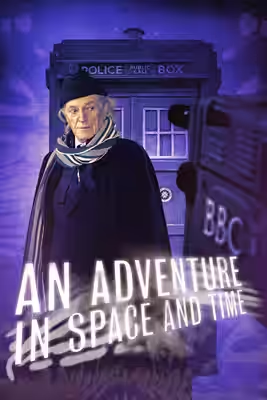
  2. An Adventure in Space and Time (2013, Fi1m 80)Another BBC film about the BBC, this time about Doctor Who, and far steadier.

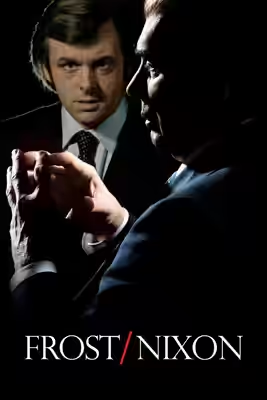
  3. Frost/Nixon (2008, Fi1m 81)A live television confrontation treated as a prizefight, with the nerves shown.

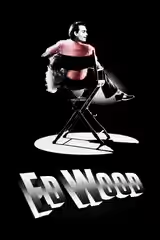
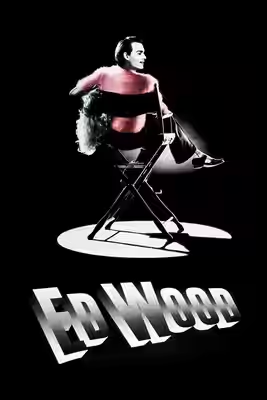
  4. Ed Wood (1994, Fi1m 84)Tim Burton’s affectionate account of a filmmaker nobody took seriously, played straight.

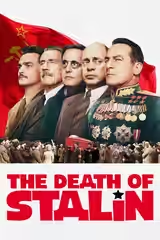
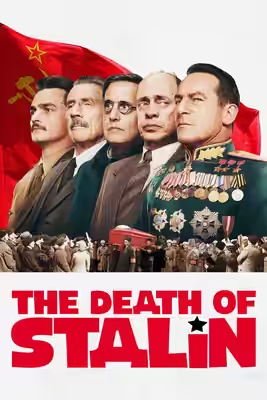
  5. The Death of Stalin (2017, Fi1m 83)Armando Iannucci finds the farce in real history without ever winking at the camera.

Free account

Know what to watch tonight

Two lists that know where things are streaming, collections you can share, your own score beside ours, and Discover that remembers what you have seen.

  • Want to see, sorted by what is streaming now
  • Seen, with your score out of ten
  • No adverts, ever