Charles Edwards and Darren Boyd make a fine Palin and Cleese, and the film keeps cutting away from them to do Python sketches that the Pythons did better. Fond, well cast and about a third as funny as it means to be.
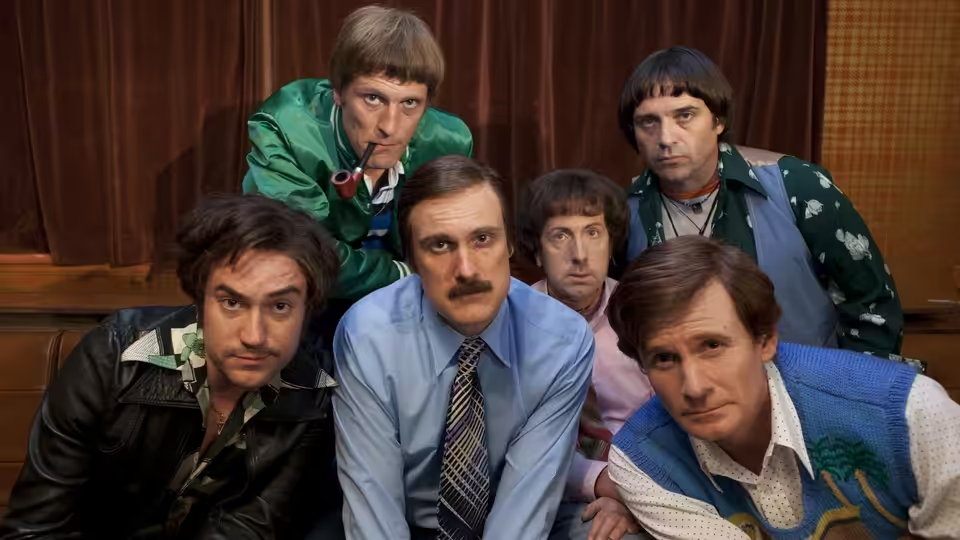
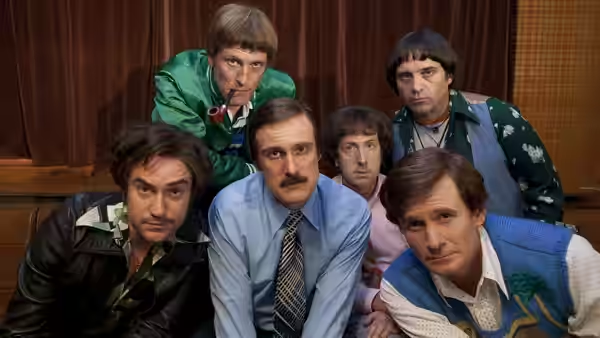
Tony Roche writes and Owen Harris directs an 89-minute comedy about the weeks in 1979 when Monty Python’s Life of Brian came out and a number of people who had not seen it decided it was blasphemous. The tagline promises something completely untrue, and that is the method: the Pythons are played by lookalikes, God is played by Stephen Fry, and the story is told in the style of the people it is about, with cutaway animations, men in frocks and a tramp who wanders in to comment. It is affectionate and well cast. The decision to do the Pythons’ act for them is the thing that holds it back.
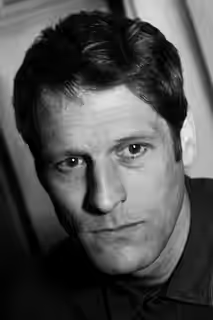
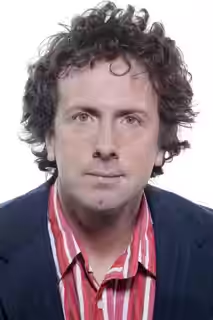
Charles Edwards is the reason to watch. His Michael Palin is a man so anxious to be reasonable that he apologises to people who are shouting at him, and Edwards gets the voice, the forward lean and the look of someone who would rather be anywhere else, without once tipping into impression. Darren Boyd plays John Cleese as a long, cross man who regards rudeness as a kind of honesty and would like the argument to come to him so he can win it. The two of them together, in corridors and taxis, working out what they actually think, are the film at its best. We laughed properly five or six times, and every time it was at one of them saying something plainly rather than at a sketch.
The sketches are where it goes wrong. Roche keeps interrupting his story to do a Python bit: Fry’s God, Tom Fisher’s Graham Chapman doubling as a tramp, an animated interlude, a scene that announces itself as a scene. The Pythons did these things first and did them better, and a film that borrows their manner to tell their story invites a comparison it cannot win. We were irritated, and more irritated when a character turned to the camera to apologise for the detour, as if that fixed it. That is the one trick the film keeps in reserve, and it reaches for it often.
Harris and Richard Mott shoot the BBC of the period flat and bright, as if the whole thing were being made in a studio on a Thursday evening, which suits it. Lisa Hall’s production design is the brown and cream of a 1970s office block, and the frocks and wigs are deliberately a little wrong. Billy Sneddon cuts quickly between the main story and the interludes and cannot disguise how often the interludes stop the story. Jack C. Arnold’s music leans on brass and a jaunty march, and is at its best when it stops being a pastiche and simply plays under a conversation.
The supporting cast is mostly asked to do turns, and does them well. Mark Heap’s Andrew Thorogood, the campaigner leading the protest, is pinched and furious and never without a placard nearby. Alex Macqueen’s Head of Rude Words, a BBC man with a clipboard counting the swearing, is the best of the invented characters and the funniest idea Roche has. Rufus Jones, Phil Nichol and Steve Punt, as the other Pythons, get a few lines each and a good deal of sitting at tables. Fisher’s Chapman is written as the one who notices the film he is in, and that joke is told more than once too.
The whole thing builds towards a live television debate between the Pythons and the Church, and we will not say how it goes. What we can say is that when the film stops imitating its subjects and lets Palin and Cleese argue about whether being offended entitles anyone to anything, it is a better and more serious piece of work than the first half suggests. Roche has a view on free speech and states it clearly. The cleverness falls away, two actors talk, and the film is suddenly about something.
Most critics landed close to where we have, finding it fond and well acted and more interesting than funny, with one review a good deal warmer. We can see what that reviewer saw; there are enough good lines here to carry a generous viewer. There were not quite enough to carry us. At 89 minutes it does not outstay anything, and if you know Life of Brian well you will enjoy watching Edwards and Boyd worry their way towards it. If you do not, start there, and come back to this as a footnote with some good jokes in it.