Anne-Marie Stretter (Delphine Seyrig) in a red dress faces a mirror as a servant stands behind her
Film review

India Song

1975 · Directed by Marguerite Duras · 1h 55m

In a sentenceEveryone is beautiful, nobody moves their lips, and the piano has the only good lines

At the French embassy, Anne-Marie Stretter (Delphine Seyrig) drifts through a reception with her lover Michael Richardson (Claude Mann) beside her and a young German attaché (Mathieu Carrière) in attendance. Outside, a beggar woman (voiced by Satasinh Manila) sings, and the sound carries in through the open windows. Also at the party is the Vice-Consul of Lahore (Michael Lonsdale), who has never spoken to Anne-Marie and cannot take his eyes off her. Nobody on screen speaks. The story is told by voices we never see, two women at first (Nicole Hiss and Monique Simonet), who remember the party as something that happened long ago, over a piano tune that keeps coming back.

Fi1m review

Marguerite Duras puts every word off screen and every body on it, and asks for more patience than most evenings have. Give it that and it is strange and quietly upsetting; refuse and it is 115 minutes of beautiful people lying down.

Marguerite Duras’s film rests on a decision most directors would not survive. Nobody on screen speaks. The actors drift through the salon of a French embassy, lie down on the carpet, dance a step or two, look into a mirror, and every word we hear comes from somewhere else: from unseen voices remembering the party, from a piano in another room, from a beggar woman singing outside. It is slow to the point of provocation. We think it is worth the patience, most of the way, and we would not say so to everyone.

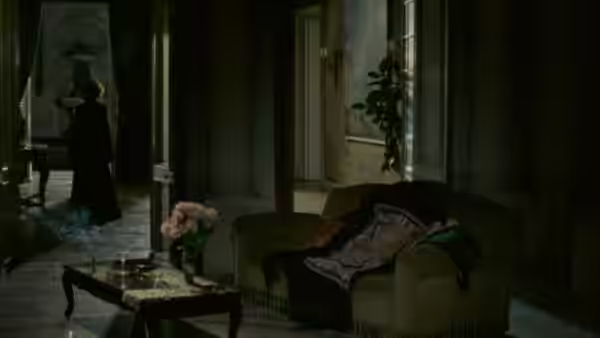
The look of it is one salon, one mirror and one lawn. Bruno Nuytten keeps the camera nearly still and lets shots run for minutes, lit by lamps and by a dusk that never quite becomes night. The mirror above the mantelpiece doubles the salon, so people arrive in the reflection before they arrive in the salon itself, and sometimes only in the reflection. Outside there is a tennis court with a red bicycle leaned against the net and a park where the light goes green through the trees. Solange Leprince cuts as seldom as she can, and when she does it is usually back to the same salon from a slightly different place.

The soundtrack does the work the picture refuses. Carlos D’Alessio wrote a slow, sweetish piano tune, the India Song of the title, and it comes round again and again, sometimes as a dance and sometimes as a blues from the next room, until you would know it anywhere. Around it are the voices: two women at first (Nicole Hiss and Monique Simonet), speaking in the past tense about the people we are watching, prompting and correcting each other like guests trying to recall a scandal; later two more (Viviane Forrester and Dionys Mascolo). And from outside, at intervals, the beggar woman’s song, in a voice credited to Satasinh Manila, a reminder of everything the party is keeping outside the gates.

For the first twenty minutes we were restless and slightly cross, waiting for the film to start. Then the tune came round for the third time, Seyrig lay down on the floor with her cheek against the carpet, and we realised it had started some while ago and we had missed it. Seyrig does almost nothing and we could not look away. Whatever grief the character carries is in the angle of her neck and in the fact that she is the only person at the party who ever looks tired.

Michael Lonsdale’s Vice-Consul is the one who breaks the rule. He stands at the edge of the reception and then, off screen, screams her name, over and over, while the guests on screen go on standing perfectly still. We were horrified. It is a raw, ugly sound in a film that has spent an hour being beautiful, Nuytten does not cut away, and the gap between what we heard and what we saw is the most upsetting thing in the film.

The middle is long. After the Vice-Consul has gone the voices slow down, the camera has run out of new places to stand, and we caught ourselves working out how much was left. The German attaché (Mathieu Carrière) and the other guests (Vernon Dobtcheff, Didier Flamand) are furniture by design, and design does not stop furniture from being dull. Duras is not interested in whether we are comfortable, which is her right, and it is also why the film will lose a fair portion of any audience by the hour mark.

There is no puzzle to solve here. The voices tell you what happened and what will happen. Watch it at night, in the dark, with the sound turned up further than feels polite and the telephone in another room, and do not try to work out where each voice is coming from. It runs 115 minutes, and at some point in the second hour you will either be with it or you will have gone to make tea. We stayed.


Critical consensus AI synthesised

3 of 6
Positive
2
Mixed
1
Negative
0
Slant Magazine
4 April 2023 · ★★★★ · Budd Wilkins
80

Wilkins finds the two films gorgeously lensed and hauntingly elusive, and considers the Criterion set strong overall. He especially praises India Song’s uncanny atmosphere and the films’ seductive use of suggestion.

Read the full review →
Time Out
· TR
73*

The available page identifies this as a film review but gives no critical verdict. Its only visible note is that the film ranked #80 on Time Out’s list of the 100 greatest French films.

Read the full review →
The New York Times
8 October 1975
64*

The headline frames the film as a sentimental story. The article text is inaccessible, so its specific verdict and points of praise or complaint cannot be confirmed.

Read the full review →

Straight answers AI written, from our review

Is India Song worth watching?
India Song is worth watching for anyone with the patience for a film in which nobody on screen speaks, and we scored it 78. Every word comes from unseen voices and a beggar woman singing outside, over a piano tune that keeps returning, and the middle hour is long. Watch it at night with the sound up, or not at all.
How long is India Song, and what is it rated?
India Song runs 1h 55m. It is a drama and romance film.
Where can I watch India Song in Serbia?
India Song is not on any streaming or rental service in Serbia at the moment. It is available in 5 other countries; change your country at the top of the page to see where. Availability is checked daily.
How does India Song compare to Hiroshima Mon Amour?
India Song is the stranger and slower of the two, and Hiroshima Mon Amour the one to try first. Both are Marguerite Duras stories of a love affair told through remembered voices, but Resnais lets his actors speak and cuts between past and present, where Duras keeps every word off screen and her camera nearly still. The earlier film is the more approachable; the later one asks for more and gives back less to anyone in a hurry.
What should I watch after India Song?
After India Song, try Hiroshima mon amour (1959, Fi1m 87): Duras’s script for Resnais; a love affair told mostly in voices and remembered rooms. Then In the Mood for Love (2000, Fi1m 91): A tune that keeps returning, a corridor, two people who never quite say it.

Cast

Awards

César Award for Best Actress, 1976

Nominated
César Award for Best Actress

César Award for Best Music Written for a Film, 1976

Nominated
César Award for Best Music Written for a Film

International Submission to the Academy Awards, 1976

Nominated
International Submission to the Academy Awards

If you liked this, try…

  1. Last Year at Marienbad (1961) · not on Fi1m yetSeyrig again, in a hotel where nobody can agree on what happened last summer.

  2. Hiroshima mon amour (1959, Fi1m 87)Duras’s script for Resnais; a love affair told mostly in voices and remembered rooms.

  3. Jeanne Dielman, 23 quai du Commerce, 1080 Bruxelles (1975) · not on Fi1m yetSeyrig peels potatoes in real time; the same year, the same patience, a colder house.

  4. In the Mood for Love (2000, Fi1m 91)A tune that keeps returning, a corridor, two people who never quite say it.

  5. Goodbye, Dragon Inn (2003) · not on Fi1m yetA near-silent film about a building and the ghosts drifting through it.

India Song (1975) review: slow, ghostly and worth the patience (Serbia) | Fi1m