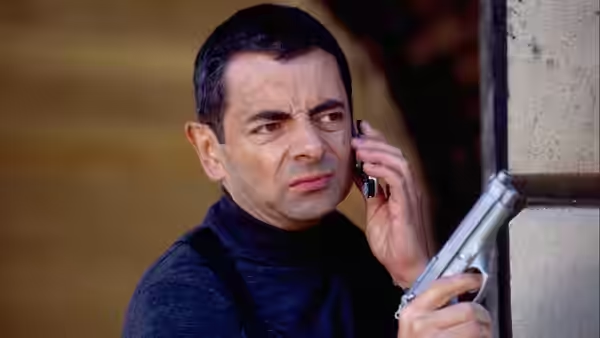
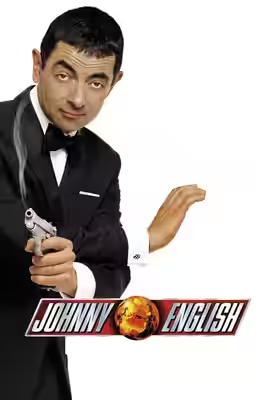
Johnny English (Rowan Atkinson) stands beside a ceremonial crown displayed inside a glass case
Film review

Johnny English

2003 · Directed by Peter Howitt · 1h 27m · ClassInd L

In a sentenceRowan Atkinson’s face does most of the work, which seems unfair on the rest of the cast

Johnny English (Rowan Atkinson) brings ample confidence and limited competence to espionage. He wants to do a spy’s work, but his own clumsiness gets in the way. Bough (Ben Miller) and Lorna Campbell (Natalie Imbruglia) are among those caught up in his exploits, while Pascal Sauvage (John Malkovich) pursues ambitions directed against Britain. English must contend with a French-accented adversary as well as his own capacity for mishaps, with the business of looking capable competing with the need to get anything done.

Fi1m review

Rowan Atkinson finds laughs in a spy’s stubborn confidence, but Peter Howitt’s comedy gives him too few fresh mistakes to make. An undemanding diversion for admirers of his physical comedy, with thin writing to forgive.

Johnny English is a mildly amusing spy spoof whose chief asset is Rowan Atkinson’s refusal to let embarrassment dent his character’s confidence. Peter Howitt keeps the ambition modest: give a bumbling agent enough trouble to expose his shortcomings, then let the actor supply the laughs. At 87 minutes, the film ought to have little opportunity to wear out that arrangement. It still finds some, though there is enough pleasure in the performance to make this a reasonable choice for Atkinson devotees.

The useful thing about Johnny English is that we can see his inadequacy before he can, which gives even a familiar pratfall a little anticipation. Atkinson’s facial tics do much of the work, turning the effort to appear capable into something more demanding than the task itself. We laughed at his facial contortions, especially the effort to keep looking competent through the pratfalls. His timing is better than the jokes, and several stretches depend on our enjoying a mannerism we have already seen.

Robert Wade, Neal Purvis and William Davies supply a script that too often treats English’s incompetence as sufficient preparation and payoff for a joke. Once we have spotted the likely mistake, there is seldom enough invention in how he makes it. The schoolboy humour is not objectionable in itself; the problem is the repetition, which asks us to laugh again without giving us much more to laugh at. Older viewers may find themselves waiting for the next piece of physical business.

John Malkovich gives Pascal Sauvage a French accent and a degree of theatrical excess that briefly makes the film feel less timid. His timing helps, but the villain gets too little room to become a comic attraction in his own right. Natalie Imbruglia brings welcome personality to Lorna Campbell, though the film is so occupied with Atkinson that another performer’s ease can feel incidental. A little more attention to the people around English would have relieved the pressure on his repertoire.

Remi Adefarasin’s cinematography is most effective as a way of watching Atkinson work: the face and the pratfall supply nearly all the interest. Chris Seagers’s production design gives the spy parody a serviceable setting, although it cannot make the repeated jokes feel any fresher. Neither contribution distracts from the actor, and neither gives us much to enjoy independently of him. That suits a vehicle for a physical comedian, but it becomes a problem whenever the comedy falters.

Robin Sales’s editing cannot entirely disguise how often the writing repeats itself, although the car chase gives the film some welcome momentum. That sequence works because movement provides a change from waiting for English to misunderstand his own abilities. Edward Shearmur’s music is effective support for the action, but it does little to make the comedy more distinctive. The film benefits whenever it remembers that a spy spoof can offer some of the pleasures of an adventure as well as mock its hero.

A spy comedy can be predictable and still earn its laughs, provided the execution keeps finding fresh ways to deliver them. This one manages that often enough to avoid becoming a chore, but too sporadically to recommend without qualification. Those who already enjoy Atkinson’s facial contortions and pratfalls are the audience most likely to forgive the thin writing. Choose it for him, and keep expectations of the espionage modest.


Critical consensus AI synthesised

56
Positive
1
Mixed
6
Negative
3

The reviews lean towards mixed, with Rowan Atkinson’s comic skills drawing more consistent praise than the material he is given. Critics find intermittent laughs in his physical comedy and familiar bumbling, though enthusiasm for the spy spoof as a whole is limited. Empire offers the warmest response, praising the crowd-pleasing set-pieces and an impressive car chase. Variety also finds an effective family romp, crediting Atkinson’s character-based comedy while acknowledging the script’s lack of polish.

Reservations cluster around predictability, repetition and a premise that promises more than it delivers. The spread runs from cheerful acceptance of familiar silliness to frustration at how little the script supplies beyond slapstick. John Malkovich’s villain earns praise for comic timing and camp amusement in some reviews, but is judged underused elsewhere. Eye for Film takes the strongest negative position, finding the film mostly unfunny and its central character unsympathetic, while still appreciating Natalie Imbruglia and Malkovich.

Empire
1 January 2011 · Caroline Westbrook
75*

Westbrook finds the film entertaining and crowd-pleasing despite its lowbrow, familiar comedy. She especially praises the funny set-pieces, singling out an impressive car chase.

Read the full review →
Variety
7 April 2003 · Derek Elley
65*

Elley finds the film an extremely silly but effective family romp, though its script lacks polish and older audiences may find little new. He praises Rowan Atkinson’s character-based comedy, especially the audience’s ability to stay one step ahead of Johnny English.

Read the full review →
RogerEbert.com
64*

The page could not be accessed, so the critic’s verdict is unavailable. No specific praise or complaint can be verified.

Read the full review →
Time Out
· DA
64*

The page identifies this as a film review, but the critic’s verdict is unavailable in the provided content. The visible description introduces the villain’s anti-British ambition but does not reveal what the critic praises or criticizes.

Read the full review →
The New York Times
18 July 2003
63*

The page is identified as a review of Johnny English, but its text is inaccessible. The available headline characterizes its spy as bumbling; the critic’s verdict and specific praise or complaint cannot be confirmed.

Read the full review →
The AV Club
22 July 2003 · Nathan Rabin
60*

Rabin finds the spy spoof mildly amusing but generally meek, and says its premise promises more than the film delivers. He singles out Rowan Atkinson’s physical comedy, especially during the lively climax, as making the limited material work.

Read the full review →

Straight answers AI written, from our review

Is Johnny English worth watching?
Johnny English is worth considering for admirers of Rowan Atkinson’s physical comedy, though its thin, repetitive writing keeps our score at 60 out of 100. We find enough pleasure in his facial contortions and stubborn confidence to make this an undemanding diversion, but anyone hoping for inventive spy parody may tire of the familiar mistakes.
How long is Johnny English, and what is it rated?
Johnny English runs 1h 27m and is rated L by the ClassInd in Brazil. It is an adventure and action film.
Where can I watch Johnny English in Brazil?
Johnny English is streaming on Amazon Prime Video in Brazil. Availability is checked daily; the links above go straight to each service.
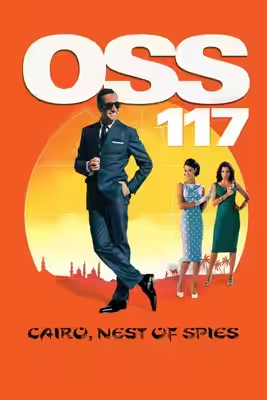
How does Johnny English compare to OSS 117: Cairo, Nest of Spies?
Johnny English is a simpler vehicle for physical comedy than OSS 117: Cairo, Nest of Spies, which we recommend as the more pointed spy spoof. Atkinson supplies familiar pratfalls, while the other film complicates its agent’s incompetence with vanity and prejudice, within a carefully recreated Fifties thriller. Its gags also thin out late, but it offers more beyond its leading man’s mannerisms.
What should I watch after Johnny English?
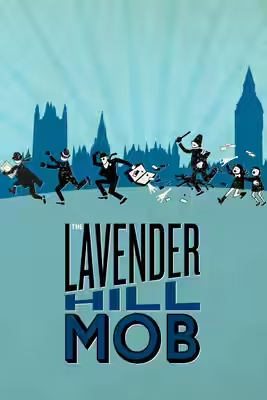
After Johnny English, try OSS 117: Cairo, Nest of Spies (2006, Fi1m 76): A more pointed spy spoof, with vanity and prejudice complicating the incompetence. Then The Lavender Hill Mob (1951, Fi1m 82): British criminal ambition meets practical difficulties, with sharper writing and affectionate comic performances.

Cast

Awards

Jameson People's Choice Award for Best Actor, 2003

Nominated
Jameson People's Choice Award for Best Actor

If you liked this, try…

  1. The Pink Panther (1963) · not reviewed yetAnother investigator whose confidence survives every available piece of evidence against it.

  2. The Man Who Knew Too Little (1997) · not reviewed yetEspionage confusion with a gentler hero and a similarly generous supply of misunderstandings.

  3. OSS 117: Cairo, Nest of Spies (2006, Fi1m 76)A more pointed spy spoof, with vanity and prejudice complicating the incompetence.

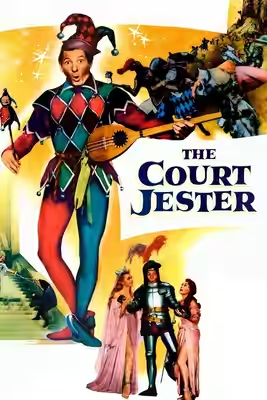
  4. The Court Jester (1955) · not reviewed yetPhysical comedy, elaborate misunderstandings and a hero struggling to look suitably authoritative.

  5. The Lavender Hill Mob (1951, Fi1m 82)British criminal ambition meets practical difficulties, with sharper writing and affectionate comic performances.

Free account

Know what to watch tonight

Two lists that know where things are streaming, collections you can share, your own score beside ours, and Discover that remembers what you have seen.

  • Want to see, sorted by what is streaming now
  • Seen, with your score out of ten
  • No adverts, ever